Michigan Senate debate spotlights increase in anti-Muslim rhetoric as midterms race heats up
To play this video you need to enable JavaScript in your browser.
This video can not be played
-
Published
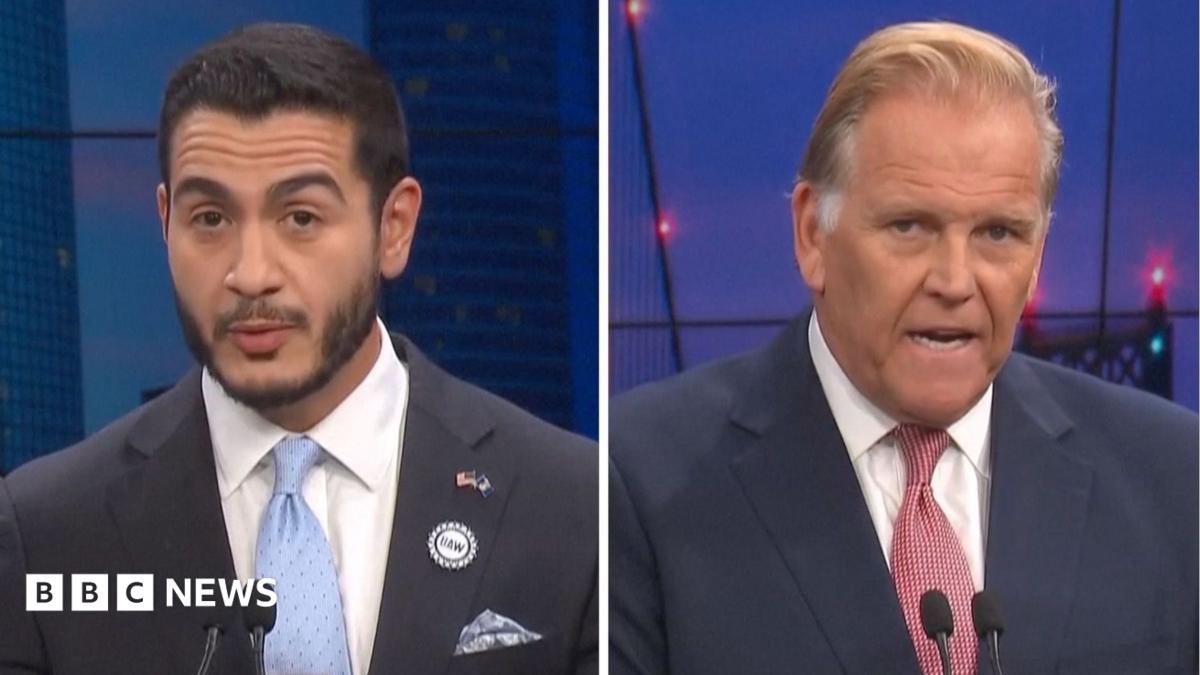
A no-holds-barred televised debate between Michigan Senate rivals Abdul El-Sayed and Mike Rogers has highlighted how ugly personal attacks are ramping up in the US midterms elections race.
In Thursday evening’s duel, El-Sayed, a Democrat, called his Republican opponent “a sock puppet for the Trump administration”. Rogers questioned whether someone in his Muslim opponent’s family might be on a “watchlist”.
Moderator Rick Albin said the barbs continued off camera, spilling into the commercial break – something Albin said he has never seen in 30 years of doing debates.
On the morning after the debate, US President Donald Trump posted on social media attacking the Democrat and bringing up his Muslim identity.
The Michigan race could affect which party controls the Senate after November’s midterm elections as Democrats campaign to wrest control of both chambers of Congress from the Republicans.
Little was considered off limits in the verbal jousting between Rogers and El-Sayed, which saw the Republican repeatedly suggest the Democrat and his family had ties to terrorist organisations.
El-Sayed, who would be the first Muslim member of the US Senate, denied this.
A fact-check from a state news outlet, Bridge Michigan, has said there is no evidence, external that El-Sayed is personally connected to the Muslim Brotherhood, branches of which have been designated as terrorist organisations by the US.
The Democrat questioned whether Rogers was even from Michigan and labelled his opponent a “Florida man”, with yachts and a mansion in the Sunshine State. Rogers denied the Florida ties and boat ownership.
“Weak, cowardly, won’t stand up until his poll numbers drop,” El-Sayed said during one heated exchange.
The economy, immigration and support for Israel were topics that came up as expected during the debate.
But tensions flared as Rogers appeared to attack El-Sayed’s family.
The rivals were discussing Flock cameras, the controversial AI-powered surveillance system, which El-Sayed said should be federally regulated.
“And why would that bother you?” Rogers shot back. “Well, if you have someone in your family that might be on the watchlist.”
El-Sayed challenged Rogers to “go ahead and say it”, adding: “Are you going after my mom?”
The Democrat’s mother, Fatten Elkomy, previously worked as a nurse practitioner for the Islamic American Relief Agency (IARA), according to the Midwesterner, external, a conservative regional news outlet.
The US treasury department designated IARA, external in 2004 for supporting terrorism.
The US justice department charged figures within IARA, external in 2007 with illegal wire transfers to Iraq, but El-Sayed’s mother was not among those indicted and she left the agency in 2004.
The BBC has contacted El-Sayed’s campaign and Elkomy for comment.
One academic told the BBC that Thursday’s debate underscores how anti-Muslim sentiment is becoming increasingly normalised at the highest level of US politics.
Quardricos Driskell, a George Washington University political science professor, pointed to the period after the 9/11 attacks as a time when there was similar rhetoric, but he noted the distinction in presidential leadership.
In the wake of the attacks, then-President George W Bush stood in front of a mosque and defended the Muslim faith, saying: “Islam is peace.”
Driskell said: “Islamophobia has long existed, I think across American political society from both parties.
“What distinguishes the current moment is that the explicit use of Muslim identity as a political attack is by prominent Republican leaders.”
On Friday morning, President Trump issued the latest in a series of attacks on the Democrat.
“Mohammad is a Jihadist lunatic who hates our Country,” Trump wrote on social media.
Some questioned why Trump chose to refer to El-Sayed as Mohammad – his full name is Abdulrahman Mohamed El‑Sayed, but he has been known as Abdul since kindergarten, according to the Detroit News, external.
Trump’s comment follows several other similar anti-Muslim remarks from elected officials, including Tennessee Republican congressman Andy Ogles posting on X earlier this year: “Muslim’s don’t belong in American society.”
After Zohran Mamdani was elected as the first ever Muslim mayor of New York City, he faced similar attacks.
“After 9/11 we said ‘Never Forget.’ I think we sadly have forgotten,” Republican congresswoman Nancy Mace wrote on X, after Mamdani’s election.
Gregg Nunziata, a Republican policy adviser, told the BBC these types of comments were “extremely destructive and deeply alarming”.
He also noted the absence of condemnation for these remarks, saying it’s “the responsibility of leaders to tamp down that type of rhetoric and police their own side and that’s not happening today”.
There has been a rise in anti-Muslim sentiment across the US, according to the Pew Research Center.
In 2002, 25% of adults said Islam “is more likely” to encourage violence than other religions. That number jumped to 51% in 2026.
It comes amid a rise in hatred more broadly in the US, including antisemitism.
Haris Tarin, vice-president of the Muslim Public Affairs Council (MPAC), said Trump’s comments like his social media post on Friday morning make him feel “sick”.
He said his organisation had tracked an eight-fold increase in anti-Muslim speech over the last year.
“This rise has coincided with elections, and it has allowed for candidates who oppose American Muslims licence to openly attack their faith,” Tarin said.
Driskell said such attacks often exploit voters’ fears.
“We have to keep in mind the motivating factor often in politics, and particularly during campaigning, which is fear,” he said.
“That’s what ultimately Islamophobia is – the fear,” he continued, “instilling fear that people get out and vote”.
-
-
Published25 June 2012
-
Disclaimer : This story is auto aggregated by a computer programme and has not been created or edited by DOWNTHENEWS. Publisher: BBC