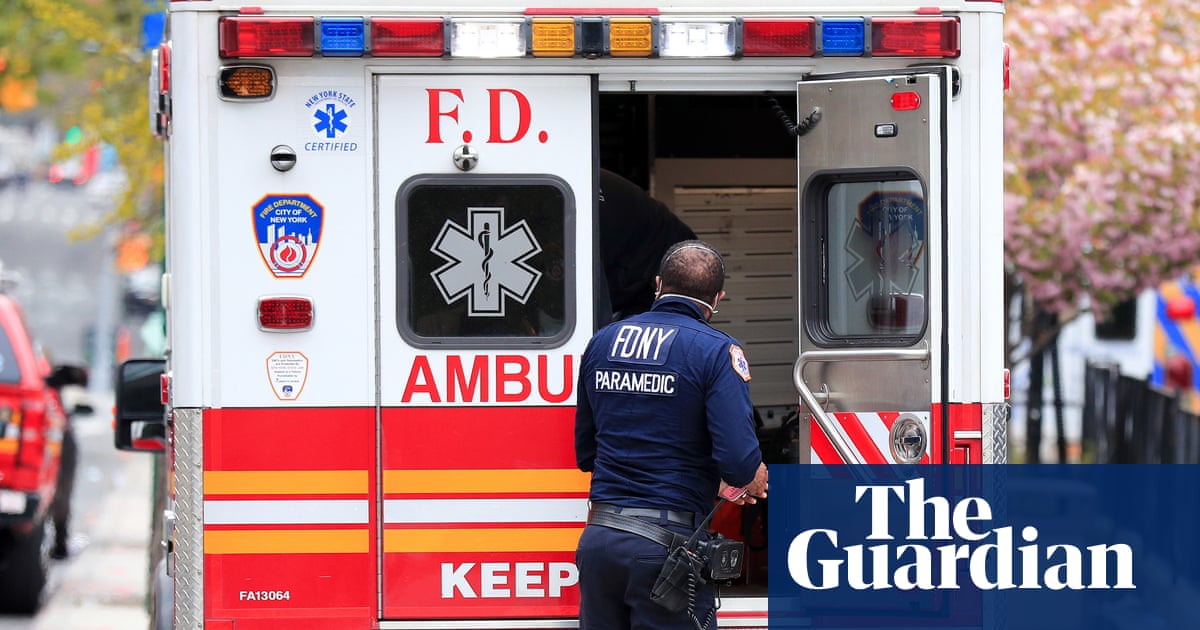
After 31 years in New York City’s emergency medical services, Oren Barzilay has started giving young New Yorkers advice he never imagined giving when he began his EMS career. “Don’t come here,” he tells them. “You are only going to hurt yourself.”
It is a striking reversal for Barzilay, the recently retired president of FDNY EMS Local 2507. What changed for Barzilay was not his view of work or the value of service. It was what he believes is the New York City failure to pay the people who put their lives at risk to save the lives of others.
“After 31 years, I am stuck at $59,000,” he said.
Barzilay’s reversal comes as New York City’s EMS workforces remain locked in a years-long fight over wages and pay parity. The fight has become an early test of a contradiction facing Mamdani’s young administration.
As a candidate, Mamdani built his political identity in part around organized labor, affordability and demands that employers pay workers more. As mayor, he now sits on the other side of the bargaining table, responsible for a vast municipal workforce and a finite city budget. EMS workers’ years-long campaign for higher wages and pay parity – unfolding as his administration filed a lawsuit to stop $10,000 payments to public-school paraprofessionals in court – is forcing that tension into the open.
For many EMS workers their job is a passionate calling. Natasha Villaruel, a paramedic, has about 20 seconds to make a life-saving decision. When the 36-year-old paramedic receives a 911 call for someone in respiratory distress, the routine begins almost automatically, with precision. “You respond with lights and sirens safely. You try to get there as fast as you can,” said Villaruel over the phone.
By the time she and her fellow paramedic reach the doorway, she is already reading the patient’s vitals.
“You assess the patient from the door to see how they’re breathing, to see the color of their skin,” she said. “The first thing you want to know is if they can speak, because now if they can’t speak, you know this is very, very urgent.”
Villaruel, who was born in Jamaica and moved to Brooklyn at four, described the pressure of those first few seconds. “Within 20 seconds, you have to make a life decision.”
More than 4,500 EMS workers such as Villaruel respond to over 1.9mmedical and fire emergencies each year across New York City’s five boroughs, making life-or-death decisions for a city of more than 8.58 million people. Yet the workers entrusted with those decisions are among the lowest-paid first responders in the city. An FDNY EMT starts at $39,386 a year, barely above New York City’s minimum wage. After five years, an EMT can earn roughly $59,534, but a firefighter with similar years of experience makes as much as $105,146 – nearly double what EMS and EMTs make. Many EMS workers are struggling to make ends meet.
Villaruel said her own household is sustainable largely because her husband is a firefighter. But her colleagues, she said, have struggled far more. “We have people that live in shelters,” she said. “We have people that get vouchers. We have people that get food stamps.”
Meanwhile, the ambulances are taking longer to reach New Yorkers facing life-threatening emergencies. The average ambulance response time rose from 11 minutes and 21 seconds in fiscal year 2025 to 13 minutes and 9 seconds in fiscal year 2026, according to the Mayor’s Management Report. The delay in emergency response comes as the city’s EMS system struggles to keep workers. According to New York State EMS workforce report, the number of active EMS responders fell 17.5% between 2019 and 2022 statewide. Union leaders said lower wages are driving an exodus of EMS workers.
“We have a tremendous attrition problem. People are leaving,” said Anthony Almojera, an FDNY EMS paramedic lieutenant and vice president of Local 3621. Almojera said he remains frustrated with the city council and successive administrations. “I don’t know why, over the years, many administrations have decided they do not want to value us,” said Almojera
For some patients, those minutes can be life-altering. “Time matters a lot,” said Dr Shreya Kashyap, second-year neurology resident at Mount Sinai. For patients suffering an acute stroke, she said, every delay can increase the risk of permanent damage to brain tissue. “There’s this phrase that’s very popular in neurology education,” Kashyap said. “It’s called ‘time is brain.’”
The pay disparity is hardly new to city hall. Sandy Nurse, a Brooklyn councilmember, who has supported efforts to raise EMS compensation, said: “EMS workers, frontline emergency management workers, make very, very low wages.” In 2024, Nurse co-sponsored bills to establish a Department of Emergency Medical Services as its own standalone organization, ensuring better wages for service workers as well as mental healthcare. Her progressive caucus also has won $1m for an EMS mental health pilot program.
Barzilay argues that the decades-long failure to achieve pay parity is not due to a lack of political support. He places much of the blame on city hall, particularly the offices responsible for negotiating labor contracts and determining what the city can afford.
Nearly four years after the last contract, the Mamdani administration says negotiations are now underway but declined to disclose when bargaining sessions have taken place or where negotiations currently stand.
“Contract negotiations are currently underway with the EMS union, and we remain fully committed to good-faith bargaining at the table,” Kenneth Londono, communications director for the mayor’s office of labor relations, said in a statement. “The Mamdani administration values the vital, life-saving work that our EMS members perform for New Yorkers every single day.”
Londono said the administration hopes to reach a “fair and sustainable outcome” that supports EMS workers while “remaining fair to city taxpayers”.
Barzilay remains skeptical. Asked whether he believed there are good-faith negotiations under the new administration, he said: “No. Not as of yet.”
Almojera was more hopeful and believes the administration is making a good-faith effort to address the problems facing EMS.
“Negotiations haven’t formally commenced,” Almojera said. “We’re just talking. You know, just talking back and forth.”
For Almojera, Mamdani’s appointment of Lillian Bonsignore as fire commissioner was an encouraging sign. Bonsignore spent 31 years in FDNY EMS, beginning as an EMT before becoming a paramedic and eventually chief of EMS operations. “Making her commissioner is acknowledging that the Fire Department is mostly EMS,” Almojera said. “She knows exactly what we do. She’s one of us.”
Villaruel was less optimistic: “I feel like politicians are politicians,” she said. “They tell you what you want to hear. And then when it’s time for the work to be put in, everyone is blind and deaf.”
Bonsignore’s office did not respond to a request for comment.
For Villaruel, who has spent more than a decade in EMS, the work itself is not what is pushing people away.
“It’s not like they don’t like the job,” Villaruel said. “It’s the pay that’s the problem.”
“Who doesn’t like saving people?” she asked.
Disclaimer : This story is auto aggregated by a computer programme and has not been created or edited by DOWNTHENEWS. Publisher: theguardian.com