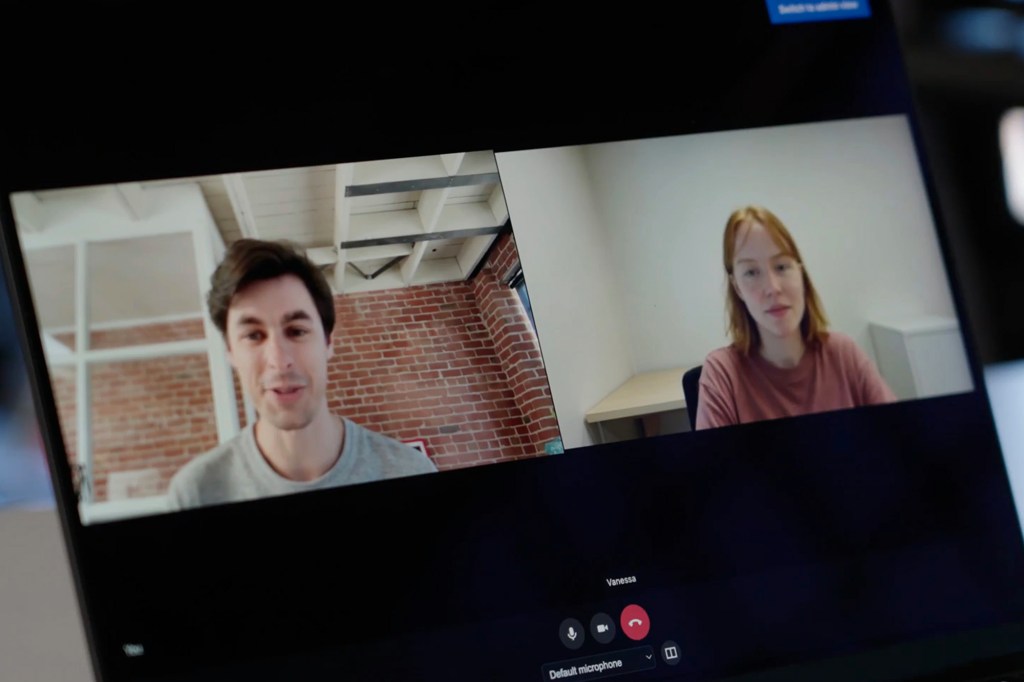
Can you spot the bot?
Nearly half the people who chatted with an AI-generated “interviewer” thought they were talking to a real person, according to the startup that built it.
Bay Area company Tavus said its new model, Griffin, fooled 48% of the 54 participants in a job interview test, a result it says shows the avatar can pass the Turing Test — which measures whether a machine can exhibit intelligent behavior indistinguishable from that of a human.
Participants who thought the interviewer was human were 79% confident, on average, according to the company’s announcement. Those who thought it was a bot were 81% confident.
Griffin generates every pixel of every frame in real time from a single reference image, the company said. That includes not just the face, arms and fingers, but also the movement of the chair, the shadows it casts and the background.
The avatars come in male and female looks and appear to breathe and blink naturally.
“Humans are evolutionarily designed to communicate face to face. We speak as much through our words as we do our expressions, tone, gestures and timing. So much of human communication is non-verbal. It’s an art, a dance,” company CEO and co-founder Hassaan Raza said in the announcement.

Raza said the new model has eliminated some of the reality-breaking aspects of communicating with an AI-generated avatar — including smiling while hearing bad news.
The Griffin model reacts in real-time and can even interrupt a person, adjust to new subject matter, and be interrupted without losing its train of thought, the company said.
In one demonstration, the model teaches a participant how to solve a Rubik’s Cube, showing that it can respond to visual cues when needed. In another clip, the model is seen successfully playing a game of Simon Says.
The company said the models can be utilized for students in schools or as tutors.
Disclaimer : This story is auto aggregated by a computer programme and has not been created or edited by DOWNTHENEWS. Publisher: nypost.com