
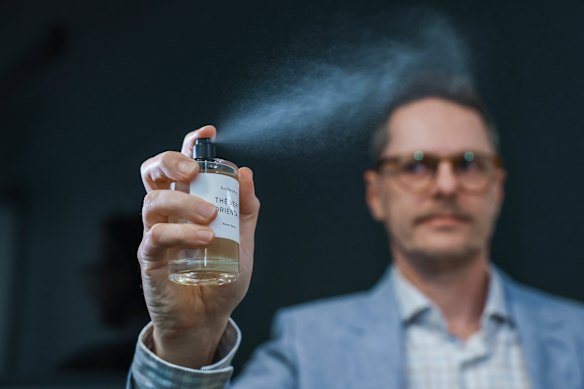

Few know it, but when walking into a Louis Vuitton boutique in Paris or Manhattan, a Cathay Pacific lounge in Hong Kong, MGM Grand casino in Las Vegas or Sofitel lobbies from Cairo to Buenos Aires, the scent that fills your nostrils was engineered in an industrial park in suburban Melbourne.
Australian outfit Air Aroma has emerged as a global leader in the increasingly lucrative world of scent marketing, where businesses discreetly pump carefully crafted odours through vents to tap into customers’ neural pathways governing emotion, encouraging them to linger longer and spend more.
The Melbourne company now boasts key offices in New York, Tokyo, Amsterdam and Dubai – as well as Moorabbin – with more than 100 employees around the world.
Air Aroma’s rise and the hyper-curation of the customer experience that its industry offers have been propelled by a growing body of research suggesting that scent manipulation can materially change how we behave – and ultimately boost sales.
‘Holy grail’ of retail marketing
The smell of fresh bread wafting into passersby’s consciousness is the best-known example of odour capitalisation. It’s a tactic employed by independent pastry shops through to megachains such as Subway, which bakes its rolls in such a way as to rapidly caramelise sugars, producing an unmistakable aroma that billows onto footpaths. Studies have found smell can increase bakery sales by as much as 300 per cent.
This tactic is effective across retail. A landmark 1990 study by neurologist Dr Alan Hirsch placed identical Nike shoes in two rooms – one with standard air, the other with a floral scent. Shoppers were 84 per cent more likely to want the shoes in the scented room, and willing to pay 10 per cent more. In a 1995 study, Hirsch pumped a pleasant ambient scent into a casino, increasing gambling revenue by 45 per cent.
Neither of the studies used overpowering scents; they were “ambient” and inconspicuously dispersed.
These ambient scents subtly alter perception. Warm smells, such as cinnamon, can subconsciously make a retail environment feel more crowded, triggering an urge to buy premium products to demonstrate power, a 2015 US study found.
Favourable scents can broadly also increase shop dwell time and expenditure by up to 23 per cent, a 2019 meta analysis found. The effects can be magnified when a scent is paired with matching music, such as low-tempo beats with low-arousal smells, one study found. Finance firms are even reportedly using signature scents in their offices, with questions about employee productivity.
Dr Rachel Herz, a Brown University neuroscientist and expert on scent science, explains that of all our senses, smell is uniquely connected to emotion and memory because the same part of the brain – the amygdala-hippocampal complex in the limbic system – governs perceptions of both.
In the bakery example, “the scent activates a hedonic response and association of the products and … will motivate”, Herz said. However, a scent must match its context. “The scent of chocolate chip cookies … will likely backfire if the retail context is high-end shoes and handbags where the scent of leather would be expected,” Herz said.
Jana Bowden, a marketing professor at Macquarie University, said that by operating at a subconscious level, smell can induce feelings of desire, power, vitality and relaxation without us realising.
Unlike visual stimuli in a shop which we interpret rationally, such as racks, sections and layouts to navigate a store or consider a price, “scent bypasses our rational thought processes and decision-making” and triggers an emotional response from consumers.
“Scent is a whole different ball game,” Bowden said. “The moment a consumer walks into a store their mindset is manipulated without them even realising it,” she said.
“[Smell] has almost a trance like effect on our minds and, before you know it, you are drawn even further inside.”
Beyond wanting to create a more pleasant environment for customers, Bowden said retailers and brands were increasingly trying to trigger a Proustian effect – named for French writer Marcel Proust whose work explored how smell or sensory experiences spark vivid, involuntary memories about one’s past.
“Scent is so powerful in encoding memories and in entrenching them,” she said.
Hotel chains were early adopters, crafting signature lobby scents, so guests link positive holiday memories with what they were smelling. Subsequent exposure – such as in another branch’s lobby; through take-home candles offered by Air Aroma clients such as Sofitel; or even encountering elements of the scent in nature – can prompt nostalgia for past trips and act as a nudge to rebook.
“The brand literally becomes embedded in the consumers mind, their self-concept and their identity,” Bowden said. “It is the holy grail of retail marketing.”
‘Olfactory logos’
Air Aroma started as a family business in 1998 in Moorabbin, founded by the parents of current CEO Alan van Roemburg – his father, John, brought his skills as a petrochemical engineer, and mother, Rita, from the health and wellness industry.
Early on, convincing businesses to invest in smell was difficult. Initially focussing on scents for wellness spaces such as saunas, gyms and hospitals, Air Aroma first found success in Japan.
By the mid-2000s, hospitality businesses had become interested. At the same time, the Australian market began to wake up. Luxury brands and chains were early adopters in the retail sector, paving the way for smaller shops and boutiques to follow. Tapping into John’s expertise, the company patented a technology to pump scents through heating, ventilation and airconditioning systems.
“It’s an olfactory logo,” said Carly Fowler, global account manager and van Roemburg’s partner. As trained “noses” (the industry term for professional fragrance designers), the couple oversee almost all custom designs, ensuring even international samples pass through Moorabbin HQ.
Crafting an olfactory logo requires balancing brand identity, demographics, and regional preferences. A clothing brand may lean on notes to appeal to one gender. Asian companies typically prefer subtle scents, while Middle Eastern businesses want bolder aromas, Fowler noted, meaning global brands must carefully strike a balance.
Prices start around $5000 for small businesses but, lately, Air Aroma is dealing with much larger clients. “We do some enormous spaces,” Van Roemburg said.
One such example is the Climate Pledge Arena in Seattle, where the owner engaged Air Aroma to design a scent for the common spaces in front of every food and concession stand in the 18,000 seat venue.
Winter wear brand Canada Goose is another notable client. It asked Air Aroma to design not an ambient scent but a noticeable one that transports customers to the snowfields or wilderness, which it disperses in specially refrigerated change rooms.
“It’s meant to immerse you in the feeling of the outdoors, so it’s the whole experience of trying on a jacket,” Fowler said.
What does cold smell like exactly? “It’s about crispness … ingredients like mint and watermelon have a cooling effect,” Fowler said.
Australian icon RM Williams wanted a similarly conspicuous scent. “For them it’s about their heritage … the link back to equestrian, the saddle and dry desert,” Fowler said of their leather-hinted signature fragrance. Beyond its shops, the brand now sells the scent as candles to customers.
Ultimately, Air Aroma can’t provide a precise return on investment figure. Van Roemburg compares the question to pinpointing the exact dollar benefit of a beautiful chandelier in a hotel lobby.
“It’s like the Nike swoosh or [McDonald’s] golden arches,” he said. “We try to do the same with fragrance.”
The Business Briefing newsletter delivers major stories, exclusive coverage and expert opinion. Sign up to get it every weekday morning.
 Elias Visontay is a National Consumer Affairs Reporter at The Sydney Morning Herald and The Age.Connect via email.
From our partners
Disclaimer : This story is auto aggregated by a computer programme and has not been created or edited by DOWNTHENEWS. Publisher: www.smh.com.au



