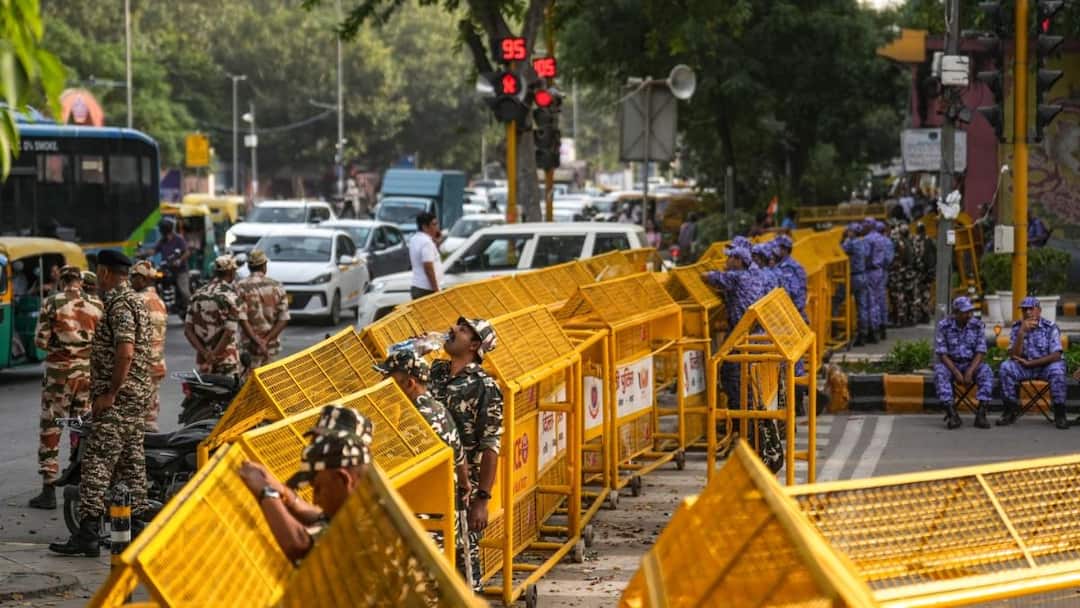
- Supreme Court ordered removal of barricades, restoring internet access.
- Court sought detailed response on restrictions and alleged detentions.
- Petitioners alleged mass detentions; SG claimed releases, normal services.
- Authorities must detail metro, railway restrictions by Tuesday.
The Supreme Court asked the Centre to ensure that barricades across Delhi are removed unless “absolutely warranted” and that internet services cannot be shut down. The top court also said that people must be allowed to move freely across the city, subject to public order considerations.
The top court on Sunday heard petitions alleging violations of its previous orders, restrictions on public movement and the detention of a large number of people, asking the authorities to submit a detailed response on the situation by Tuesday.
During the emergency hearing, lawyers appearing for the petitioners alleged that metro stations and railway stations in New Delhi and Nizamuddin had been closed, roads had been blocked and people had been detained, including in areas where prohibitory orders under Section 163 were not in force.
The court was also told that around 7,000 people had been detained. The Solicitor General, however, disputed the allegations of unnecessary restrictions, saying metro services had continued to operate and that all stations had reopened by 10 pm on Saturday.
The apex court directed the authorities to provide details of the restrictions imposed on metro services, railways and roads, including the stations affected and the availability of alternative stations. The next hearing has been scheduled for Tuesday.
Court Asks Authorities To Explain Metro Station Restrictions
At the hearing, senior advocate Menaka Guruswamy submitted that several people, including leaders, had been stopped and detained. She also alleged that metro stations, including GTB Nagar and Delhi University, had been closed to the public in violation of the court’s earlier orders.
The Solicitor General said the authorities had no intention of imposing further restrictions on metro services. He submitted that entry and exit had been restricted at 45 of Delhi Metro’s 303 stations, and that all stations were now fully open.
The court noted that an earlier order had covered 57 stations before the number was reduced to 45. It asked the authorities to specify in their written response which stations had been closed or restricted, the circumstances surrounding the restrictions and whether alternative stations were available to passengers.
The court also sought a comprehensive response on the situation concerning metro services, railway stations and roads by Tuesday.
ALSO READ: ‘Just One Step Away From Becoming A Police State’: SC Hears Pleas On Curbs In Delhi Amid CJP Protest
Petitioners Allege Mass Detentions, Seek Action Over Order Violations
The hearing was convened after petitions alleged that the court’s previous directions had been violated and that a large number of people had been taken into custody.
Justice Bagchi, while dictating the order, said the court had been told that metro stations, New Delhi and Nizamuddin railway stations, and roads had been closed, while people had not been adequately informed about the restrictions.
The petitioners also alleged that people had been detained in areas where Section 163 was not in force. Guruswamy argued that the restrictions and detentions went against the court’s earlier directions. She further submitted that the action had not been limited to prominent personalities and that ordinary citizens had also been detained.
Senior advocate Arundhati Katju said it had been difficult to approach the court the previous day because online filing was challenging. Guruswamy said the rapidly changing situation had made it difficult to obtain complete information when the petition was filed due to the lack of internet access.
Describing the circumstances as unusual, Guruswamy said such a situation had come before the court after 50 years, comparing it with the period when the Emergency was imposed.
The court said it had received submissions from other lawyers on the issue as well.
Solicitor General Says Detainees Released, Metro Services Normal
Responding to the allegations, the Solicitor General said a detailed reply was not yet ready. However, he submitted that some people had been detained at around 2 pm and released by 6 pm.
On this basis, he argued that the habeas corpus petition no longer survived, as the people concerned had been released.
The Solicitor General also maintained that there had been no unnecessary interference with public movement and that metro trains had operated normally. He said the restrictions concerned entry and exit at 45 stations out of a total of 303, and that all stations had reopened by 10 pm on Saturday.
The court asked the authorities to place the relevant details on record, including the status of the affected stations and the arrangements made for commuters.
Court Says Lawyers Must Be Allowed To Carry Out Professional Work
The court said lawyers should not be prevented from carrying out their professional work. The Solicitor General responded that there was no problem in this regard.
The court also raised the issue of internet access. The Solicitor General told the bench that internet services had been restored at 10 pm on Saturday.
The court said it was taking the Solicitor General’s submissions on record and observed that public movement should remain free, subject to the maintenance of public order.
The issue of restrictions outside the court also came up during the hearing. When the court asked whether Section 163 was in force outside its premises and whether lawyers were facing difficulties reaching the court, the Solicitor General said he would seek instructions.
ALSO READ: YouTuber Dhruv Rathee Released From Detention, Warned Against Joining Jantar Mantar Protest
A lawyer told the court that Section 163 was in force outside the premises and that barricades had been put up. The Solicitor General said the order was not specifically intended for the court but covered the area in which the court was located.
A lawyer argued that the restrictions should not have been imposed without the Chief Justice of India’s permission and called for their immediate removal.
Sibal Argues For Peaceful Protests Within Four-Kilometre Radius
Senior advocate Sibal argued that peaceful demonstrations should be permitted within a four-kilometre radius. When the court asked whom the proposed permission would apply to, he clarified that he was referring to any citizen.
The court questioned whether citizens needed permission to hold such demonstrations and described the argument as interesting, saying it would like to hear it in detail.
However, the court also pointed out that Article 19(2) of the Constitution places reasonable restrictions on certain rights, with public order being one of the grounds.
Senior advocate Venugopal told the court that one of his junior colleagues had also been detained and released around 11 kilometres away.
The court said it would examine detention-related matters by considering three aspects: the circumstances, the manner in which the detentions were carried out and the arguments presented.
The Solicitor General sought a hearing on Wednesday, but the court declined and said the matter would be heard on Tuesday. The bench then indicated that it would hear Sibal, followed by Venugopal again, before concluding the day’s proceedings.
The authorities have been asked to submit their response by Tuesday, when the court will take up the matter again.
Disclaimer : This story is auto aggregated by a computer programme and has not been created or edited by DOWNTHENEWS. Publisher: abplive.com