Lost monastery masonry may have been reused for hospital’s drain
-
Published
Surviving parts of a monastery set up by King James I of Scotland almost 470 years ago may have been found in an old drain.
The Charterhouse was established in Perth for monks of the Carthusian Order, external, and at the heart of the complex was a lavishly decorated church.
The monastery was later demolished and over the centuries the medieval site disappeared under a hospital and houses.
During an excavation last month, archaeologists and volunteers uncovered an 18th Century culvert that appeared to have been partly made using stone from the torn down monastery.
The culvert once drained waste water from King James VI Hospital, which was built around 1749-1750 and was converted into flats in the 1970s.
The drain was discovered during the dig in a grassy open space at the former hospital.
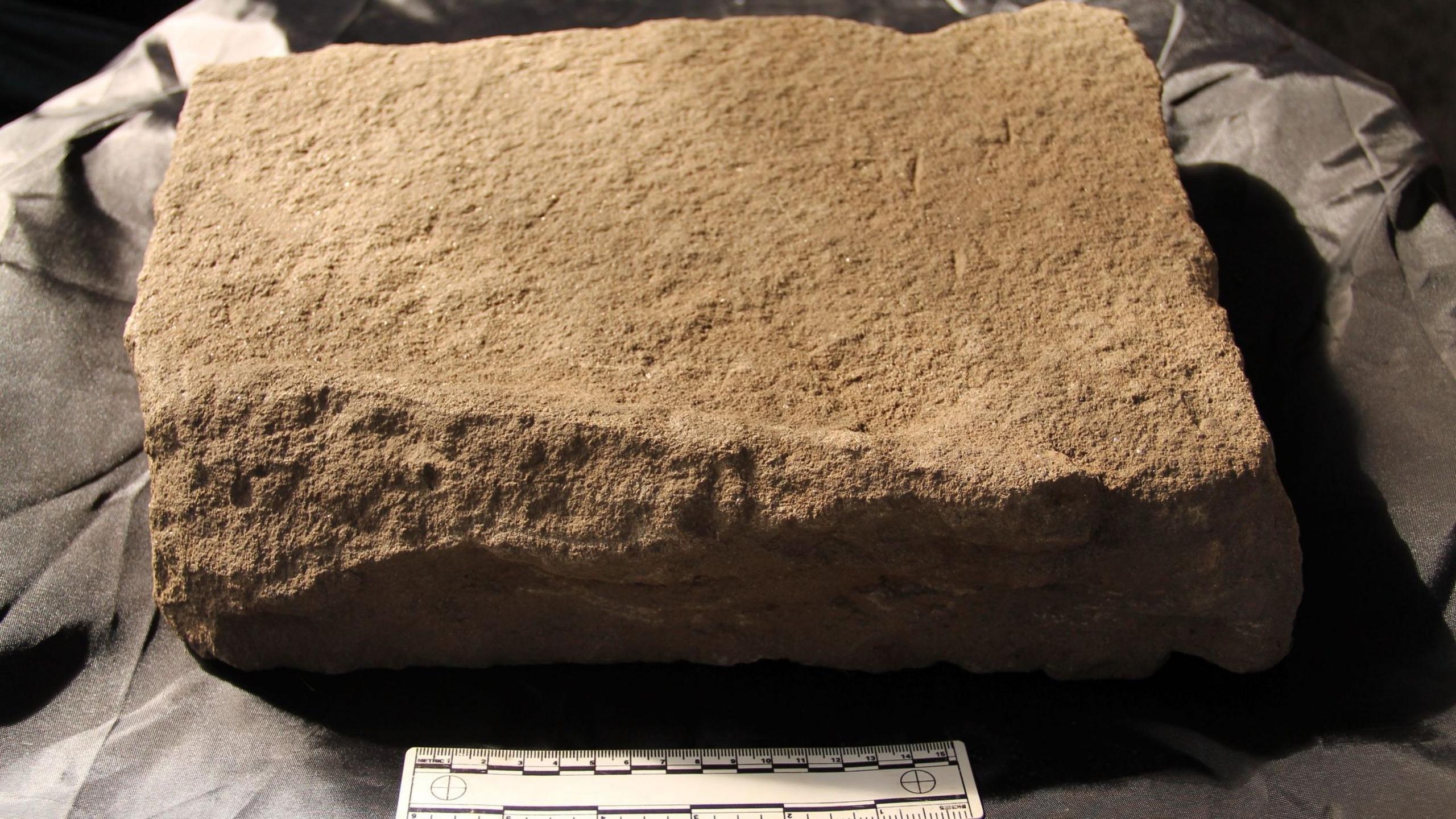
Covering the top of the drain were flat stones, which are believed to be medieval masonry.
Archaeologist Dr Gavin Lindsay told BBC Scotland News: “You can see clear chisel marks from when they had been worked very carefully to create these beautiful smooth sides.
“They are clearly far more elaborate, and far more effort had gone into their production, than you would do for a drain in the 1700s.”
The selection of masonry also include stone floor slabs.
Dr Lindsay said a stone mason who visited the dig suggested the slabs’ smooth surfaces were the result of people walking on them over many years.
“Possibly by many monks’ feet, and to push it a bit further, maybe King James’s feet had been across it,” said the archaeologist.
 Image source, Gavin@AllAges
Dr Lucy Dean, of the University of Highlands and Islands Centre for History, is also involved in the Perth Charterhouse Project.
She said: “The volunteers that we had did a lot of sifting through the soil that we were taking out.
“They were finding, alongside quite a lot of 19th and 20th Century pieces of pottery and glass, a number of pieces that are probably medieval.”
The stones from the drain along with fragments of pottery will be examined further by specialists.
 Image source, Gavin@AllAges
The archaeologists said the next stages of the project included studies of archives to find out more about the monastery, and going back to the local community to let them know what has been found so far.
Further digs could take place in the future.
Residents of Perth have also been asked to look out for more masonry that had survived and been reused.
Dr Lindsay said: “We have identified a number of different fragments that have been incorporated into the retaining wall of Perth Station, for example, and into boundary walls of gardens.”
The University of Stirling and Perthshire Society of Natural Science have been involved in the project, while funding for the dig was provided by the trustees of the King James VI Hospital and The Guildry Incorporation of Perth.
Related internet links
Disclaimer : This story is auto aggregated by a computer programme and has not been created or edited by DOWNTHENEWS. Publisher: BBC