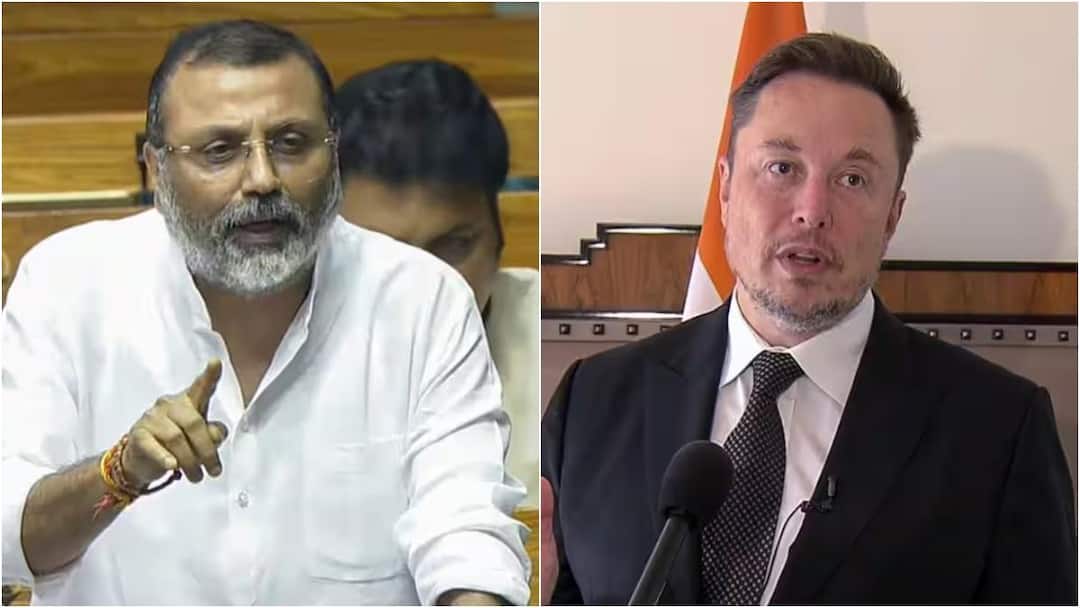
- Elon Musk criticized arguments against Starlink’s entry into India.
- BJP MP Dubey cited national security concerns against Starlink’s operations.
- Dubey asserted India will not change security policy under pressure.
- Ministry of Communications affirmed fair, non-discriminatory satellite communication rules.
BJP MP Nishikant Dubey on Sunday hit back at SpaceX CEO Elon Musk over Starlink’s proposed entry into India’s satellite communications market, asserting that the country would not change its security policy under pressure and that national security concerns would take precedence over commercial interests.
In a post on X responding to Musk, Dubey said a parliamentary committee had examined the challenges Starlink could pose to India’s security agencies. He added that the Ministry of Defence, the Ministry of Home Affairs and investigative agencies had raised concerns over the potential threats associated with such developments.
“As the Chairman of the Parliamentary Committee, our committee has understood the challenges facing the country’s security agencies through @elonmusk’s Starlink,” Dubey wrote, alleging that the company’s activities raised security concerns for government agencies.
Also Read: ‘Govt At War With Citizens’: CJP Leaders Allege ‘Open Emergency’, Slam Modi Govt Over Detentions
‘India Does Not Change Security Policy Under Pressure’
Referring to the previous UPA government, Dubey claimed that the Manmohan Singh-led government had alerted the Telecom Regulatory Authority of India (TRAI) to the potential threats in 2013-14.
He stressed that India was a sovereign democracy and would not alter its security policy because of commercial pressure or social media criticism.
“First, provide connections to the poor in your own country, America, at affordable rates, and then level accusations; India is a healthy democratic, sovereign nation; it does not change its security policy under pressure or social media,” Dubey said.
संसदीय समिति के अध्यक्ष होने के नाते हमारी कमिटि ने देश की सुरक्षा एजेंसियों के समक्ष आने वाले चुनौतियों को @elonmusk के स्टार लिंक से समझा है,रक्षा मंत्रालय,गृह मंत्रालय,हमारी जॉंच एजेंसी इन खतरों के ख़तरनाक खेल से प्रभावित हो रही है ।2013-14 में मनमोहन सिंह जी की सरकार ने @TRAI को इन खतरों की जानकारी दी थी ।पहले अपने देश अमेरिका में तो गरीब को सस्ते दामों पर कनेक्शन दे दीजिए,फिर आरोप प्रत्यारोप लगाइए,भारत एक स्वस्थ लोकतांत्रिक,संप्रभु राष्ट्र है,दबाव और सोशल मिडिया से अपनी सुरक्षा नीति नहीं बदलता है ।पैसे पर हमारी नीति चलती तो आपको सुरक्षा एजेंसियों के विरोध के बावजूद रेड कार्पेट वेलकम करते,आप तो अमेरिका से लेकर ब्रिटेन तक राजनीतिक दलों को सहयोग से भी ज़्यादा सहयोग करते हैं?
— Dr Nishikant Dubey (@nishikant_dubey) October 11, 2026
He further argued that if commercial interests alone drove the government’s decisions, India would have welcomed Musk’s company despite objections from security agencies.
“If our policy were driven by money, we would have rolled out the red-carpet welcome for you despite opposition from the security agencies,” he added, questioning Musk’s alleged support for political parties in the US and the UK.
Musk Calls Arguments Against Starlink ‘Absurd Hypocrisy’
Dubey’s remarks came after Musk renewed his push for Starlink to enter India’s satellite communications market, arguing that competition would give consumers more choices.
In a post on X on Saturday, Musk criticised arguments against Starlink’s entry and targeted supporters of the existing market structure, referring to them as an “army of Internet shills”.
“The ridiculous arguments by Ambani’s army of Internet shills make no sense,” Musk wrote, arguing that critics could not simultaneously claim Starlink would be unable to compete with the low prices offered by Reliance Industries Chairman Mukesh Ambani’s telecom businesses and suggest that it would pose too strong a competitive threat.
Musk described the arguments as “absurd hypocrisy and hyperbole”, while acknowledging that greater competition could reduce the profits of existing players.
He also said Starlink would need to make its pricing affordable to attract Indian consumers.
“Obviously, if Starlink is too expensive in India, no one will buy it, so SpaceX will need to make pricing affordable,” he added.
Also Read: ‘I Was Kidnapped By Goons’: YouTuber Dhruv Rathee After Being Released From Detention
Centre Says Satellite Communication Rules Are Fair
Amid the debate, the Ministry of Communications said India’s regulatory framework for satellite communication services was fair and non-discriminatory.
In a statement issued on October 8, the ministry said telecom licences had been granted to three global mobile personal communication by satellite service providers using non-geosynchronous satellite orbits.
The ministry added that security assessments were under way for all three licensees. Once the process is completed, each licensed entity can proceed to seek spectrum assignment.
“At present, all three entities are at broadly the same regulatory stage,” the ministry said, dismissing allegations that the framework or its application was unfair or discriminatory as “baseless and misconceived”.
The debate over Starlink’s proposed Indian operations continues as the company seeks to navigate the country’s licensing, security assessment and spectrum assignment processes.
Disclaimer : This story is auto aggregated by a computer programme and has not been created or edited by DOWNTHENEWS. Publisher: abplive.com