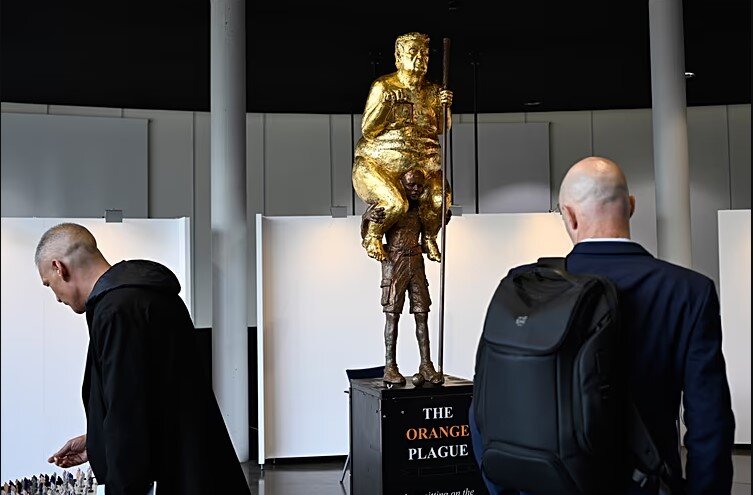
TEHRAN- A gold-covered sculpture depicting US President Donald Trump naked and sitting on the back of a frail man has sparked a political controversy at the European Parliament in Strasbourg, France, drawing criticism from several European lawmakers and a call by Slovak Prime Minister Robert Fico for its removal, while others have defended the artwork as a form of political satire and freedom of expression.
Created by Danish artist Jens Galschiøt, the 2.6-meter sculpture, titled “The Orange Plague” and also known as “The King of Injustice,” was unveiled on October 7 as part of a three-day exhibition hosted by Danish Member of the European Parliament Per Clausen. The installation was removed on October 8, according to Italian broadcaster Sky TG24, which reported that the exhibition had been scheduled to run for three days.
The work portrays Trump as a naked, overweight figure covered in 23-karat gold leaf, holding a golf club in one hand and scales of justice in the other. He sits on the shoulders of a smaller, frail man, whose posture suggests that he is struggling under the weight, while a globe resembling a golf ball lies near the man’s feet.
An inscription at the base of the sculpture offers a pointed commentary on the relationship between power and responsibility.
“I am sitting on the back of a man. He is sinking under my burden. I will do anything to help him. Except stepping down from his back,” the inscription reads.
The text presents an ironic image of a powerful figure who claims to help those beneath him while refusing to abandon the position that causes their suffering.
According to Euronews and The Art Newspaper, Galschiøt conceived the work as a protest against Trump’s climate and foreign policies, which he believes undermine international cooperation and efforts to address the climate crisis.
Slovak prime minister calls for removal
The exhibition drew criticism from Robert Fico, who called on European Parliament President Roberta Metsola to have the sculpture removed.
According to Slovakia’s news agency TASR, Fico objected to the installation despite acknowledging his disagreements with some of Trump’s policies. He argued that political differences should not justify what he regarded as an insult to a partner country on the premises of a European institution.
Fico also questioned whether those supporting the display would accept similar depictions of French President Emmanuel Macron or German Chancellor Friedrich Merz. His remarks brought diplomatic sensitivities into a debate over the limits of political satire.
Other lawmakers also criticized the artwork. Belgian MEP Barbara Bonte described the installation as a disgrace, while Hungarian lawmaker Ernő Schaller-Baross questioned what he considered a double standard in the treatment of political leaders. Irish MEP Barry Cowen also called the sculpture “silly and objectionable” and said he had written to the parliament to express his opposition.
The objections highlighted divisions within the European Parliament over whether the sculpture represented legitimate political expression or an inappropriate use of the institution’s premises.
Danish lawmaker defends the display
The sculpture was brought to Strasbourg at the invitation of Danish MEP Per Clausen, who defended the decision to exhibit it.
Clausen, who invited Galschiøt to exhibit the sculpture, dismissed concerns about a possible negative reaction from Trump.
“If someone is so thin-skinned that they cannot tolerate this sculpture being exhibited in the European Parliament, then they have no place on the world stage,” Clausen said, according to Euronews.
The exhibition was approved by the European Parliament’s quaestors, a cross-party group responsible for certain administrative matters. The approval allowed the work to be shown in designated exhibition space but did not make it an official artwork commissioned or endorsed by the institution.
Galschiøt has described the sculpture as a personal attack on Trump, an approach he said differed from his usual focus on political systems.
“Normally I attack systems, but in this case, I will attack Trump personally,” the artist told The Art Newspaper.
Galschiøt said the work was intended to draw attention to the reluctance of governments and organizations to challenge the US president openly because of potential economic and political consequences.
“Nations as well as NGOs are afraid to openly raise the subject [of] how to deal with Trump and his policies, fearing tariffs, fund-cuts, deportations or the like,” the artist wrote on his website, in a statement quoted by The Art Newspaper.
The sculpture’s gold finish also carries a satirical message. Galschiøt told the publication that Trump’s extensive use of gold in his properties, including the Oval Office, inspired the decision to cover the figure in the precious metal.
The artist also drew inspiration from Hans Christian Andersen’s fairy tale “The Emperor’s New Clothes”, in which a vain ruler parades naked while those around him pretend that he is wearing magnificent garments. The story’s central theme — the reluctance to challenge authority even when its failings are obvious — reinforces the sculpture’s political message.
Miniature replicas extend the protest
The Strasbourg exhibition was accompanied by an effort to circulate the artwork beyond the parliament building. Galschiøt produced approximately 20,000 miniature, 3D-printed versions of the sculpture, distributing them to visitors and parliament staff. He also made the digital design files freely available online for people wishing to print their own copies.
The idea was inspired by Hong Kong’s democracy movement, whose supporters produced miniature reproductions of Galschiøt’s “Pillar of Shame”. The original sculpture, created in 1997 to commemorate human rights violations including the 1989 Tiananmen Square crackdown, was dismantled in Hong Kong in 2021.
“The Orange Plague” had previously appeared at demonstrations in Copenhagen opposing US pressure over Greenland and at the COP30 United Nations climate conference in Belém, Brazil, in 2025.
Following its Strasbourg appearance, Galschiøt planned to display the sculpture again at the COP31 climate conference in Antalya, Türkiye, in November 2026.
In a report published on October 9, Euronews also placed the installation within a broader tradition of satirical art targeting Trump, noting how artists have used exaggerated and often gilded depictions of the president to challenge his public image and political influence.
The controversy surrounding the sculpture illustrates how political art can become a point of contention over freedom of expression, diplomatic sensitivities and the role of public institutions.
SAB/
Disclaimer : This story is auto aggregated by a computer programme and has not been created or edited by DOWNTHENEWS. Publisher: tehrantimes.com