“1 Plant, 100 Uses” explores the many ways familiar Indian plants, leaves, fruits and trees have been part of everyday life — from food and farming to homes, traditions and natural remedies. Each story takes one plant and uncovers the surprising ways people have found it useful, often across generations.
Ask anyone what tamarind is for, and they will talk about chutney, rasam, or the sour candy of childhood. All of that is true, but it covers only one part of the tree. Look at what grows on it, under it, and out of it, and the fruit starts to seem like the least of its talents.
A newcomer that stayed
Tamarind feels so Indian that people are surprised to learn it isn’t. Botanists place its origins in tropical Africa, and it reached South Asia thousands of years ago with human travellers. It has been grown here for so long that it is often taken for a native. Even the name carries the journey. It means ‘date of India’, because early visitors thought the pods came from an Indian palm.
The shade everyone gathers under
Long before anyone thought about its pulp, people valued the tree for its canopy. World Agroforestry’s species database describes the wide crown as a ‘rest and consultation tree’ in villages. The same entry says the tree stands up well to storms, which is why it also works as a windbreak. Anyone who has sat through a hot afternoon under a tamarind will not need convincing.
Beyond the rasam pot
In the kitchen, the pulp does far more than sour a curry. The World Agroforestry Centre’s Agroforestree Database says it is a staple of Indian curries and chutneys. The sour types are made into juice, jam, syrup, and candy, according to the PROSEA handbook on edible fruits.
Green fruit and flowers are used to sour soupy fish and meat dishes. In the Philippines, where the fruit is called sampalok, this includes sinigang, a sour soup that a popular Filipino recipe builds on a broth of boiled young tamarind. Even the tender pods can be eaten as a vegetable, cooked or pickled.
The tree is generous, too. A productive one can yield up to 150 kg of fruit a year, and it keeps going into old age. The foliage has high forage value, though it is rarely lopped for animals because that cuts the fruit crop. In southern India, cooked tamarind seeds are fed regularly to draught animals.
Timber, dye, and a home for wildlife
The hard, dark red heartwood is used in woodworking, and the tree also yields a dye. Almost every part of the tree finds a use, whether as food, fodder, timber or fuel, or in the textile and chemical industries.
/filters:format(webp)/english-betterindia/media/media_files/2026/10/12/tamarind-tree-uses-2026-10-12-12-45-44.png)
Wildlife leans on it as well. In Madagascar, the fruit and leaves can supply up to half the food resources of ring-tailed lemurs.
The seed once thrown away
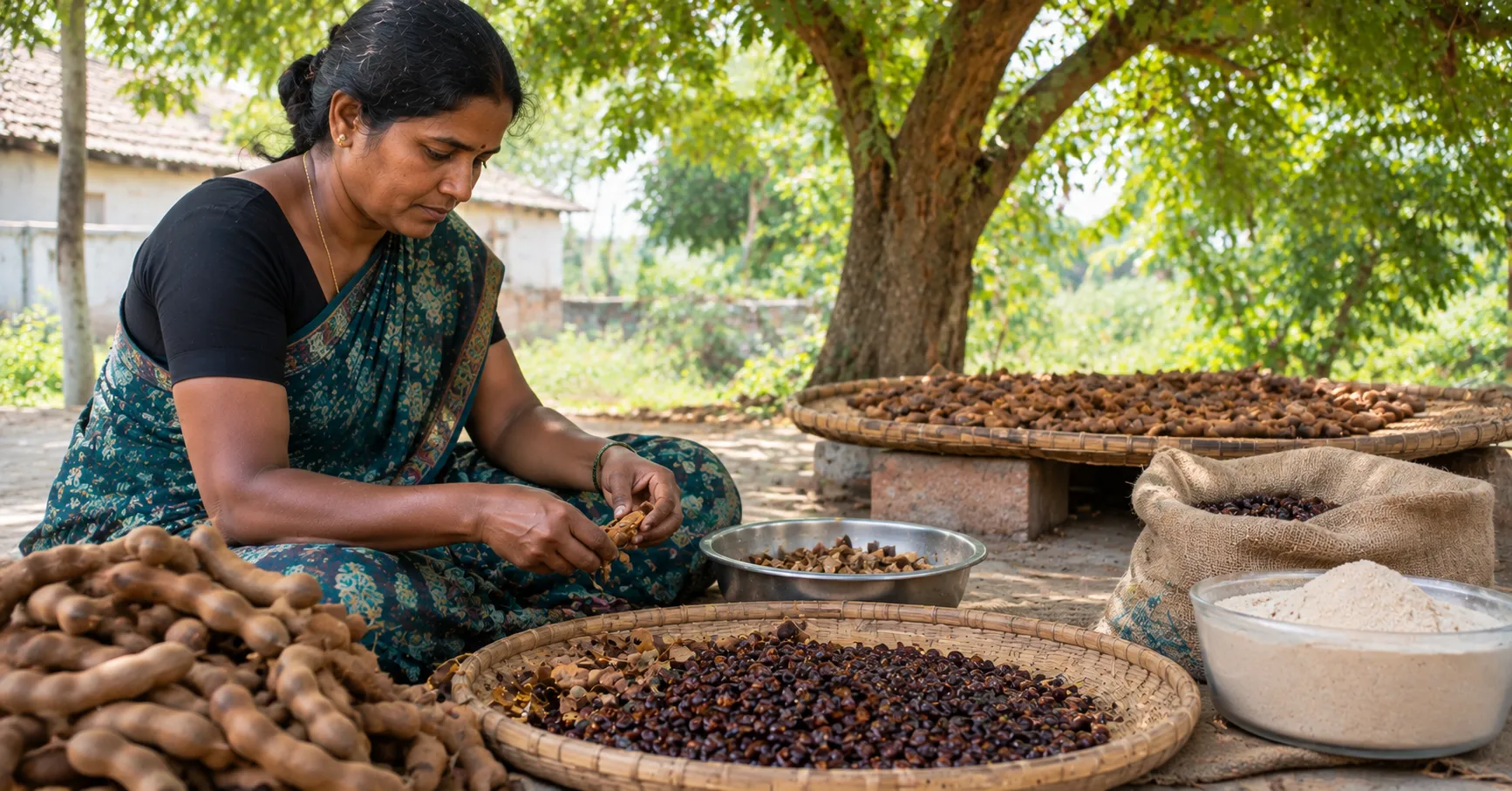
The seed is the best argument that nothing on this tree is waste. The kernel makes up roughly 70 to 75 percent of it, and when ground, it becomes tamarind kernel powder.
According to a 2025 review, the powder was first produced commercially in 1943 as a substitute for starch in sizing cotton in the Indian textile industry. Sizing is the coating that helps threads survive the loom. Another review describes the powder as widely used for jute and cotton yarns, where it replaced starch because it was cheaper and worked well. It also finds its way into paper, leather, printing, and food.
The key ingredient is xyloglucan, a food-grade, starch-like polysaccharide. A Royal Society of Chemistry review looks at its promise in food technology and textiles. The 2025 review adds that regulators in several countries, including Japan, the United States, China, South Korea and Canada, have recognised the seed polysaccharide as a safe food ingredient.
What the labs are trying
Researchers are now testing what else the seed can do. One study made composite films from tamarind xyloglucan and chitosan that held microbial growth below 30 CFU/g in laboratory tests. Food packaging is one possible use. These are early results, not products you will find on a shelf, but they show how much we still have to learn from a seed once we sweep it aside.
/filters:format(webp)/english-betterindia/media/media_files/2026/10/12/tamarind-tree-uses-2026-10-12-12-47-28.webp)
The tree that was always there
Shade, food, fodder, timber, dye, textile sizing, and a growing list of experiments all come from one species. Perhaps the most telling part is the seed, long treated as a by-product and now a support for the fabric industry. The tamarind in your neighbourhood is probably doing more work than anyone gives it credit for.
Disclaimer : This story is auto aggregated by a computer programme and has not been created or edited by DOWNTHENEWS. Publisher: thebetterindia.com