Updated ,first published
The imam of a Melbourne mosque has denied allegations by United Arab Emirates officials that he is linked to the accused flydubai hijacker.
In a statement posted to social media, Samir Mohtadi – also known as Abu Hamza – denied that accused terrorist Hammam al-Hammami attended Islamic centre, MyCentre, in Broadmeadows.
“I (Abu Hamza) strongly reject recent media reports suggesting any connection between myself, Multicultural Youth Centre and the co-pilot, Al-Hammami,” the statement said.
“I have never met Al-Hammami, who has been referred to in recent media reports, and we have no record of him ever attending our centre. The relevant authorities should have verified these claims with me before releasing or publishing such information,” he said.
“Throughout my life, I have consistently preached peace, and both my work and the work of the centre have always focused on promoting peace, harmony, mutual respect, and community wellbeing. We unequivocally reject violence in all its forms.
“I strongly reject any attempt to associate me or Multicultural Youth Centre with Al-Hammami. Such claims are unfounded, misleading and risk unfairly damaging the reputation of an organisation that has served the wider Australian community for decades.”
UAE officials allege al-Hammami became radicalised in 2017 while studying in Australia, and that while living here he was also associated with MyCentre. This masthead is not suggesting the mosque or Mohtadi intentionally taught al-Hammami to engage in violence or terrorism, or were involved in any wrongdoing.
While terror experts say al-Hammami’s radicalisation appears to have been largely self-driven and online, the UAE reports have prompted calls to review the almost $2 million in government funding that has flowed to MyCentre since 2018.
Described as a hub for the Muslim community in Melbourne’s northern suburbs, the Broadmeadows centre of which Mohtadi is a director and community leader, includes fitness and aquatic facilities, a college that teaches English, maths, Arabic and Islamic Studies.
The centre also runs Ayesha Mosque, at the same address.
State and federal government documents show MyCentre received a $730,000 grant from Victoria for community infrastructure and $1.17 million from the federal government to subsidise childcare worker wages.
The statement followed the release of a video posted online on Sunday night, in which Mohtadi vowed to “fast from talking”, and declared critics are too “fixated” for his words to alter their views.
“You find those who are righteous; they’ve always been attacked, abused, accused, killed, imprisoned – and this is the way it is,” Mohtadi said.
“I’m going to fast from talking because there are circumstances, my beloved brothers and respected sisters, regardless how much you explain yourself to people, that’s it, they’re fixated with their ideas – and that’s it. You can’t change them. So the best thing, sometimes, is not to say anything.”
Terrorism expert Dr Josh Roose said the information from UAE authorities should prompt a review of government funding for the centre, as well as the need to review Australia’s charity legislation.
“He has raised $3-4 million for a centre that he’s building in Victoria, and his organisations are charitable.
“There are significant issues with charities legislation”.
The Deakin University associate professor said extremist views and radicalisation tended to be rejected by Australian mosques and pushed into smaller fringe groups.
“Extremists tend to be kicked out of the mainstream mosques and then go and form their own organisations,” he said. “And often what you’ll find is that even within these more mainstream groups, there’s fringe organisations that have been kicked out of them… and they form their own bookshops or meeting garages and gyms and so on.
“This [MyCentre] is a reasonably large, well-funded centre with a reasonable number of people attending. But there’s broader questions about the messaging, which is basically, ‘You don’t need to get into Australia at all, all you need is your faith, Australia’s corrupted and terrible’.”
In 2025, the Victorian government also provided $2.5 million to the Northern Community Support Group through MyCare, according to Broadmeadows Labor MP Kathleen Matthews-Ward, who told parliament the funding would support Muslim communities and make it harder for isolated people to be manipulated.
A Victorian government spokesperson told this masthead on Monday that it had no active funding agreements with MyCentre.
Mohtadi, whose family migrated from Lebanon, is considered a prominent Islamic figure, known particularly through his youth work.
In 2017, he described MyCentre as promoting “anti-extremism” in a witness statement supporting a centre volunteer Omar Chkhaidem, a then-teenager convicted over an illegal tobacco-growing operation.
“According to the imam … the centre provides drug and alcohol counselling and promotes anti-extremism,” the judgment noted.
Mohtadi also appeared as a prosecution witness and gave evidence against terrorist leader Abdul Nacer Benbrika, in what was then Australia’s biggest-ever terrorism trial.
“[Benbrika] was said by [Mohtadi], a prominent Muslim who was called by the Crown, to follow a version of Islam which he … regarded as ‘harsh’,” County Court Judge Bernard Bongiorno noted in his sentencing remarks.
Under cross-examination, Mohtadi admitted that in his experience, many young Muslims and people – including himself – have looked at extremist material, including beheading videos.
In 2010, the imam travelled to several Middle Eastern countries with IS propagandist Robert “Musa” Cerantonio to secure funds for MyCentre. According to a 2015 Good Weekend report, ASIO officials told Cerantonio at the time that the government supported his efforts to travel and raise the money.
Cerantonio was convicted in 2019 alongside five other extremist Australian men for leading the group’s plans for a foreign incursion to help overthrow the government of the southern Philippines.
Mohtadi has also faced criticism – including from within the Muslim community – over his arch-conservative views and anti-LGBTQ rhetoric.
“In Australia, in general, the biggest issue that we have is drugs, alcohol, porn, LGBTQ,” he said during an August interview with a Malaysian Islamic radio station.
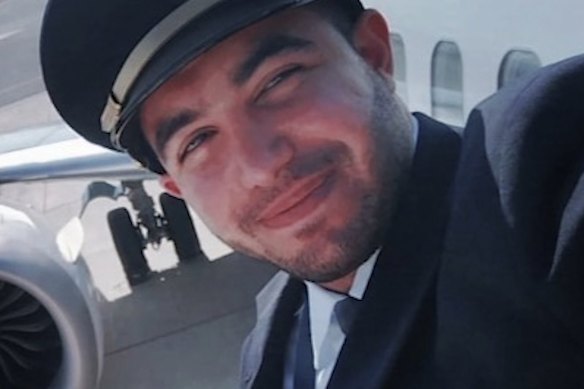
On September 30, al-Hammami, 29, was co-pilot on a flydubai flight from Dubai to Tel Aviv. He is accused of attacking the captain with the intent of crashing the plane into Ben Gurion Airport in Tel Aviv, until he was overpowered by passengers.
According to UAE authorities, al-Hammami began gravitating “towards extremism and terrorism” when he was studying in Australia.
“During that period, he was influenced by takfiri [radical] ideology through reading extremist literature and following online content glorifying terrorist organisations and suicide attacks,” the UAE’s attorney-general said in the statement.
“[Al-Hammami] stated that the centre was managed by a Lebanese man known as Abu Hamza and allegedly received support from an association linked to the Muslim Brotherhood.”
Australian authorities have not confirmed the allegations detailed in the UAE’s statement, published last week by its state-operated news agency.
Three anti-terror experts familiar with Victoria’s Muslim communities and leaders told this masthead that it appeared al-Hammami’s radicalisation took place well away from a mosque or recognised community.
One senior Melbourne Muslim leader, who asked not to be identified due to the accusations that had followed the UAE reports, said al-Hammami’s radicalisation was not connected to a mosque.
“While we welcome everyone, it is impossible for any community to foresee or be linked to the actions an individual might independently take nearly a decade later.”
Victoria University extremism researcher Dr Debra Smith said while it may be tempting to look for a specific social connection to explain someone’s pathway to terrorism, radicalisation was frequently a self-directed process.
“When this happens, the radicalising person tends to withdraw from the peers or community they have connected to. That kind of active withdrawal is often a much stronger catalyst for terrorism,” Smith said.
“What we see in this case is that al-Hammami seems to have withdrawn from various areas of his life, including his university studies and his connections to the Muslim community in Australia.
“It appears he was acting alone and was very self-directed on his pathway to terrorism.”
Al-Hammami was pursuing a mechanical engineering degree at Melbourne’s RMIT University. According to an article published by Emirates News Agency, he had regularly attended a mosque affiliated with the university, where he became acquainted with individuals associated with MyCentre.
The Victorian Joint Counter-Terrorism Team is investigating al-Hammami’s time in Australia, including his time studying at RMIT University.
London’s Financial Times reported that Australia’s intelligence services had opened a file on al-Hammami while he was living in Melbourne. However, a senior source in the national security community strongly denied this.
Al-Hammami might have been included in a database or mentioned in relation to someone else but had not been investigated by ASIO at a serious level, said the source, who spoke on the condition of anonymity to discuss sensitive matters.
The Australian Federation of Islamic Councils rejected any insinuation of a connection between MyCentre and violent extremism, in a statement released on Sunday.
“AFIC affirms unequivocally that MyCentre is a respected community organisation known for its youth engagement, family support programs, counselling services and balanced community messaging,” the statement read.
“The centre has a long record of constructive work with young people, families and local institutions, and has consistently promoted lawful, peaceful and socially responsible conduct.”
There is no evidence the centre had ever endorsed, facilitated or tolerated any form of violence or unlawful activity, according to the federation of Islamic councils.
“Attempts to associate MyCentre with terrorism are misleading, harmful and inconsistent with the facts,” it said.
Federation president Rateb Jneid said community organisations that had spent years supporting young people and families should not have their reputations damaged through speculation or guilt by association.
“We must not allow sensationalism to undermine the valuable work being done within our communities or create unnecessary suspicion and division.”
Read more on the flydubai incident:
 Carla Jaeger is a journalist for The Age. Got a tip? Email carla.jaeger@theage.com.au or message carlajaeger.62 on Signal.Connect via X or email.
 Eryk Bagshaw is an investigative reporter for The Sydney Morning Herald and The Age.
He was previously North Asia correspondent. Reach him securely on Signal @bagshawe.01Connect via X or email.
From our partners
Disclaimer : This story is auto aggregated by a computer programme and has not been created or edited by DOWNTHENEWS. Publisher: www.smh.com.au