On a recent morning, Tucson mayor Regina Romero knocked on a yellow door above a mat emblazoned with a cat’s silhouette and the words “go away, peasants”. A young man cracked the door open and stood there silently, a toothbrush dangling from his mouth.
After giving him a moment to finish brushing his teeth, the mayor introduced herself and asked if the man had heard of JoAnna Mendoza, the Democrat running to unseat Republican congressman Juan Ciscomani. Romero handed him a pamphlet and rattled off her candidate’s virtues. The young man stood stone-faced, until she mentioned that Mendoza had served for nearly two decades as a US marine.
His eyebrows raised as he looked over the brochure: “This is cool.”
The man declined to disclose his voting intention or to be named in this story, citing privacy concerns. But the interaction, however brief, marked a victory for Romero. Democrats’ ambitions of retaking the House of Representatives in next month’s midterm elections will depend partly on Mendoza’s ability to sway voters like him.
Congressional district six is a swing seat in a swing state, where voter identification is weak and more than a third of residents identify as independents. Located in south-eastern Arizona, the district tethers parts of liberal Tucson to a saguaro-dotted swath of more conservative countryside stretching toward New Mexico. In recent cycles, voters here have narrowly favored Republicans.
But as the national mood turns sharply against Donald Trump amid soaring costs and an unpopular war with Iran, Democrats believe they have a real chance – and the right candidate – to tip the balance in this desert battleground.
“Our political system is not designed for everyday working-class folks – and those are the voices that are needed,” Mendoza said in an interview. “Right now we have a Congress that’s very focused on themself and enriching themselves.”
A first-time candidate in a federal race, Mendoza is drawing on her unique biography to connect with the working-class voters in a district that is roughly 20% Hispanic and home to a large population of military veterans. The daughter of farmworkers, she grew up in rural poverty, enlisted in the navy and served as a Marine Corps drill instructor.
“That oath doesn’t expire,” Mendoza said. “I came back home and still felt this need to serve.”
In an election that will be decided largely by kitchen-table issues, Mendoza is railing against Republicans for the myriad ways in which she says they’ve raised the cost of living since Trump’s re-election – the scattershot tariffs, the war in Iran, an “upside down” tax system that favors billionaires and corporations, and safety net cuts that left nearly half a million Arizonans without food assistance. While her campaign has a notably a populist tinge, she has not embraced leftwing causes such as Medicare for All.
Playing to the political center is a commonsense strategy for running in purple Arizona, said University of Arizona political scientist Samara Klar.
“The way Democrats usually win in Arizona is by conveying the most moderate image they possibly can,” Klar said. “Mendoza definitely seems like she’s following that playbook.”
No one knows that better than her opponent, Juan Ciscomani, the telegenic, two-term Republican incumbent. With slicked-back silver hair and six children, Mexico-born Ciscomani made his immigrant story a part of his political identity during the past two elections, when he narrowly defeated the same Democratic challenger.
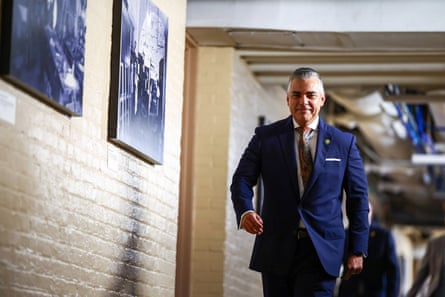
But Ciscomani’s natural strengths as a candidate and bipartisan self-branding are now being tested by Trump’s increasingly extremist second term – most notably the president’s so-called “big, beautiful” spending bill, which cleaved healthcare and food assistance while showering tax cuts on the wealthy.
Ciscomani led well-publicized efforts to soften the bill’s impact locally, but they ultimately failed. Like most Republicans in office these days, Ciscomani avoids publicly contradicting a notoriously vengeful White House. Ciscomani’s campaign did not respond to requests for an interview.
That chain of events has left him the unenviable task of trying to sell the few elements of the president’s unpopular spending bill that benefit the working class, like eliminating federal taxes on tips.
Compounding Ciscomani’s problems, the issues that elevated Trump to the presidency two years ago have lost their resonance with many voters. Trump’s immigration crackdown made border security a less urgent issue fo∫while the president’s violent mass deportation campaign has gone too far for many moderate voters.
Meanwhile, Trump returned to the White House promising to hold back inflation, but prices have continued to climb, partly due to his rudderless war in Iran, which is costing Arizonans dearly at the pump.

“Trump has a record-low approval in Arizona,” said non-partisan pollster Mike Noble. “His rating is actually below where it stood right after January 6. Put that in perspective. The only thing worse than storming the Capitol is apparently paying $4.50 a gallon for gas.”
Facing such headwinds, Ciscomani is keeping a low profile, allowing the power of incumbency, name recognition and the conservative cultural tilt of much of his district to do the campaign’s heavy lifting.
“Ciscomani is just invisible,” said Mo Goldman, a Democrat and Tucson immigration attorney who briefly ran for the House seat, before dropping out and endorsing Mendoza. “He keeps pounding the fact that he’s the most bipartisan representative in Arizona, but the people in his district have rarely seen him.”
Activists from the left see Ciscomani’s limited public appearances as vulnerability to exploit. For months, they’ve staged protests outside his district office, urging him to hold a public event to discuss the spending bill’s cuts.
The same morning Romero went canvassing, dozens of protesters had gathered again outside of his Tucson office. Standing on all four corners of a busy intersection, they waved signs with slogans that read “no more war” and “Ciscomani, stop raising our costs.” A woman walked up and down the sidewalk, beating a drum slung over her shoulder, as passing drivers honked in support.
“Juan Ciscomani votes with Maga every time,” protester Norma Itule said. “He’s two-faced and insincere.”
With both candidates fighting for the political middle, Ciscomani has focused his attacks on Mendoza’s alleged “wokeism”, highlighting pandemic-era comments she made criticizing ICE and police officers in the wake of high-profile officer-involved shootings.
“She doesn’t have the ability to work across the aisle,” Ciscomani said at a televised debate in August.
Mendoza brushed off the criticisms, saying that her words were taken out of context. She doesn’t support defunding the police, abolishing ICE or open borders, she said.
“The truth is, I spent my life protecting our country, willing to die for American values,” she said.
With the slightest opportunity, Mendoza resurfaced her military service, contrasting it against Ciscomani’s life as a civilian. (Ciscomani worked as a staffer for former Arizona Governor Doug Doucey, a Republican, before becoming a member of Congress.) Her most notable jab came as Ciscomani insisted that last year’s spending bill had not impacted Veterans Affairs medical centers.
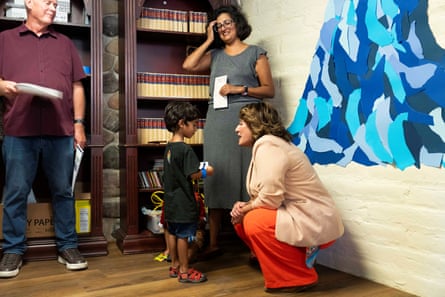
“As someone who actually gets my care at the VA, I can tell you that doctors were let go,” Mendoza, who deployed to Iraq and Afghanistan, shot back.
With national small-donor money pouring into the race, Mendoza has so far out-fundraised Ciscomani. But the Mendoza campaign is hoping its edge will come from constantly connecting to individual voters however they can – TV ads, radio, public events and old-fashioned door-knocking.
That’s why Romero, the Tucson mayor, was out walking the palm tree-lined streets of Tucson’s second ward, looking for voters in the midday heat. Almost no one answered as Romero wound her way through the courtyard apartments and bungalows, a broad-brimmed hat shading her face from the desert sun. But she said she loved the work all the same.
Mendoza shares her enthusiasm, she said. The two met in 2019, when Mendoza joined Romero’s first mayoral campaign as a volunteer. Mendoza showed up three days a week, towing her then four-year-old son behind her on a stroller attached to a bike.
“Ciscomani might have all the Elon Musk money in the world, but JoAnna has people power,” Romero said. “She has always been a public servant.”
Disclaimer : This story is auto aggregated by a computer programme and has not been created or edited by DOWNTHENEWS. Publisher: theguardian.com