Irish army received warning day before Omagh bomb, inquiry told
-
Published
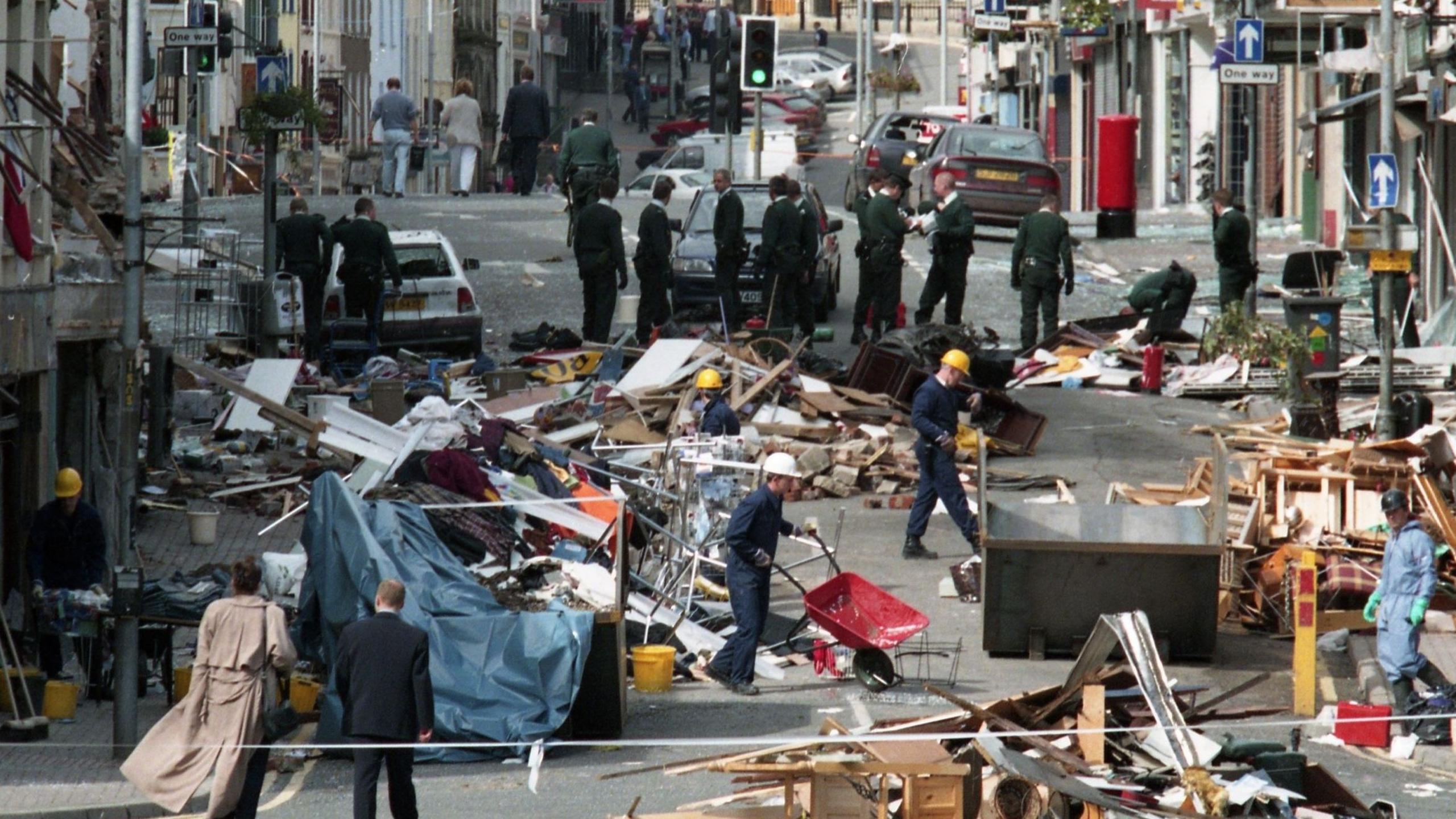
The Omagh Bombing Inquiry has heard that an Irish army camp received a warning that the town was to be the target of a bomb the day before the fatal explosion.
It was revealed during evidence from the journalist John Ware who has reported extensively on the bombing.
He told the hearing that a warning call was received on 14 August 1998 at Finner Camp near Ballyshannon, County Donegal.
“The caller wasn’t drunk, sounded sensible and said, get onto the guards, tell them to check the back routes or back roads and then repeats three times: Omagh, Omagh, Omagh.”
This warning call has not previously been reported.
“It would appear that a warning that something was going to happen imminently to the town of Omagh was received on the 14th August by An Garda Síochána (Irish police force).
“Now what the guards did with that I don’t know”.
-
Omagh bomb: Timeline of families’ bid for justice
-
Published28 January 2025
-
-
Omagh bomb: The 29 victims
-
Published28 January 2025
-
Ware said the information about the call was given to him by the counsel for the bombing Inquiry in preparation for giving evidence.
He said the existence of such a call made sense of a situation that had “puzzled” him.
That the information from his source saying there was a warning, did not fit in with an “emphatic” denial that one existed in a report carried out by Sir Peter Gibson.
“I’ve always puzzled about this; Sir Peter is emphatic ‘no evidence whatever’,” he said.
“There’s no evidence whatever that a warning on the 14th was passed to the police but that is different from saying that there is no evidence whatever of a warning on the 14th.
“This is a possible explanation to the conflict that there was a warning on the 14th and it wasn’t reported to the RUC (Royal Ulster Constabulary) until the 17th”.
 Image source, PA Media
During his evidence, Ware also named the people he believes carried out the attack including the man who he said made the bomb.
He told the inquiry his information came from a pool of confidential sources who he would not be naming, and including senior figures within the RUC and in the Republic of Ireland.
He would not confirm if he had sources within the UK intelligence community.
‘A culture of control’
During his evidence, he said that the RUC and An Garda Síochána did not routinely share information relating to the attack.
“It seemed to be much more an inquiry that was operating in parallel rather than in collaboration.”
He also recounted a disagreement between the forces over the sharing of pictures of 60 suspects which the gardaí (Irish police) had gathered.
“The guards had penetrated the dissidents quite well and they didn’t want to compromise that in anyway, shape or form and therefore, they weren’t going to hand over pen portraits,” he told the inquiry.
“And there was a bit of a row about that.”
Ware said the gardaí was “very strict” about intelligence sharing and there was “a culture of control permeating” the force.
In a quote from his notes, he outlined how a senior figure in the RUC told him they had extra resources on standby in case of a bombing.
“After Banbridge they feared that the worst would happen, in other words that there would be a mass casualty bombing,” he said.
“The assessment was that it would target the same Newry corridor as previous attacks, Lisburn, Newry and Banbridge.
“They thought as a result there was heightened security along the border the following day in the south Armagh, north Louth area but not as far west as Aughnacloy where the Omagh bomb convey made the crossing into Northern Ireland.”
 Image source, Getty Images
Ware said that his source told him that on 14 August 1998, the day before the Omagh bomb, the RUC received an alert from the gardaí that some sort of terrorist device was to be moved across the border imminently.
“Special Branch assessed this as another car bomb,” he said.
He was told that special branch held a briefing and had plans for checkpoints and “sealing off the border”.
But those plans never materialised and the bomb went off.
Ware was asked by the counsel for the inquiry who he thinks was responsible for the Omagh bombing.
He said while he is “not certain” who did what, he named Colm Murphy, Seamus Daly and Seamus McKenna as being involved.
‘We know where you live’
The inquiry heard that following the broadcast of a Panorama documentary in 2000 Ware received threats believed to be from the Real IRA.
“I remember I got a call from someone saying ‘your washing machine has been repaired’, and you know, I hadn’t got a broken washing machine and I think the next day, or a day or two later, a washing machine appeared outside where I lived.”
“I reported that to the police and the police did an assessment of it and that was it really.
“I had some security lights and stuff, but it was very odd thing to have happened and I took it to mean, we know where you live.”
A car bomb also exploded outside BBC Broadcasting house in London on 4 March 2001, which was linked by some to the broadcast.
“I guess there was speculation to that effect, but I don’t know if there were any links,” said Ware.
Disclaimer : This story is auto aggregated by a computer programme and has not been created or edited by DOWNTHENEWS. Publisher: BBC