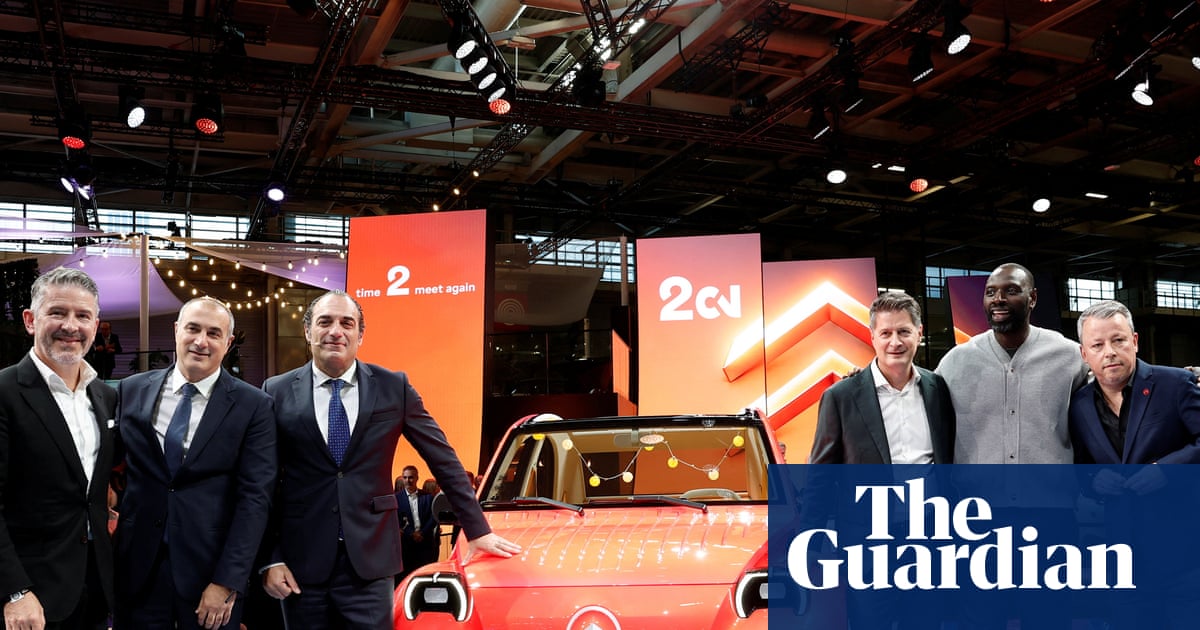
Stellantis and Renault have backed the UK car industry for inclusion in proposed rules to protect EU industry, but urged the British government to consider limiting imports of Chinese cars.
Emanuele Cappellano, who leads Stellantis’s European brands including Fiat, Citroën, Opel and Vauxhall, and François Provost, the chief executive of France’s Renault, said the UK should effectively be counted as one of the EU’s 27 member states for the purposes of the proposed “Made in Europe” legislation.
The new rules aim to ensure EU subsidies and government procurement benefits Europe’s industry, rather than helping manufacturers from other countries.
The executives were speaking at the Paris motor show, which was attended on Monday by the French president, Emmanuel Macron. Brands including Li Auto, GAC and Chery were among a host of Chinese manufacturers exhibiting in Paris with ambitious European expansion plans.
Europe’s car industry is under enormous pressure as it copes with lower demand than before the coronavirus pandemic, while also investing tens of billions of euros in shifting production to electric vehicles (EVs). At the same time, Chinese carmakers’ market share has soared as the transition to EVs opens the door to new entrants.
The EU confirmed on Monday it would limit the number of hybrid electric vehicles imported from China to 350,000 cars a year. The EU expects that the quota, which will come into force in December, will halve China’s market share, which now stands at 6% in a landmark four-year agreement made in Beijing last week.
The Made in Europe rules are another plank of the EU’s response to the rise of China in key manufacturing industries such as carmaking and chemicals.
Under the proposed Industrial Accelerator Act (IAA), cars will have to be “made in Europe”, and contain enough European parts and materials, to continue to qualify for EV grants and to be bought by public bodies in the EU. However, automotive manufacturers and politicians are haggling over the details.
If Brussels sticks to a strict definition of “European” as being only EU countries, Britain risks being left out – prompting intense lobbying from UK car industry and government to be included.
Stellantis is among the manufacturers that still has a British factory, its facility in Ellesmere Port, Merseyside, which produces small vans.
“I think that UK somehow needs to be equalised to the EU 27,” said Cappellano, referring to the bloc’s 27 member states. “We have a lot of relationship, we have footprint. Historically UK has been very close to the European market.”
Europe’s main automotive lobby groups ACEA and Clepa have also put their weight behind the UK to be included. Some parts of European manufacturing, including France’s industry minister, had argued that the UK should be left out given Brexit.
Provost said there was “no other choice” but a deal between the UK and EU. However, he said the UK would also have to stop allowing Chinese cars in without limits.
“On your side, you have also to take decisions,” he said. “If the UK is willing to join the European ecosystem, this is to have an industrial ambition … to keep a strong automotive industry.”
He said this would be an industry that “is not closed to Chinese competitors, but … if you want to operate in Europe, you have to deeply invest in the whole value chain, final manufacturing, suppliers, R&D, technologies.”
Provost added: “I’m not here to demand whatsoever, but I think if UK is willing to join this ecosystem of IAA, there is some open question about the level of imports.”
London has so far rejected pressure to impose its own tariffs on Chinese imports, but the UK business secretary, Jonathan Reynolds, this month said that decision was under review.
Cappellano also said the UK should consider imposing tariffs on Chinese imports. “It’s very important that the UK defines what is the priority,” he said. “It’s very difficult to defend industrial footprint and at the same time let the market completely open to import. Either one or the other.”
He expressed scepticism over whether other countries beyond the EU such as Japan, Turkey and Morocco should be included in the rules.
“We don’t necessarily need to have a larger definition of European scope,” he said, pointing to proposals that carmakers be allowed to source 30% of their materials from outside the EU.
He also argued for more time until 2030 for manufacturers to source batteries from within Europe. China is dominant in the global supply of batteries and Cappellano said it would take longer to build up the European industry.
Disclaimer : This story is auto aggregated by a computer programme and has not been created or edited by DOWNTHENEWS. Publisher: theguardian.com