
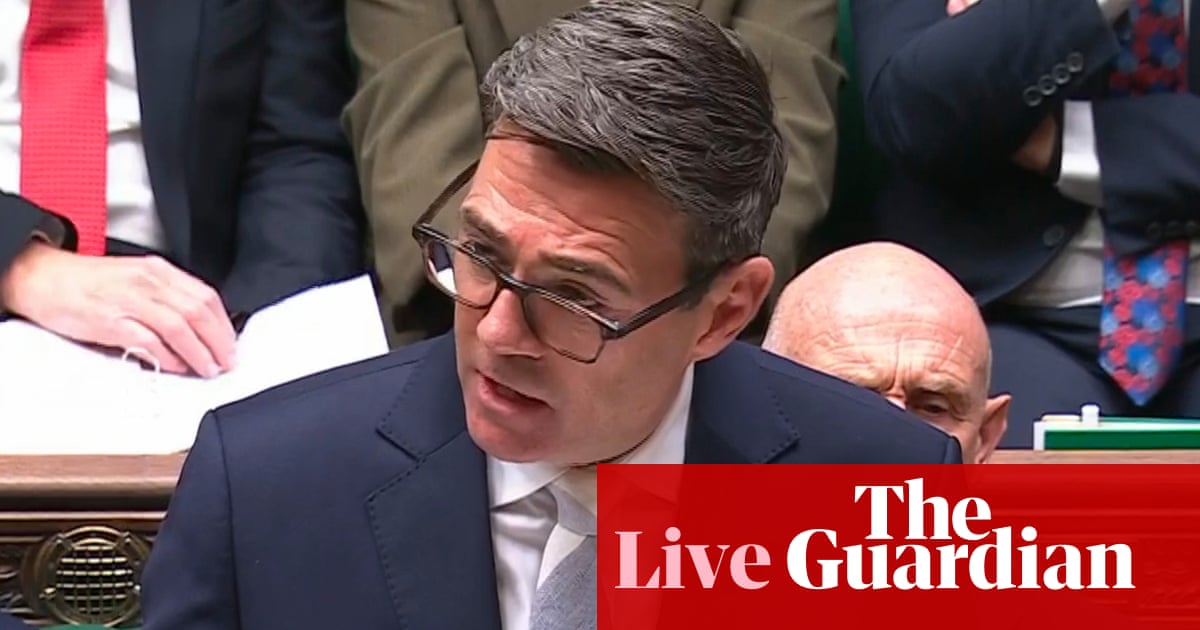
Burnham confirmed that he wanted to open a discussion about the UK’s future relationship with the EU.
If we are serious, if we are serious about promoting growth, controlling immigration, upholding our values and security, it is a conversation we must have.
The status quo is not good enough for Britain.
Worse, it would be a major dereliction of duty to turn away.
We need to take a calm, clear-eyed, rational look at the world as it is today to consider what is best for our country.
Our immediate priority is securing a successful outcome at the summit, and I believe we should then set up a serious dialogue about the different options for our relationship in the long term.
At every stage, the British public will be the boss, and I am clear that public opinion currently supports a pragmatic approach like the one I am suggesting.
-
Andy Burnham has told MPs that it would be a “dereliction of duty” not to seek deeper partnership with the EU. In a long statement to MPs, he repeatedly refused to rule out taking the UK back into the EU single market after the general election. But he also insisted that the British public would be the “boss” at every stage of renegotiating the relationship. He critcised the Brexit deal negotiated by the last Tory government and said, if the opposition were genuinely committed to growth, they would accept the need to revise it. He said:
If we are serious about promoting growth, controlling immigration, upholding our values and security, it is a conversation we must have.
For a full list of all the stories covered on the blog today, do scroll through the list of key event headlines near the top of the blog.
Lisa O’Carroll is a senior Guardian correspondent covering post-Brexit issues.
Labour’s Stella Creasy asked Burnham if he accepted that it was harder for the UK to control its borders because, after Brexit, it lost access to the Eurodac database, which contains biometric data about asylum seekers. Burnham accepted this was a big problem.
He told MPs:
We are in a weaker position when it comes to controlling immigration than we were, just over 10 years ago.
It is really important as we go into this next phase that all sides of the house support the British position when we go towards this negotiation.
Is any member of this house truly saying to me this afternoon that they do not want to have access again to that European immigration information?
If they are saying that they need to be honest about it.
Later Labour’s Chris Webb asked if the forthcoming EU-UK summit would allow the UK to regain better control of immigration. Burnham replied:
One of the most positive aspects of my meeting with [EU president Ursula] von der Leyen in New York was her openness to the conversation about restoring data sharing on immigration across the EU, across Europe. That is something that Britain has long sought in the decade since Brexit. It is the control that we lost, actually, at the time of the referendum.
It’s one of the issues that doesn’t get enough attention, and it should get more, and I can say to [Webb] I will work hard to see if we can get a practical arrangement on that very issue at the summit in November.
As well as losing access to Eurodac, which would allow the UK to swiftly identify if people claiming asylum in the UK had previously applied somewhere else in the EU, with Brexit the UK also lost access to the Schengen information systems, which provide alerts on criminals and stolen goods, and the European arrest warrant database, which provides immediate alerts about fugitives.
The Labour MP Jonathan Hinder, who represents Pendle and Clitheroe, asked Burnham to confirm that, as long as he remains PM, “there will be no return to freedom of movement”.
Burnham said that he would fully respect the Labour manifesto which ruled out joining the single market during this parliament. Being in the single market would mean the UK having to comply with freedom of movement for EU nationals.
But he went on:
What we have to look at are the options that are available for the long-term relationship. This country in the next decade needs to know where it’s going.
There are no assumptions here. And as I said in my [opening comments – see 4.01pm], the British public will be the boss of whatever, whatever is decided.
A few minutes later the Labour MP Melanie Onn, who represents Great Grimsby and Cleethorpes, said Burnham was evasive in his answer to Hinder. She asked Burnham for an assurance that, in his proposed renegotiation with the EU, the UK would not have to accept freedom of movemment, and would not have to “capitulate” and join the euro.
Burnham again sidestepped the question. He said:
As I’ve said many times this afternoon, we will honour the manifesto in full, and the red lines are in place.
Later the Conservative MP Saqib Bhatti said Burnham was evading the question. He asked Burnham for a straight yes or no: in any future renegotiation, would freedom of movement be on the table.
Burnham replied:
The honourable gentleman is getting way ahead of himself. There is no proposal for a referendum. There’s no deal on the table. All I have said is, as we go towards this negotiation, it makes sense to consider also our longer term options because it helps our European partners if they know where Britain wants to go in the future. That is all that is being said at this moment in time.
Richard Tice, the deputy leader of Reform UK, has Burnham if he could comment on “serious suggestions” that some of those arrested and bailed in relation to the RAF Fairford suspected bomb plot had Iranian diplomatic immunity.
Burnham said he would not go into detail. But he said the home secretary would make a statement about this later.
In the Commons Graham Stuart (Con) asked Burnham to give MP an unequivocal assurance that he considered the Brexit referendum result to be legitimate.
Burnham replied:
I will very much say so on the record. It was legitimate. I have always respected the result. I have never questioned its legitimacy.
But I am within my rights to point out where foreign actors are looking to interfere in British democracy.
Pippa Crerar and Jessica Elgot have been talking about the Brexit/Russia row on the latest edition of the Guardian’s Politics Weekly UK podcast. You can watch it here.
Andy Burnham had a formal meeting with Manchester City’s chair Khaldoon Al Mubarak at an investment summit, chatted to him in the stands at a star player’s testimonial game and was accompanied by staff from the club on official overseas visits, the Press Association reports. PA says:
Details of the prime minister’s contacts with the scandal-hit club and its Abu Dhabi owners during his time as Greater Manchester mayor were released by the combined authority.
Burnham told MPs that “all of my dealings” with Manchester City’s owners would be published.
A spokesperson for the Greater Manchester combined authority said:
In October 2021 Andy Burnham, in his role as mayor of Greater Manchester, had a formal meeting with Khaldoon Al Mubarak at the UK Government’s Global Investment Summit arranged by the Department for International Trade.
In his capacity as mayor, he was a guest of Manchester City FC at home matches on a small number of occasions, including attending Vincent Kompany’s testimonial match in September 2019, where he met the chairman informally in the stands. These have been declared in the usual way.
Also during his time as mayor, representatives of Greater Manchester sporting clubs would routinely join business delegations as part of mayoral international visits. This included representatives from Manchester United travelling to Austin and Dublin, Lancashire Cricket Club joining a delegation to India, and Manchester City FC staff supporting visits to China and Japan.
In the Commons Liam Byrne, the Labour chair of the business committee, asked Andy. Burnham to consider the case for new tariffs on Chinese imports.
He said:
The EU’s made-in-Europe proposals risks destroying any ambitions to re-industrialise our country. To avoid that peril, we are going to have to get serious with the EU in tackling unfair competition from China.
So will the prime minister reserve the right to introduce new tariffs on unfairly subsidised imports from China, so that British and European businesses have got a fair level playing field on which to compete?
Burnham replied:
I agree with him, though, that Made in Europe does present risks to British manufacturing, and I know he will have concerns about the automotive industry in the West Midlands.
I am raising those concerns with European partners. It is important that we get to an arrangement here that works for both the UK and the EU. After all, we are both trying to deal with the same issue, which is Chinese exports and the damaging effect that’s having on our industry.
So the way to approach this is to do it together, and that’s the case that we’re making to the EU.
In his response to Kemi Badenoch, Andy Burnham explicitly denied implying that the Brexit referendum result was illegitimate when he made his comment about Russian interference. (See 4.17pm.) The Conservative party has now issued a thoroughly misleading statement ignoring what he said. A spokesperson said:
The leader of the opposition just asked the prime minister, in light of his comments on Russian interference, if he thought the 2016 EU Referendum result was legitimate or illegitimate. Andy Burnham refused to answer.
There can be no doubt that his words to the Rest Is Politics were intended to cast doubt on the legitimacy of the referendum result. By not answering Kemi Badenoch’s question, Andy Burnham has all but conceded this was a deliberate ploy intended to sow more division, reopen the battles of the past, and bolster his own case for rejoining the EU.
This reads like the sort of statement which gets drafted in advance in expectation of one response in the Commons, and which then gets released anyway even though it doesn’t apply to what was actually said.
The former Tory PM Boris Johnson is also misrepresenting what Burnham said. He posted this on social media this afternoon.
This is just not true. As soon as I became foreign secretary I asked the security services the same question and they replied that there was no evidence of any successful interference in the 2016 referendum, by Russia or any other power.
Either the security services have changed their view – which would be very odd – or Burnham is lying about what he has been told. After all Starmer was in power for two years and had access to exactly the same information.
You can read what Burnham did actually say on the Rest is Politics at 10.33am.
Ed Davey also asked Burnham to bring together a coalition of countries willing to condemn President Trump for the deal he has agreed to buy Russian diesel.
Burnham ignored this question when he replied to Davey, but the Tory MP Roger Gale challenged him on it again later. Gale asked Burnham to unequivocally condemn “this act of treachery” by Trump.
Burnham replied:
I did make it clear in my statement that, when I heard news, I was immediately on the phone to President Zelenskyy offering any help that I could provide.
And I think where Britain can best provide help is in trying to bring people back together to get a solution that works for Ukraine. And you have to think about that more than anything in these circumstances – what will be most helpful?
Ed Davey, the Lib Dem leader, praised Burnham for his comments about Brexit. He said:
His predecessor turned a blind eye to the disastrous consequences of the Conservatives’ Brexit deal, so it’s welcome to hear him recognise that damage today.
We on these benches have consistently argued that their Brexit deal has made us all poorer, weaker and less safe.
So I’m glad the prime minister has arrived at the same conclusion as we have.
But now it’s time to do something about it.
Davey said that Burnham should not revisit the Labour manifesto red lines ruling out joining a customs union or the single market this parliament.
Burnham said he thought public opinion had shifted, and people now wanted a “pragmatic” approach to Europe.
But, he went on:
I also want to maintain trust in politics. And I’m afraid I’m not prepared to revisit the red lines. in our our manifesto.
Edward Leigh, the Conservative father of the Commons, asked if Burnham would view this as a reasonable statement. This is the statement he asked the PM to endorse.
I’ve been elected by my MPs to serve a full term of government. I’m going to get on with bread and butter issues such as the care system, pensions, asylum. And of course we would like a good, close relationship with our partners on security in Europe.
But I say this to the people – this is the prime minister speaking – I am very wary about reopening the whole Brexit wars …
And I give this absolute commitment that I would not seek to join the EU unless there was a general election first and I offer the British people a full referendum.
Burnham replied:
Can I say to the father of the house that I stand by every single one of those words.
I am not reopening the referendum. I respect the referendum result … but what I will do is take a pragmatic approach.
When I can boost growth in the British economy, when I can increase cooperation to get a grip on the boat crossings across the channel, I will do those things where I believe they can be in the country’s best interests.
Burnham rejected Badenoch’s claim that his comment about Russia on the Rest is Politics podcast meant he did not accept the legitimacy of the Brexit referendum. He said “no such thing”, he told MPs. He went on:
It is a matter of record that Russian actors sought to interfere in the 2019 general election. And we think it is inconceivable that this was the first time.
In his response to Badenoch, Burnham said that her comments about the proposed EU-UK deal revising the Brexit settlement implied that she wanted to preserve the status quo.
He went on:
I’m sure I heard her say at her conference that increasing growth would be the operating principle of any government that she leads.
So how can she justify turning her back on a deal that is potentially on the table now to add billions to the UK economy? How can they justify turning their back on farmers and the food industry?
And referring to her attack on his negotiating tactics, Burnham added sarcastically: “Because the Tories were so good, weren’t they, at negotiating deals with our with our partners?”
Disclaimer : This story is auto aggregated by a computer programme and has not been created or edited by DOWNTHENEWS. Publisher: theguardian.com




