Staff writers
Updated ,first published
The Australian sharemarket has opened on a weaker note after a selloff in chipmakers left US stocks wavering ahead of the reporting season, with Wall Street recording its slowest session this year.
The S&P/ASX 200 was down 27.70 points, or 0.3 per cent, to 8755.50 shortly after 11am AEDT, with eight of its 11 industry sectors in the red. Miners and tech stocks led the early losses, while energy stocks and defensive sectors advanced. The ASX added 0.8 per cent on Monday.
The Australian dollar was trading at US69.53¢.
Australia’s big mining giants set the tone for early trade, with iron ore and copper giants BHP (down 1.7 per cent), Rio Tinto (down 2.4 per cent) and Fortescue (down 2.5 per cent) all in retreat amid concerns the exacerbating energy crunch resulting from the wars in the Middle East and Ukraine-Russia will weigh on global growth and demand for its exports.
Brent crude futures hit a two-week high overnight amid a crumbling Russia-Ukraine “energy ceasefire” and a new round of Houthi attacks in Saudi Arabia, with the international oil benchmark settling near $US107. A barrage of drone and missile attacks by Iran-backed Houthi militants on Saudi Arabia’s main airport has intensified pressure on the United States to step up its efforts in the conflict in Yemen.
Meanwhile, there were doubts over President Donald Trump’s claims of an “energy ceasefire” between Russia and Ukraine. Ukraine will continue attacks against Russia as Moscow keeps targeting its energy infrastructure, President Volodymyr Zelenskyy said.
The tensions also weighed on gold miners Northern Star and Evolution, which were down 0.4 per cent and 1 per cent, respectively, in early trade. Gold prices dipped overnight from a one-week high as traders assessed what the oil price swings mean for the Federal Reserve’s interest rate path. Silver miner South32 slumped 3.3 per cent as silver prices fell 1.1 per cent.
Gold is down by about 20 per cent since the Iran war started in late February as disruptions to global energy supplies quickened inflation and prompted central bank tightening. Higher rates are typically a headwind for the non-yielding precious metal.
Tech stocks were the other big decliners, tracking losses by their peers on Wall Street. Electronic components maker Codan, the biggest tech stock on the ASX, dropped 1.6 per cent. Software makers WiseTech, Xero and Technology One slumped 3.6 per cent, 1.9 per cent and 3 per cent, respectively, while AI data centre operator NextDC fell 2.7 per cent.
On the winning side, energy stocks had another strong morning on the back of the jump in oil prices. Oil and gas giant Woodside rose 1.6 per cent, its biggest rival Santos climbed 2.5 per cent and refiner Ampol added 1.4 per cent.
Defensive industries such as utilities and consumer staples also benefited from the rise in tensions, with power companies Origin and AGL up 2.5 per cent and 0.9 per cent, respectively, while supermarket chains Woolworths and Coles edged up 1.1 per cent and 0.9 per cent.
The key financial sector, which accounts for more than a third of the ASX, also helped limit losses on the local bourse. All four big banks were in the green. Commonwealth Bank and National Australia Bank both added 0.6 per cent, Westpac edged up 0.3 per cent and ANZ Bank rose 0.4 per cent.
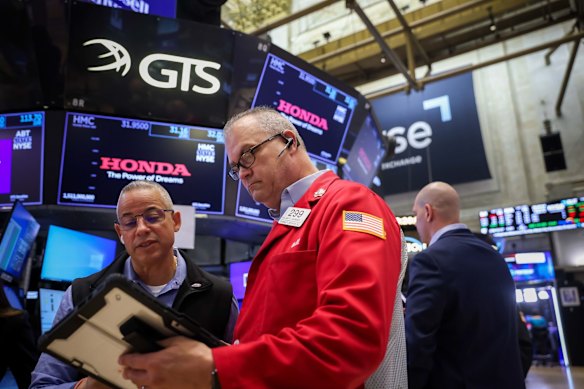
In New York overnight, Wall Street kicked off a busy week with a mixed finish for its major stock indexes, although the market remained near its all-time high. The trading volume was the lowest in 2026, however, as traders stayed on the sidelines before the start of the US earnings season.
The S&P 500 slipped 0.1 per cent after fluctuating between small gains and losses. The benchmark index set a record high on Friday and is up 14 per cent so far this year. The Dow Jones Industrial Average rose 0.4 per cent, and the Nasdaq composite fell 0.4 per cent.
Wall Street’s equity bull run completed its fourth anniversary, with the S&P 500 up nearly 120 per cent from the 2022 bottom. Investors are bracing for high-stakes corporate results that will be crucial to sustaining the rally. Profit resilience helps explain why stocks have remained so strong, said Bret Kenwell at eToro.
“Growth has been powerful enough to keep valuations in check and allow investors to look past higher yields, interest rates and inflation,” he added. “Another strong quarter could reinforce the bull narrative intact into year-end, while a disappointment could catalyse a broader pullback.”
Shares in roughly 64 per cent of the companies in the S&P 500 rose, led by communication services stocks. Meta Platforms rose 3.4 per cent, T-Mobile added 2.2 per cent, AT&T gained 1.4 per cent and Verizon Communications rose 2.7 per cent.
Energy stocks had some of the biggest gains as oil prices kept rising. Chevron rose 1.4 per cent.
Despite those gains, a slide in big technology stocks dragged the market into the red.
Micron Technology fell 3.9 per cent, Advanced Micro Devices dropped 2.3 per cent, Broadcom slid 1.9 per cent and Nvidia gave up 1.3 per cent. They are among several companies in the sector with big stock values that tend to have a heavy influence on the market. They have also been the driving force behind the broader market’s record gains throughout the year.
Those companies could face more scrutiny from investors during this round of corporate earnings as Wall Street tries to get a better sense of whether the stock gains made during the frenzy over artificial intelligence can translate into future growth.
“AI continues to support growth, reinforcing the outlook for tech and critical suppliers across the supply chain,” wrote Magdalena Ocampo, market strategist at Principal Asset Management, in a report. “Yet uncertainty about AI’s long-term impact persists, making future gains more reliant on earnings delivery rather than potential.”
Facebook and Instagram owner Meta bucked the trend after it released a long-awaited artificial intelligence model, a milestone that will test whether its multibillion-dollar push to rebuild its AI organisation has improved its technology enough to compete among leaders.
Known as Muse Wonder, the new model is the company’s most capable since chief executive officer Mark Zuckerberg overhauled his AI operation through an aggressive hiring push that put new talent at the helm. The company claims the model, dubbed “Watermelon” internally, is a big leap over its own predecessors, with “frontier capabilities” that its leadership say put it on par with OpenAI’s ChatGPT and Anthropic PBC’s Claude when it comes to coding, or working through financial or legal questions.
Stocks are reaching for records often because of the tech sector, but remain very volatile on a daily basis, partly because of big shifts in oil prices and their impact on bond yields and inflation.
The surge in energy prices and its impact on the broader economy will be a key focus this week as Wall Street reviews several important economic updates. They include fresh data on the housing market, inflation and retail sales.
The big updates this week involve reports about inflation hitting consumers and businesses. On Wednesday, the government will release the closely-watched consumer price index, or CPI, which measures price changes for a wide range of products and services. Economists expect the index to show the rate of inflation worsened to 3.6 per cent in September from 3.4 per cent in August.
A report on inflation called the producer price index will be released on Thursday and is also expected to show that inflation remains stubbornly high. It measures inflation faced by businesses before it hits consumers.
An update on how consumers are reacting to high prices will be released on Thursday. Economists expect the report on retail sales for September to show that households pulled back on spending.
The rate of inflation by any measure remains well above the Federal Reserve’s target rate of 2 per cent. That prompted the central bank to raise its benchmark interest rate at its last meeting in an effort to cool inflation. Wall Street expects another rate hike before the year ends.
Inflation and expectations for high interest rates have been driving Treasury yields higher in the bond market. The 10-year Treasury yield, which influences mortgage rates, recently touched its highest level since 2002. It has since eased a bit and stood at 5.24 per cent late on Friday. US bond trading was closed Monday for the Columbus Day holiday.
Higher mortgage rates have been weighing on the housing market and Wall Street will get an update on home sales on Tuesday.
The latest round of corporate earnings updates ramps up this week with financial results from banks. Citigroup, JPMorgan Chase and Wells Fargo will report their results on Tuesday and Bank of America will report its results on Wednesday. They have been reporting record profits throughout the year and Wall Street expects more of the same for the latest quarter.
Markets in Europe gained ground and markets in Asia were mostly lower. Markets in Tokyo were closed for a holiday.
with AP, Bloomberg
The Market Recap newsletter is a wrap of the day’s trading. Get it each weekday afternoon.
From our partners
Disclaimer : This story is auto aggregated by a computer programme and has not been created or edited by DOWNTHENEWS. Publisher: www.smh.com.au