
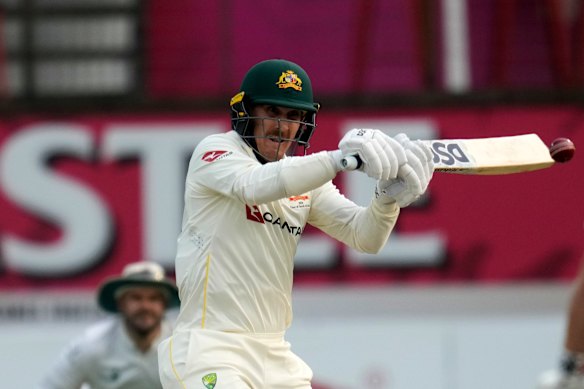

The pitchforks were out for Australia’s chairman of selectors George Bailey when Nic Maddinson trudged off for an ugly 33-ball duck on day one of the first Test against South Africa in Durban.
After being carved up by Matthew Hayden for “promoting the greatest pile of mediocrity that we’ve seen in a generation of cricket” by selecting Maddinson – who is without a first-class match to his name in 579 days – you suspect Bailey may have been feeling a little uneasy sitting in the Australian dugout.
With Australia 6-124 after winning the toss and batting, Bailey would have been edgy.
Three days later, Maddinson (0 and 48) has scored more than twice as many runs as his opening partner and established star Travis Head (9 and 11).
No.5 Matt Renshaw, initially brought back into Australia’s team to open before being shuffled down the order, has amassed 272 runs (190 and 82), the fourth-highest aggregate by an Australian batsman in a Test at that position.
Only Doug Walters (345 runs against the West Indies in 1969), Michael Clarke (329 against India in 2012) and Sir Donald Bradman (304 against England in 1934) have managed more.
For all the heat selectors cop – and it comes with the territory – Bailey and friends deserve their flowers when they’re warranted.
It’s also a reminder that criticism is sometimes best reserved until the end of a Test, or at least until there’s a reasonable sample size.
Australian cricket fans were quick to declare Maddinson’s selection to be bone-headed. To be fair, there were legitimate questions about whether he deserved a place in the XI, given his lack of recent red-ball cricket. The NSW captain added to that by conceding before the Test that he was surprised to be called up.
His first innings wasn’t good, but all batsmen fail in Test cricket. Even Don Bradman didn’t pass 25 in nearly a third of his Test innings.
Declaring Maddinson’s return a resounding success is a massive stretch, but it certainly wasn’t a failure.
In some ways, a 33-ball duck is worse than a first-ball dismissal, but Maddinson is too good a player to miss out twice.
In the second innings, he took the game on with a swashbuckling 48 off 38 balls, ensuring South Africa had little chance of clawing their way back.
Maddinson’s match tally isn’t anything to write home about, but context matters.
Had he and Head both fallen cheaply, another top-order collapse might have given South Africa a sniff of victory. Instead, Maddinson’s counter-attack helped keep the hosts at arm’s length.
The Renshaw selection could not have gone any better. He could have been retained as an opener, but the No.5 spot suited his game beautifully.
His breakthrough century, and equally impressive second-innings performance, will be talked about for years. The only problem is that he now joins a growing queue of Australian batsmen wanting the coveted No.5 spot.
It has been a profitable position lately, with the injured Cam Green’s century against Bangladesh, albeit in a losing cause, giving him every reason to want that spot back once back to full health.
Then there’s Head, Australia’s dominant force at No.5 for several years before being promoted to open because of Usman Khawaja’s troublesome back in Perth.
Head was brilliant during last summer’s Ashes, but since the second innings of January’s SCG Test has registered scores of 29, 22, 17, 22, 9 and 11.
It’s difficult to imagine him turning down an opportunity to return to No.5 if Australia can solve their openers conundrum.
They got the batting right this time, but the selectors will still have to earn their money over the next two Tests with more variables to consider. Will Steve Smith be ruled out with concussion? Is Green fit? If one or both are unavailable, who comes in? And does Renshaw’s mountain of runs make him impossible to move from No.5?
These are good headaches to have, particularly when Australia is winning.
Bailey won’t get every call right, no selector does. But the rush to condemn Maddinson after one innings was a reminder of how quickly opinions harden in Australian cricket.
Winning Test matches builds a buffer that keeps the wolves at bay.
The selectors can be criticised for their methods, their timing and their occasional left-field calls. But ultimately, they are judged on results.
And right now, Bailey certainly has more reason to smile than when Maddinson walked off for a duck on Friday in Durban.
 Tom Decent is the chief sports writer for The Sydney Morning Herald.Connect via X or email.
From our partners
Disclaimer : This story is auto aggregated by a computer programme and has not been created or edited by DOWNTHENEWS. Publisher: www.smh.com.au



