
Ronnie Mulitalo – and thousands of New Zealand supporters – are expected to be at their heckling best on Thursday night when the World Cup opener is played in front of the biggest rugby league Test crowd in Sydney in more than 50 years.
Officials confirmed on Tuesday just under 40,000 tickets had been sold for Thursday night’s blockbuster, with Allianz Stadium’s capacity at 42,500.
The biggest Sydney attendance for an international in the NRL era was 34,571 when New Zealand and Australia played in the 2008 Centenary Test at the SCG. The last sellout was 1974 when 55,505 fans saw the third Test between Australia and Great Britain, also at the SCG.
To appreciate how much belief there is in Stacey Jones’ Cup squad, New Zealanders have bought thousands of tickets in the hope their nation can cause an opening-game boilover.
The Kangaroos will not only try to block out the noise from the Moore Park stands, but also the left wing where Mulitalo will be heckling the Kangaroos.
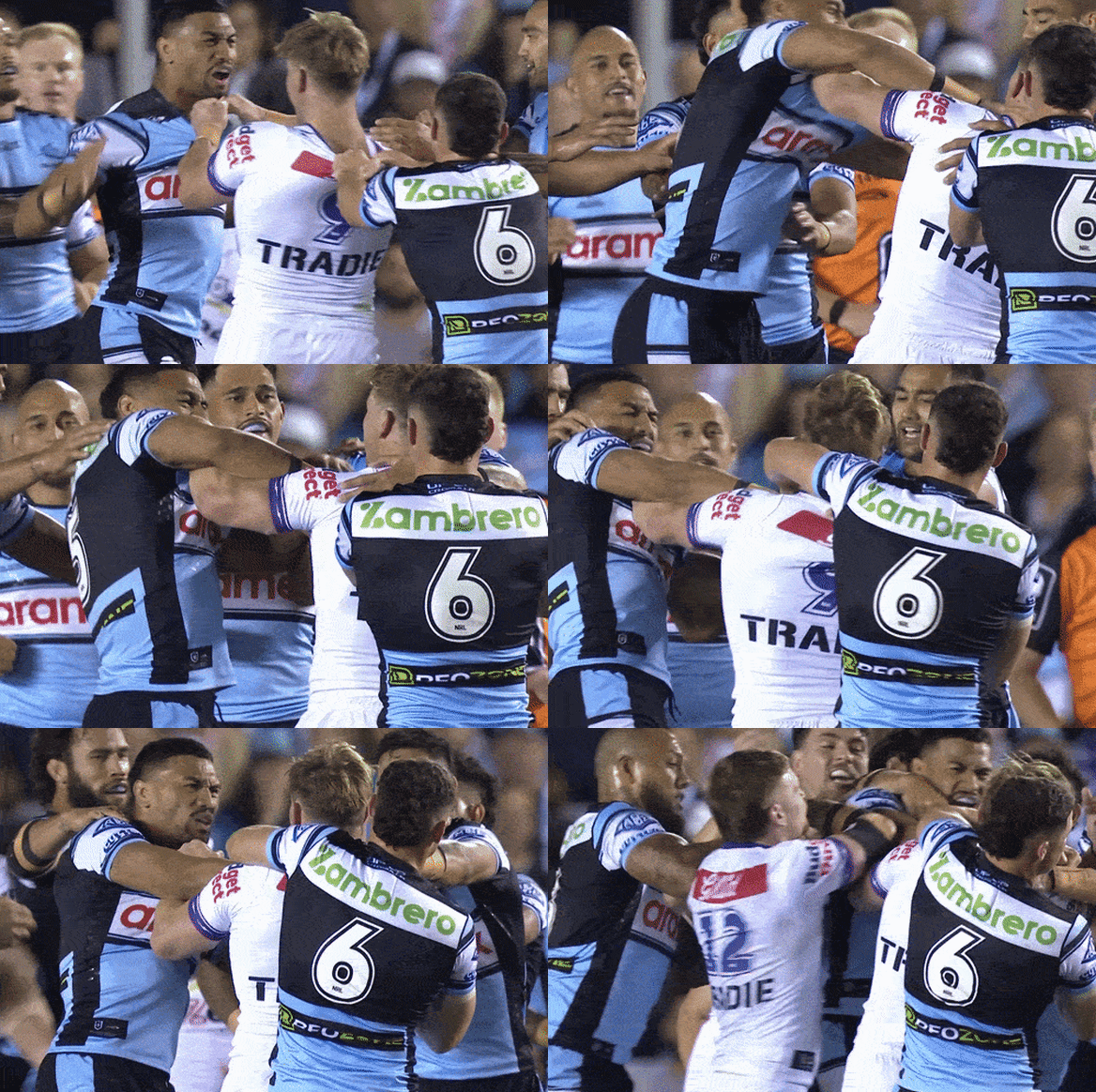
Mulitalo is one of the biggest nigglers in the game, and the last time he went up against Melbourne and Kangaroos’ No. 9 Harry Grant, he slapped him in the face and was given 10 minutes in the bin.
“He’s one of those players you don’t necessarily like playing against because he’s so loud and always letting you know about it – to be on the same team as him is awesome,” Kiwis’ playmaker Kodi Nikorima said about Mulitalo.
“The first day he came into camp, he was into Moses Leota about being on the end of a ‘KP’ [Kalyn Ponga] hit.
“He’s full of energy, he’s a competitor, and that’s what we love about him.
“He knows his strengths, and getting under the boys’ skin is one of them. What you see is what you get.”
Fellow Kiwi Joseph Tapine described Mulitalo as “one of the best blokes off the field, but one of the worst to play against”.
Kangaroos captain Isaah Yeo said some players thrived on being on the end of verbal barbs, while others were just as happy to shut it out.
“At this stage [of your career] you should know what helps you play your best football, whether that’s going back at them, or worrying about your own game – it’s up to the individual,” Yeo said.
“I think we’re experienced enough at this level, playing for your country, you do whatever makes you perform at your best.
“I don’t get caught up in it because it doesn’t help me play my best, but for someone I’m sure it will.”
The likelihood of a rare sellout in Sydney was proof international rugby league was the strongest it had been, according to ARL Commission executive chairman Peter V’landys, whose organisation revamped State of Origin eligibility rules this year to strengthen the global contest.
Queensland pair Ponga and Dane Gagai will represent New Zealand for the first time, while Victor Radley was allowed to represent NSW this year after already playing for England.
“I grew up with international rugby league, and to bring it back to the magnitude it is now, has been a major objective of the commission,” V’landys said.
“The interest in international rugby league is there, and it will only continue to grow. What’s happened the last few years is countries have developed their squads, particularly Samoa and Tonga, so any of them can win it. It’s the most open World Cup we’ve had in a long time, and it’s not dominated by Australia.”
From our partners
Disclaimer : This story is auto aggregated by a computer programme and has not been created or edited by DOWNTHENEWS. Publisher: www.smh.com.au