
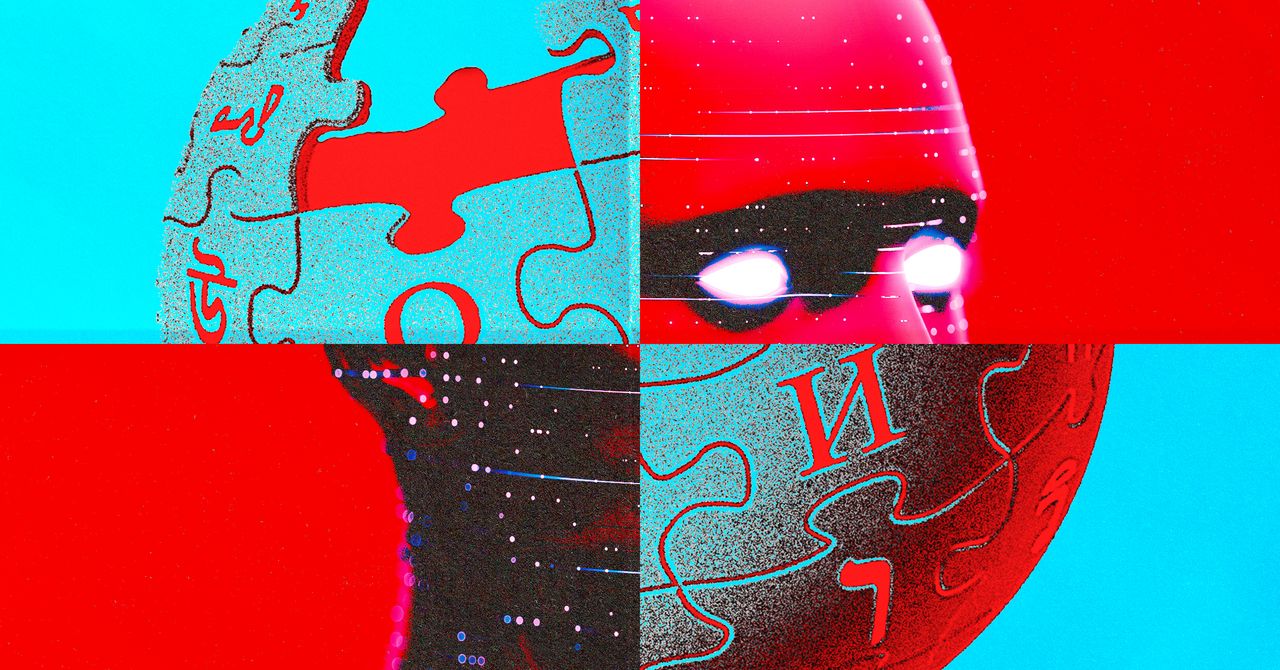
Long before the storm of AI struck Wikipedia, the Wikimedia Foundation was making preparations. Wikipedians battened down the hatches and made confident-sounding predictions that it would break and wash over them. Large language models might even improve Wikipedia, it was said, automating more of the housekeeping—formatting, sources, citations, missing links—and so freeing up humans to do creative work. It was not so simple. In 2019, then-Wikimedia Foundation head Katherine Maher wrote an op-ed in The New York Times under the headline “Without Humans, A.I. Can Wreak Havoc.” “Too often,” she wrote, “artificial intelligence is presented as an all-powerful solution to our problems, a scalable replacement for people.” The issue confronting Wikipedia, retaining human control over machines, was the same one soon being faced everywhere.
Already in 2018 Google was training AI to write “Wikipedia-like articles,” and by October 2024, a Princeton University study found that about 5 percent of nearly 3,000 newly created articles on English Wikipedia in a single month (August 2024) contained a substantial amount of AI-generated content. There were signs. ChatGPT was fond of em dashes—parenthetical statements that look like this one—and curly quotation marks. Sometimes, residues from the prompts used to compose articles were left behind (“Here is your Wikipedia article,” they might say.)
At first, Wikipedians tried to shape and control AI, to make its output “acceptable and constructive,” or to fix or remove if it proved otherwise. Generic fluff like “praising a village for its fertile farmlands, livestock, and scenic countryside” and fake sources were weeded out. By March 2026, AI content was found to violate its core principles so often that writing with large language models was banned outright, and their role restricted to translation and minor proofreading.
A much-read essay titled “Death of Wikipedia” explained this defensive posture. It predicted a ripple effect: As contributors reduced their contributions in response to AI pervading the platform, there might be a temptation to replace their work with still more AI, creating a downward spiral. One viral X post lamented that artificial intelligence seemed to be changing things in the wrong direction: “I want AI to do my laundry and dishes so that I can do art and writing, not for AI to do my art and writing so that I can do my laundry and dishes.” The “Death of Wikipedia” warned against something similar: Rather than AI performing Wikipedia’s “housekeeping” roles, it might compose its articles instead, leaving humans relegated to formatting and cleanup. The result would trap editors in an endless curatorial project derived not from human priorities but from the frostbitten harvests of machines.
“The potential ‘whittling down’ each year of our pool of talented writers is the greatest threat to Wikipedia,” another Wikipedian wrote, “as we must increase the number of editors, especially expert editors, to be able to fix the sprawling hellscape of weak, inaccurate and incomplete articles that drag down the project.” A Wikipedia written and read by machines threatened to create a new, deracinated Wikipedia, stripped not only of its context, but of its animating passion. It would be artless, and soulless. When the Wikimedia Foundation says that the care and commitment of Wikipedians to “reliable encyclopedic knowledge is something AI cannot replace,” that is not the same as saying that it will not be replaced.
Once Google introduced AI Overviews in search, they quickly became as central to the experience as Wikipedia was until recently. (This also means Wikipedia still does play a crucial role as a source, only at one step removed.) Anyone who uses AI agents knows that they give plausible, almost intuitive answers, which can pass a superficial review of their sourcing. They are also often wrong. If Wikipedia itself becomes corrupted by artificial intelligence, by what means will we prove when they are wrong?
Implicit in the idea of a single, machine-edited encyclopedia to rule them all is that such a phenomenon should act as a final authority. Its appeal, to the kind of people who find it appealing, is that it will be coolly rational, a kind of digital King Solomon that can act as a disinterested arbiter. There is no reason to think such cold logic would not be cruel instead. Its aesthetic failings are a clue: “Slop” is a useful word for the product of artificial intelligence, which implies something unvariegated and monotonous, absent not only of nutritional value but also of the flavor that makes nutrition a pleasure.
There is also no reason to believe an AI encyclopedia, or any other encyclopedia, should be unifying. Whatever its shortcomings and eccentricities, Wikipedia is the closest thing to an “encyclopedia of everything” we have ever had. Once smartphones became widespread after the iPhone’s launch in 2007, the old speculations, however far-reaching, were realized: Wikipedia was costless, portable, immediate, and electric. Enormous and omnipresent, it really became an approximation of the “sum of all human knowledge.” But so what? What did access to this oracle mean for human flourishing? What good has Wikipedia done?
A documentary maker, wanting to bring Wikipedia’s story to the screen, asked me a sharpened version of this question. Yes, Wikipedia was the little encyclopedia that could. It had overcome humble origins to become massive. But the dictates of streaming television needed something more. Were there, she asked, any real-life episodes where Wikipedia had “saved the village”? Has Wikipedia saved lives? The answer is “probably,” though not in dramatic or famous ways. Quick-fire encyclopedic knowledge has helped with accidental poisoning, and there are signs that Wikipedia is accessed with special frequency during natural disasters. But these anecdotes are difficult to corroborate, and often, when Wikipedia’s role is scrutinized, it turns out to be incidental. If someone calls for help in an emergency, it is not the phone which is the hero.
Does Wikipedia perform a public good? This seems self-evident but is much harder to measure and, in a way, is out of the project’s hands. In 2013, when an online poster posed the question “If someone from the 1950s suddenly appeared today, what would be the most difficult thing to explain to them about life today?” the top answer went viral as a mordant sign of the times: “I possess a device, in my pocket, that is capable of accessing the entirety of information known to man. I use it to look at pictures of cats and get in arguments with strangers.” Elsewhere, the “arguments with strangers” line was expressed in less lighthearted ways. “The greatest threat to democracy may no longer derive from human agency but from new forms of technology, which have the capacity to undermine democracy without anyone having intended it,” the academic David Runciman wrote two years later. “The forces from which democracy needs rescuing are no longer pressing on it from the outside. They come from within.”
No one is credited with foreseeing Wikipedia more clearly than H. G. Wells, a reputation built on a series of essays collected in his book World Brain, and its advocacy for a “Permanent World Encyclopaedia.” But Wells expounded on this idea many times, and his other writings were much more equivocal, and he even satirized his own obsessions in The Camford Visitation: “He wants a universally educated world, educated on the same lines, with every artificial difference eliminated. He is a cantankerous, disagreeable little nobody and yet at times one feels he has got hold of something most exasperatingly vast and right.” Soon after World Brain was published, Wells had lost faith in his encyclopedic vision altogether and succumbed to late-life pessimism. Humanity had orchestrated to create a world war, not a world brain, and in the civilizational race between “education and catastrophe,” as he put it, catastrophe looked to have a winning lead.
Less obvious to us now is that World Brain was also an antidote. The most significant new European encyclopedias that preceded it, the Great Soviet Encyclopedia and the Enciclopedia Italiana, were direct expressions of nationalist and totalitarian intent, so much so that the entry on “Fascism” in the Enciclopedia Italiana was credited to Benito Mussolini himself. Wells understood that “internationalism” needed its own encyclopedia as a counterweight, but that did not make it a simple force for freedom. He assumed that the World Brain would assist a world government in projecting its power, and though democratically available, his Permanent World Encyclopaedia would make such a world government omnipotent. A world government that was all-seeing as well as all-knowing would inevitably be repressive; a sinister side to Wells’ ideas seemed to have partly inspired George Orwell’s Nineteen Eighty-Four.
Orwell also critiqued Wells more explicitly in his 1941 essay “Wells, Hitler, and the World State.” One of its more perceptive observations is that Wells was not, in fact, a futurist. He was a nostalgic, Orwell thought, a “nineteenth-century liberal” who had spent 40 years repeating the same idea: that history was a battle between “the man of science who is working towards a planned World State” and “the reactionary who is trying to restore a disorderly past.” With Orwell’s help, we can see that Wells’ World Brain was an old idea, not a new one. Versions of it had preexisted Wells by centuries, and this particular encyclopedic worldview sprang from his Edwardian conception of Progress with a capital P.
The encyclopedia handed down to us from the Enlightenment is much more than a collation of facts in a book or on a website. It is a whole mode of seeing and doing, a lens through which a clear, scientific vision of all things can come into view, unobstructed by superstition. Witness the world in this way, and the world changes. So far-reaching is this idea that the philosopher Alasdair MacIntyre classed “encyclopaedia” as one of the three major approaches of Western ethics, what he called “rival versions of moral enquiry.” The others were “tradition,” starting with Thomas Aquinas and Aristotle, and “genealogy,” which began with Nietzsche. Tradition was a marriage of faith and reason. Genealogy emphasized hidden power relations. Encyclopaedia relied on reason alone, trying to build an objective picture of the world that could determine how to act, thanks to a consensus version of the truth. The purest expression of this was to be found in the 19th century, in the ninth edition of Encyclopaedia Britannica, which promised “the available facts of human history, collected over the widest areas … carefully coordinated and grouped together, in the hope of ultimately evolving the laws of progress, moral and material, which underlie them.”
When Three Rival Versions of Moral Enquiry was published in 1990, MacIntyre’s notion was already criticized for being out of date. One reviewer complained that it saddled “the encyclopaedists with their 19th-century dogmatic statements in Britannica and plays down the fact that few if any of their heirs hold such views today.” Yet there were some places that rational-liberal outlook did survive in an unapologetic form. It remained at the very forefront of Encyclopaedia Britannica—the 1987 edition opened with the motto of its associate, the University of Chicago: “Let knowledge grow from more to more and thus be human life enriched.” Most pertinently, it undergirded the beliefs of Wikipedia’s cofounders. Not only did Wikipedia’s text-heavy format reflect a centuries-old Enlightenment tradition, it was also created by two men who still believed, earnestly, that discovering the facts and learning lessons from them was not only the purpose of an encyclopedia, but the central task of a life well lived.
The divergent paths of Jimmy Wales and Larry Sanger offer a kind of parable for the fate of this worldview and the cultural crosscurrents that swamped it. Twenty-five years after Wikipedia’s founding, Wales is still a Davos Man, an international person for an international project, who lives in the capital of the United Kingdom and makes frequent criticism of the MAGA movement. Sanger never left Ohio, where he homeschooled his children, became a vocal vaccine skeptic during the Covid-19 pandemic, and voted for Donald Trump. In 2025, he announced that he had given up his long-standing agnosticism to become a professing Christian, and wrote a book-length philosophical proof for the existence of God. If Wales remained wedded to the MacIntyre-style notion of “encyclopedia”—Enlightenment rationalism, with an added Objectivist trim—Sanger had returned to “tradition.”
As Wikipedia affirmed its status as a knowledge institution, it also lost its immunity from the crises afflicting knowledge institutions everywhere. The only surprise was that it had been exempt for so long. At the end of her tenure as head of the Wikimedia Foundation, Sue Gardner had likened the experience to living on a peaceful tropical island as “cruise missiles flew overhead.” Culture war had broken out all around, and now Wikipedia was an island no more. In the 2010s, “disinformation,” “misinformation,” and “fake news” were all selected as words of the year in short order, and the saturation of information was just as blameworthy as its corruption. Instead of adjudicating between facts like judges, audiences acted like lawyers assembling a brief and took only what they wanted. The results of “doing your own research,” an off-kilter version of the Enlightenment demand “dare to know,” were algorithmically personalized pseudo-informational systems. Mired in this uncertain environment, Wikipedia approached its 25th anniversary facing unprecedented political, cultural, and technological threats.
All of this added an elegiac note to its birthday celebrations in January 2026. The Pew Research company marked the occasion by quantifying the encyclopedia’s staggering reach—in the decade between 2015 and 2025, Wikipedia had been viewed 1.9 trillion times, an average of 508 million views per day. These immense numbers nevertheless contained an unmistakable arc of decline. In the days prior to the anniversary, a long-time Wikipedian, Christophe Henner, published a long and detailed “wake-up call” for the Wikipedia movement. Since 2022, the encyclopedia had lost almost a quarter of its readership, more than 1.1 billion visits per month, a missing audience who, presumably, were seeking out AI summaries instead. Even when answers offered by AI agents contain links, readers tend not to follow them: One figure showed that the click-through rate from AI chatbots was only 0.33 percent; for the Google search engine, it had been closer to 9 percent. For a model whose lifeblood was readers becoming editors, it was a disaster.
Artificial intelligence was an existential risk to Wikipedia, Henner warned, and the encyclopedia risked being remembered as a “historical artifact that AI once trained on … a footnote in the training data of models that have moved on without us.” An editing crisis meant that fewer and fewer editors were performing more and more labor, “a smaller club working harder to maintain something fewer people see,” as he put it. Past moments of opportunity—for example, when Wikipedia might have harnessed the growth of the internet outside Western countries—had mostly been squandered. The energy generated by places like India and Nigeria going digital had passed Wikipedia by, and in the wake of all this, the encyclopedia risked becoming a “temple,” maintained by the last in a priest class of superannuated Wikipedians. Once sacrilegious ideas, like paying editors for their work, had to be considered anew. Otherwise, the whole of Wikipedia might be reduced to an abandoned cathedral.
Media coverage marking the occasion was just as bittersweet. In Nature, Dariusz Jemielniak wrote that “academic indifference” and artificial intelligence threatened Wikipedia’s survival, accusing agentic AI of exploiting a “parasitic relationship” that “endangers the last bastion of freely accessible, human-curated knowledge and undermines the premise of collaboration on which many of Wikipedia’s knowledge-sharing practices rely.” “Wikipedia’s Existential Threats Feel Greater Than Ever” was the headline for a Stephen Harrison piece in WIRED, a catalog of threats beleaguering the project. More dangerous than hostile think tanks and lawmakers was an increasingly indifferent public, slowly drifting away from its founding ideals. “Economic precarity [has] trained many Gen Zers to see any unpaid labor as a scam,” Harrison wrote. In the cold light of the dawning era, becoming a Wikipedia super editor during a period of unemployment seemed a distant luxury, or outright perplexing, “thankless work that AI companies strip-mine for a profit.”
The tide turning on Wikipedia was more than the advent of artificial intelligence or a fragmentation of reading habits. Christophe Henner thought the “AI summaries” were only a “convenient explanation.” “I’m skeptical,” he wrote:
Even this undersold the quantum of change. Something far older was fast losing relevance as well: It was the beginning of the end of the encyclopedic age. Near the front of the French Encyclopédie there is a diagram called the “figurative system of human knowledge,” which is now sometimes called “The Tree of Diderot and d’Alembert.” The Tree is a system for not only ordering “the parts of knowledge,” but connecting them in a logical chain so long it can wreath the universe. It represents a bold idea: that an encyclopedia’s unifying force will show how everything in existence is linked. It suggests that knowing everything will lead to knowing One Big Thing about everything. This old-fashioned idea was resuscitated in the computer age, and gathered momentum with the concept of AGI, artificial general intelligence, the moment machines surpass every form of human understanding. If realized, it will represent not only the end of encyclopedias, but their culmination. Human-written encyclopedias will still exist after AGI, but only as secular scriptures in the mind of a digital god.
The longest-standing critique of “encyclopaedia” is religious: It is the belief that human activity on a godlike scale is a doomed act of conceit. It was only during the Enlightenment that absolute knowledge came to be considered beneficial (and today, “know-it-all” is still an insult, not a compliment). Beforehand, desire for absolute knowledge was viewed as a sin or a crime, a proscription that continues in many cultures. Greek mythology is full of cautionary figures like Pandora and Prometheus, who knew too much and suffered for it; when the Norse god Odin seeks the sacred well waters granting wit and wisdom, a single drink costs him one of his eyes. In the very first book of the Bible, two different stories, the Tower of Babel and the Garden of Eden, carry variations on the same moral: Total understanding must be God’s alone. Curiosity is not only a sin, but the first sin.
One of the many artworks inspired by Wikipedia speaks to this phenomenon. In the 2010s, the bio-artist Joe Davis declared that he would engineer a real, living Tree of Knowledge, the tree described in the Bible that holds forbidden fruit and results in the fall of humankind. To do so, Davis planned to take a 4,000-year-old strain of apple trees and copy the English-language edition of Wikipedia into the letters of its DNA. He called the project Malus ecclesia, which in Latin is a pun that means both “evil church” and “apple tree church.” In interviews, Davis refused to say whether he would eat the Tree’s fruit; because of laws around genetic modification, ingesting an apple or even planning to may have been a criminal act. Mired in red tape, this tantalizing idea never came to fruition, but its forbidding message remains: The sum of all knowledge is cursed.
The real existing Wikipedia feels less melodramatic than that, and the most lasting dividend of Wikipedia may not be its contents but its process, which holds a promise quite unlike the Tree of Knowledge or even the Tree of Diderot. For years, the annual Wikimania conference has sustained a fledgling tradition: At the opening ceremony, Wikipedians wear their national dress. When almost three-quarters of the nations on earth are in attendance, this produces a real spectacle, even against a backdrop of convention center carpet. All around the room are people wearing hanboks and kaftans and kimonos (the practice was initiated by a Japanese Wikipedian), and when they intermingle, the effect is like those old, quaintly hopeful pictures canvassing the “Peoples of the World.” Appreciating the depth and variety on display takes longer. Those golden headdresses, called serimpak, are worn by the seafaring tribes of Borneo, and that is why they are shaped like ships. The chapan robes that seem to swirl under their resplendent colors are from central Asia; those heavy ponchos, overkill against the air-conditioning, have come all the way from the Andes. Someone offers Jimmy Wales a conical nomad’s hat from Burkina Faso, but he cannot accept all the paraphernalia presented to him. There is too much.
Those might be lederhosen in the distance, although someone jokes that the real German national dress is sandals with socks. At least one tech type seems to be wearing Hawaiian shorts for a similar reason, as the official livery of Silicon Valley. Everywhere there is embroidery, silk and brocaded colors, headscarves and skullcaps, a pageant of signs and patterns from parts unknown. Once congregated, the people wearing this garb do not generate an atmosphere of hubris. In this room their shared mission seems humble. Their talk is the slow, uncertain work of mutual understanding, graced with the tentative socializing of the shy. They are bounded by human fallibility, the same thing that ennobles them. Together, they call to mind a Latin phrase very different from Malus ecclesia. E Pluribus Unum—out of many, one.
Disclaimer : This story is auto aggregated by a computer programme and has not been created or edited by DOWNTHENEWS. Publisher: wired.com




