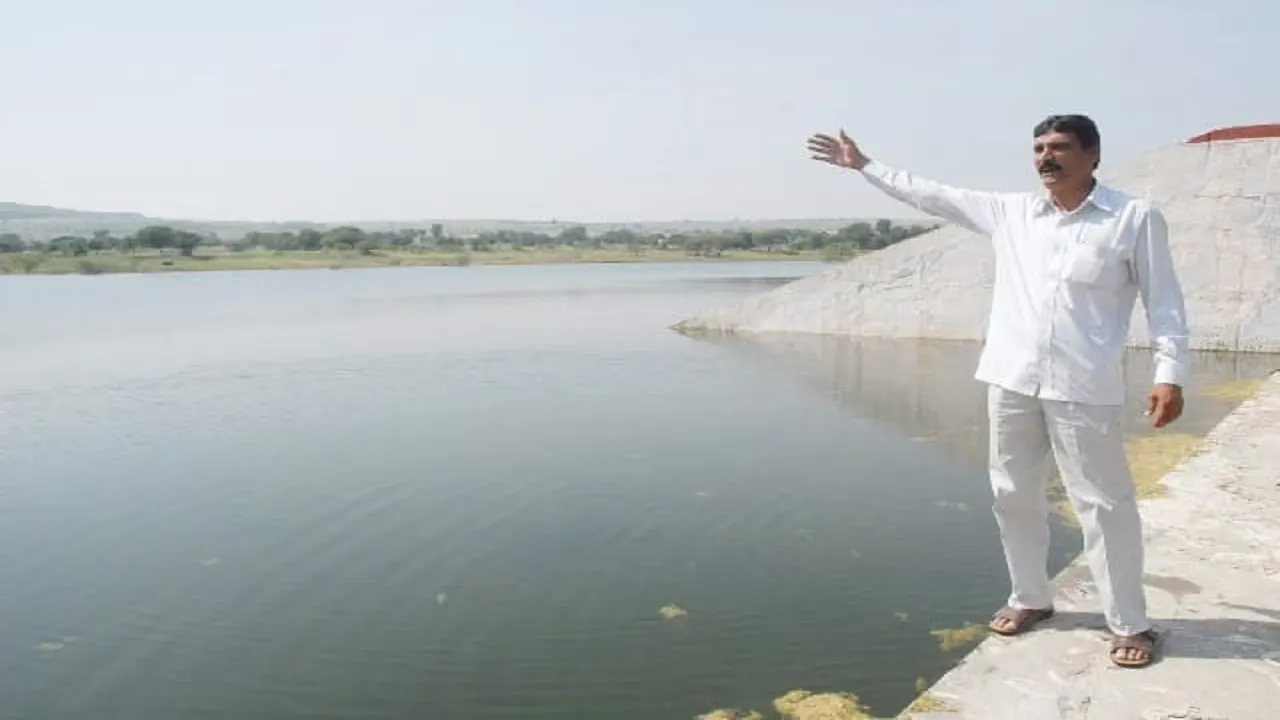
According to its sarpanch, Popatrao Pawar, around 90% of the residents of Hiware Bazar, a village in Maharashtra’s Ahilyanagar district (earlier Ahmednagar), had migrated by the early 1990s, and only 13% of its farmland could be irrigated.
The village lies in a rain shadow and receives about 400 mm of rain a year. Down To Earth reported in 2017 that its crop production did not fall in 2015, when it received around 50% less rain than normal.
That record carries fresh relevance. India’s monsoon ended 12.6% below average, its weakest in more than a decade, a senior India Meteorological Department official told Reuters on 30 September, 2026. Maharashtra recorded an 18% deficit and declared 265 of its 358 tehsils drought-affected on 26 September, 2026.
A rulebook from 1880
Paying people to build public assets during drought is an old idea. The Famine Commission of 1880 recommended Famine Codes to guide officials in anticipating and relieving crop failure.
According to economist Jean Drèze, their backbone was public works paying subsistence wages within reach of workers’ homes, supported by early warning, with specific guidelines on how to recognise and declare a famine.
After Independence, the codes became Scarcity Manuals, and during the 1972-73 drought in Maharashtra, as many as 5 million people attended relief works at the peak of distress.
Public works remain part of the response. Maharashtra has earmarked Rs 6,728 crore under its rural employment mission, and the number of households seeking Employment Guarantee Scheme work rose from 402,493 in July to 493,169 in September. The state has identified 375 types of work, including water conservation.
Relief work turned into water
Hiware Bazar used Employment Guarantee Scheme funds to regenerate its land and water. Pawar won the 1989 panchayat election unopposed and immediately began work on water conservation.
In 1993, the district social forestry department helped regenerate 70 hectares of village forest, and with donated labour the panchayat built 40,000 contour trenches around the hills.
In 1994, the state brought the village under the Adarsh Gaon Yojana, and the gram sabha, the village council, approached 12 agencies to carry out watershed works according to its own five-year plan for 1995 to 2000. Ralegan Siddhi, the village Anna Hazare turned around, was its role model in the district.
A 2008 Down To Earth account puts numbers on the work. The state spent Rs 42 lakh under the scheme to treat 1,000 hectares, at Rs 4,000 a hectare, and the village added 414 hectares of contour bunding and around 660 structures to harvest rainwater. Wells rose from 97 to 217, and irrigated land grew from 120 hectares in 1999 to 260 hectares in 2006.
Families began returning. Panchayat records show that 40 families came back from Pune and Mumbai between 1992 and 2002, and households rose to 216 by 2007.
Sunderbai Gaekwad returned from Mumbai’s slums in 1998 after hearing that the scheme was reaching her village. In 2007, she bought 3 hectares with a bank loan that the gram sabha guaranteed, grew onions, and no longer needs the scheme’s work.
Budgeting every drop
Pawar told Down To Earth in 2017 that the gram sabha meets every October and advises farmers on crops using the village’s annual water budget, which estimates runoff, groundwater recharge before and after the monsoon, and the water available for use. The village banned deep borewells in the early 1990s; residents rely on 16 shallow hand pumps for drinking water, and sugarcane and cotton are prohibited.
Pawar said the village had grown millets instead of wheat the previous year because rainfall was low. He also said groundwater has stayed at 11 to 12 metres below ground level since 1995, against about 37 metres earlier.
The same report said Ralegan Siddhi had to ask for water tankers in the summer of 2016, after which Hazare said it began water budgeting. It added that Pimpal Gaon Kauda, next to Hiware Bazar, had replicated the approach and met its water needs without government help for three years.
/filters:format(webp)/english-betterindia/media/media_files/2026/10/13/5-2026-10-13-13-24-21.jpg)
communities prepare for erratic rainfall and dry summers.
By 2017, the Maharashtra government was looking to replicate Hiware Bazar’s approach in other villages of Ahilyanagar district, with officials being trained to help communities practise water budgeting.
But the model in Hiware Bazar goes beyond building water structures. Its gram sabha uses the water available each year to decide what can be grown, how much can be irrigated and what the village can realistically sustain.
That means drought relief is not treated only as a response to a bad season. In Hiware Bazar, it became an opportunity to build structures that could hold water, restore farmland, and give the village a way to plan for the next dry year.
In a state where drought continues to shape how rural communities earn a living, the village’s experience offers a simple lesson: relief can address the crisis of today while also preparing a village for the summers to come.
Sources:
-
‘India records lowest monsoon rainfall in more than a decade‘: by Thomson Reuters for WHTC (syndicated Reuters report), Published on 30 September, 2026
-
‘Maharashtra earmarks Rs 6,728 crore for rural employment as drought grips nearly three-quarters of state‘: by Himanshu Nitnaware for Down To Earth, Published on 30 September, 2026
-
‘This Maharashtra village remains untouched by drought‘: by Sushmita Sengupta for Down To Earth, Published on 21 April, 2017
-
‘Hiware Bazar – A village with 54 millionaires‘: by Neha Sakhuja for Down To Earth, Published on 5 January, 2012 (online; originally in the 16-31 January, 2008 print issue)
-
‘Famine Prevention in India‘: by Jean Drèze for the World Institute for Development Economics Research (WIDER), Published in February, 1988
Disclaimer : This story is auto aggregated by a computer programme and has not been created or edited by DOWNTHENEWS. Publisher: thebetterindia.com