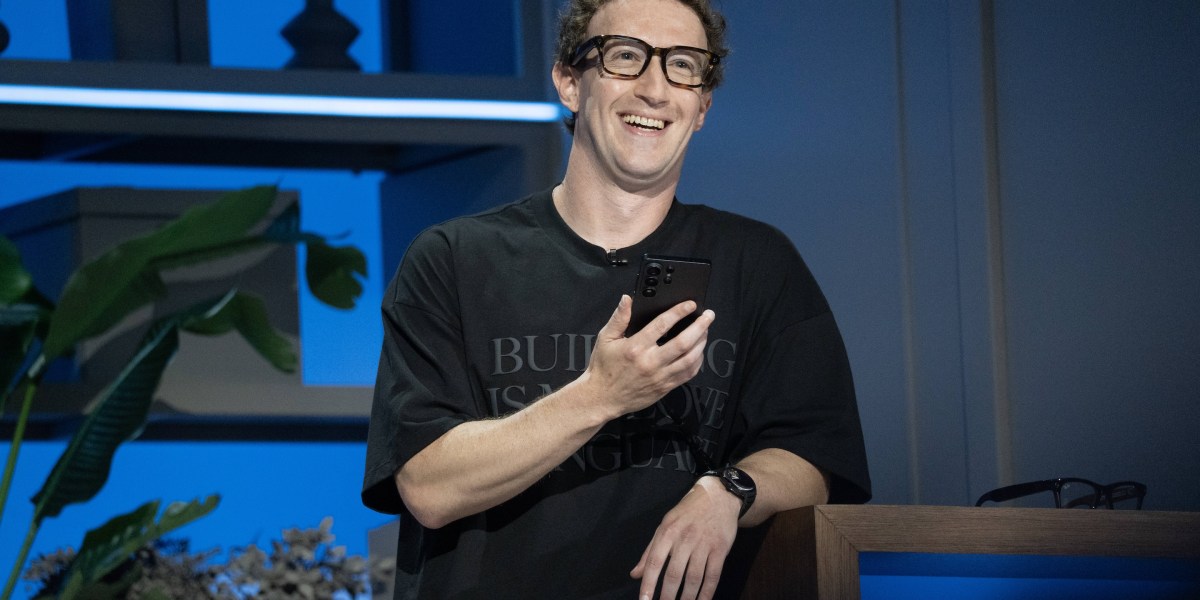
For weeks, Sony Pictures has been needling Mark Zuckerberg with an ad campaign promising that the Meta CEO will love The Social Reckoning. The spot ends with a jab about Instagram not fact-checking most ads, and it runs on Meta’s own platforms. Now that the film is out, Zuckerberg likely didn’t love the movie. But he may be taking some delight in its box office performance.
Aaron Sorkin’s follow-up to 2010’s The Social Network opened in 2,606 theaters on Oct. 9. It took in about $5 million at the domestic box office over its first weekend, according to The Numbers. That was below the $5.5 million estimate reported Sunday and less than a quarter of the roughly $22 million The Social Network debuted to 16 years ago. The weak start came despite the critical and commercial success of its predecessor; an all-star cast led by Mikey Madison, Jeremy Allen White, and Jeremy Strong, and a splashy marketing campaign.
A modest opening for a not-so-modest bet
Under normal circumstances, $5 million wouldn’t be a disastrous opening for a political drama. After all, most of The Social Reckoning is people in suits having tense conversations, which is hardly blockbuster fare. But Sony and coproducer Alcon Entertainment spent a reported $30 million to make the film, a generous budget for a movie of its type. They also backed it with a full-fledged marketing campaign. The hope was that it might recapture some of the runaway success of The Social Network, which went on to gross $225 million worldwide and win three Academy Awards.
Audiences haven’t shown up for the new Facebook drama the way they did for the original, and critics have been lukewarm at best. The film holds a 55% critics score on Rotten Tomatoes and a B- CinemaScore. Some blame the change behind the camera: David Fincher directed the original, while Sorkin, who wrote both films, directed this one himself. Others feel a disconnect between Jesse Eisenberg’s portrayal of Zuckerberg in The Social Network and Strong’s in Reckoning. The film’s underperformance goes beyond artistic differences, though. It reflects changes in culture, politics, and moviegoers’ tastes, as well as the broader media landscape.
The mystique is gone
In 2010, making a movie about Facebook’s origins was truly bold. Few people outside the tech community knew the story in earnest. Facebook’s elusive creator had a timely mystique, and the way he launched the site from his Harvard dorm room in 2004 had an almost mythological quality. The Social Network stripped that mythology away and put Zuckerberg in an unflattering spotlight for the first time.
Zuckerberg and Facebook, now Meta, are ubiquitous today. The Social Reckoning dramatizes events between 2019 and 2021, when Facebook product manager Frances Haugen gathered tens of thousands of internal documents. She handed them to the Wall Street Journal, which published “The Facebook Files,” a series detailing how the company chased engagement while struggling to rein in misinformation and harm to users.
It’s a compelling story, but anyone who followed the news at the turn of the decade already knows it. Haugen testified before a Senate subcommittee in October 2021, and Zuckerberg has been grilled by Congress repeatedly. Countless hours of mainstream coverage have been devoted to Meta’s questionable practices, most recently around the landmark child-safety case it settled with state attorneys general in August for up to $17.1 billion. Sony intentionally dropped its teaser the same day. The new film is hardly the peek inside Zuckerberg’s college dorm room that audiences got in 2010.
Facebook isn’t cool anymore
Back in 2010, Facebook still held a positive connotation in the culture. The site was connecting people in unprecedented ways. As a business, it represented a new kind of entrepreneurialism that seemed to cost consumers and society very little. Big Tech didn’t yet carry the negative associations it does now, and Facebook was a hot, trendy platform largely beloved by its 500 million–plus users. That made The Social Network daring in its nuanced depiction of the enterprise, and the film consequently raised profound questions for audiences to grapple with.
The tone toward Facebook has changed since then, partly because of the very events The Social Reckoning dramatizes. The company’s business practices and hands-off approach to political content have made audiences more skeptical of it, and less shocked when Zuckerberg comes off as a villain.
Business and politics aside, Facebook is simply no longer the fashionable topic it was 16 years ago. The flagship app is now associated with older users, while TikTok and Instagram have eclipsed it in relevance among youth. Those are the same platforms where the film’s trailers went largely ignored. Meta’s other services, like WhatsApp and Messenger, are still widely used. But they have become fixtures of everyday life rather than cool, exciting revolutions. The Social Network tapped into the zeitgeist of its moment. Sixteen years later, the culture has moved on.
A more political film for a more divided audience
Then there is the change in politics. It seems platitudinous to say America is more politically divided now than it was in 2010, and The Social Reckoning argues that Facebook played a role in that transition. Increased polarization may by itself mean the film can’t attract some of the audience The Social Network once drew. But the audience’s politics aren’t the only thing that changed. The film is also far more political than its predecessor.
The Social Network was a largely apolitical film. Its legal battles were civil suits between Zuckerberg and other individuals, and Washington was a barely mentioned, peripheral presence. In The Social Reckoning, politics takes center stage. Its climax intercuts Haugen’s Senate testimony with a re-creation of the Jan. 6, 2021, attack on the U.S. Capitol. Audiences haven’t merely become more partisan. The film also leans into divisive territory that The Social Network never came close to touching.
The result: The Social Reckoning finished its opening weekend fifth at the domestic box office, behind Universal’s horror film Other Mommy. The Social Network, by comparison, held the No. 1 spot for its first two weekends in 2010.
It took 16 years, but Zuckerberg may be getting the last laugh.
Disclaimer : This story is auto aggregated by a computer programme and has not been created or edited by DOWNTHENEWS. Publisher: fortune.com