
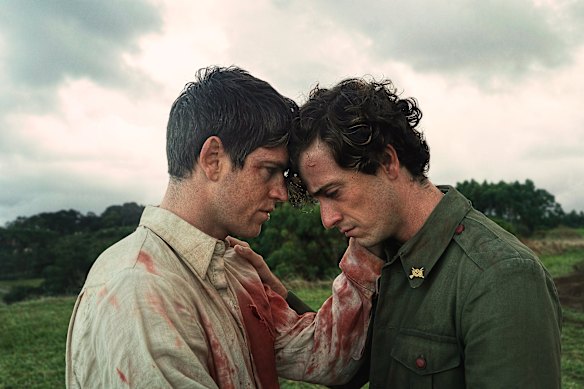

A gay romantic saga set largely during the Spanish Civil War is tipped as the foreign-language film most likely to be a Best Picture contender at the next Oscars. Currently topping the Spanish box office, this festival hit – which opens in Australia this week – is predicted to run neck and neck with The Odyssey through awards season, with a good chance of beating Christopher Nolan’s classical epic to the gold statuette.
The film centres on a young village musician Sebastian who, having fallen in with General Franco’s rebel forces, is obliged to guard Rafael, a Republican prisoner who was the last lover of Federico Garcia Lorca, the great poet and playwright who was murdered by the fascists in 1936. Dying of his wounds, he asks Sebastian to find and save Lorca’s last play, La Bola Negra. The play itself – of which only four pages remain in reality – is interwoven with the soldiers’ love story.
La Bola Negra has resonated strongly with audiences in Spain, where a general reluctance to talk about the civil war and long years of dictatorship are being overtaken to usher in an often bitter political debate about the past. The film, by contrast, shows characters who form loving bonds despite political divisions and endemic homophobia. “When I read this, I already felt transformed,” said actor Penélope Cruz, whose dynamic turn as a cabaret singer is also tipped to earn an Oscar nod, in a Q&A panel at the London Film Festival.
“Obviously, we don’t feel that every time we read a script and we don’t make movies thinking they are going to change the world, but when something is this good, it is a contribution to a better world, I am 100 per cent sure. And this is what you see on the faces of people when they watch the movie, those tears, strangers of all different generations hugging each other. That is what is happening every day in Spain, where the movie has been playing for three weeks.”
La Bola Negra is the work of a young directing duo, Javier Calvo and Javier Ambrossi, known collectively as “Los Javis”, who were first inspired by a play about the relationship between two civil war soldiers that mentioned the lost play. The four pages are held in an archive in Granada. “They opened up the safe of manuscripts for us and there they were. Those four pages are the starting point of this journey. The first page is the list of characters,” says Ambrossi. “Federico was killed and couldn’t write the play, but we researched and found he was going to use the first explicitly gay character in his career.”
La Bola Negra means “the black ball”. The Javis’ idea of what it might have been like begins with Carlos, a young man from a powerful family, being blackballed from Granada’s exclusive men’s club because he is suspected of being homosexual. “We were reimagining Federico’s [Garcia Lorca] world,” says Ambrossi. “And at some point we realised this is a story of the past of our country, a story of our grandparents.” They agreed they had to weave in a present-day storyline as well, “to talk about how much the past influences our present.” This is the film’s third intertwined narrative strand, in which the missing manuscript turns up in a bequest to a contemporary gay writer.
The film was intended as a love story between men, but the directors soon realised they needed some female characters in it “as a breath of fresh air”. Cruz’s character, Nene, sings in clubs jammed with young soldiers who paw and slaver over her while she sparkles, bringing some trashy joy into their lives. “I felt her pain that she has to hide every day for the hour – or whatever it is – she’s on stage to try and make those young people dream,” says Cruz. “Probably she is raped every three or four days, but that is also her escape: when she is up there, she is getting oxygen back to keep herself from totally crashing. I fell in love with her.” Working on La Bola Negra was, she says, “one of the best periods of my life”.
Miguel Bernardeau plays Lorca’s bereaved lover. Rafael Rodriguez Rapun really existed; he was a mining engineer, top footballer and arts enthusiast who met Lorca when he joined his anarchist theatre troupe, La Barraca. After Lorca was murdered, Rapun joined the Republican forces. Although every Spanish schoolchild learns Lorca’s poems and is aware of his literary importance, Bernardeau says nobody was taught anything about his personal life. “Which I think for an artist like him is very important. So this was a rediscovery of his work for me.”
Bernardeau says the film has landed at a crucial time in Spain, where a resurgent extreme Right is now trying to reclaim General Francisco Franco as a hero. Liberal Spaniards, he believes, have been caught off guard. There has been so little discussion of the war or its aftermath until now, because when democracy was restored in 1977 most people wanted to draw a line under those decades. All that mattered was a brighter future. “I am now conscious, having studied more about the war and that specific part of our history, how much we wanted to leave it in the past, not observe it or learn from it,” he says. “We didn’t work through the transition with any consciousness of what had happened.”
A general election has just been announced in Spain, to take place in on November 29. This makes it an interesting time, Bernardeau says, to watch La Bola Negra. “The topic is very divisive, and this movie is awakening that kind of conversation. Polarisation is not good, but we need to create that conversation between different sides. And this movie, because of the emotions it creates and because it doesn’t tell you what to think, creates conversations between people that they probably wouldn’t have at home. If we stop talking to each other, we are done. We are done! And I think that is the beautiful side of this movie.”
La Bola Negra is in Australian cinemas from October 15 (except for Perth, where it will be released on December 10).
Must-see movies, interviews and all the latest from the world of film delivered to your inbox. Sign up for our Screening Room newsletter.
 Stephanie Bunbury is a film and culture writer for The Age and The Sydney Morning Herald.
From our partners
Disclaimer : This story is auto aggregated by a computer programme and has not been created or edited by DOWNTHENEWS. Publisher: www.smh.com.au








