
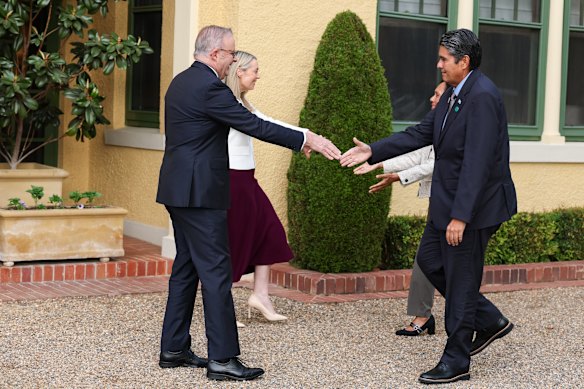

Palau President Surangel Whipps Jr and other Pacific leaders have rejected criticisms that climate talks co-hosted by Australia in the Pacific last week were a failure.
“I have just returned from pre-COP in Fiji and Tuvalu, which Australia helped to organise and co-fund, and I have followed the media commentary here about who attended and what the gathering cost,” Whipps said, during a speech delivered at the Australian National University in Canberra on Wednesday.
“Media scrutiny is important. But so is perspective, and while cost matters, so does value. For the first time in the history of pre-COP, heads of state and government were invited to participate.”
Speaking with this masthead on Tuesday, Tuvalu’s climate change minister, Dr Maina Talia, also said the talks were a success. He said he saw first hand how the views of world leaders and their representatives shifted after they visited Tuvalu during the talks.
On the leadership group’s return to Fiji, he said, one representative told him, “My heart bled when I saw the children in Tuvalu, when I saw that strip of land in Tuvalu.”
The event was always going to be controversial. It was cast by the opposition as an expensive pet project of Climate Change and Energy Minister Chris Bowen. Opposition energy spokesman Dan Tehan labelled it a farce.
Bowen secured the talks in negotiations when it became clear Turkey would succeed over Australia in its bid to host United Nations climate talks in November.
Pre-COP talks are a regular feature of the diplomatic calendar leading up to annual United Nations negotiations over the Paris Treaty, but are normally small affairs attended by officials seeking to narrow the scope of the negotiations to follow.
Bowen invited world leaders to the Fiji pre-COP in a bid to increase their diplomatic impact, but in the end just two from outside the region attended, opening the door to criticism that he had failed in his efforts and wasted more than $20 million.
Whipps said those focused on the presence of leaders missed the substance of the talks.
“Yet some have dismissed the gathering by counting the leaders who were absent, rather than recognising the significance of those who came,” he said. “Global leaders, ministers and international institutions all came to our region to help shape negotiations that will determine our collective future.”
Fiji’s environment minister Lynda Tabuya told this masthead that pre-COP’s success should be measured by the political trust and consensus it built leading into the COP rather than by a “roll-call of world leaders”.
“Hosting pre-COP here has put Pacific priorities on the global climate agenda, and that’s something I am very proud of,” she said.
Talia said criticism missed the point. “I would say it’s very disheartening for us from Tuvalu to read those negative comments because for us what counts is the countries that were able to come.”
During the talks, representatives made a side trip to Tuvalu to witness the immediate impact of climate change. It was, said Bowen, the largest high-level diplomatic delegation ever to visit the world’s least-visited nation.
As talks resumed in Fiji, leaders of 13 countries and representatives of more than 50 nations, as well as the European Union and UN, and COP host, Turkish COP president-designate, Environment Minister Murat Kurum, did forge common ground.
They agreed that the pursuit of the Paris Agreement target of 1.5 degrees warming would remain on the agenda at the COP negotiations, even though the UN Environment Program has declared it is likely to be broken.
They agreed that the protection of oceans – a key concern of the Pacific – should be included, and also agreed on securing climate finance for vulnerable nations that is efficiently deployed and does not impose debt, and to accelerate the transition away from fossil fuels.
It is in this area that trust in Australia, the world’s third-largest fossil fuel exporter, is frayed.
The Albanese government has made it clear it sees championing the Pacific’s climate concerns on the world stage as central to efforts to maintain influence in the region as China flexes its muscles.
Whatever your views on climate change, goes the argument, $20 million spent on a pre-COP is money well spent. This position is harder to defend if the Pacific’s anger over fossil fuel exports undoes any ties built via COP.
Talia called Australia’s expansion of fossil fuel exports as it leads climate talks a “moral contradiction”.
“We cannot talk about all these issues and then continue to open coal mines. It’s unbelievable. So we need to hold to account the government of Australia and all the major polluters when it comes to this discussion because it is about the very survival of those who continue to live in small island countries like mine.”
Asked if Australia had deepened ties with the Pacific with its efforts, Talia chose his words carefully. “We were able to sit down and dialogue, and we will continue to dialogue on that, even though it’s a moral duty for major producers to look into this issue seriously.”
Asked if Bowen was trusted by Pacific leaders he said: “We will continue to work closely with minister Bowen and to see a very concrete outcome of COP 31.”
Whipps rejected the notion that the Pacific was a small global player, noting the oceans for which they bore responsibility represented nearly 20 per cent of the Earth’s surface.
“The Pacific has never been small. We have only been measured as if we were,” he said. “But the Pacific is not a chessboard, it is our home.
“Our islands are not squares to be won or lost in somebody else’s strategic competition. Our partnerships are not prizes. Our sovereignty is not negotiable.”
Get to the heart of what’s happening with climate change and the environment. Sign up for our fortnightly Environment newsletter.
 Nick O’Malley is National Environment and Climate Editor for The Sydney Morning Herald and The Age. He is also a senior writer and a former US correspondent.Connect via email.
From our partners
Disclaimer : This story is auto aggregated by a computer programme and has not been created or edited by DOWNTHENEWS. Publisher: www.smh.com.au



