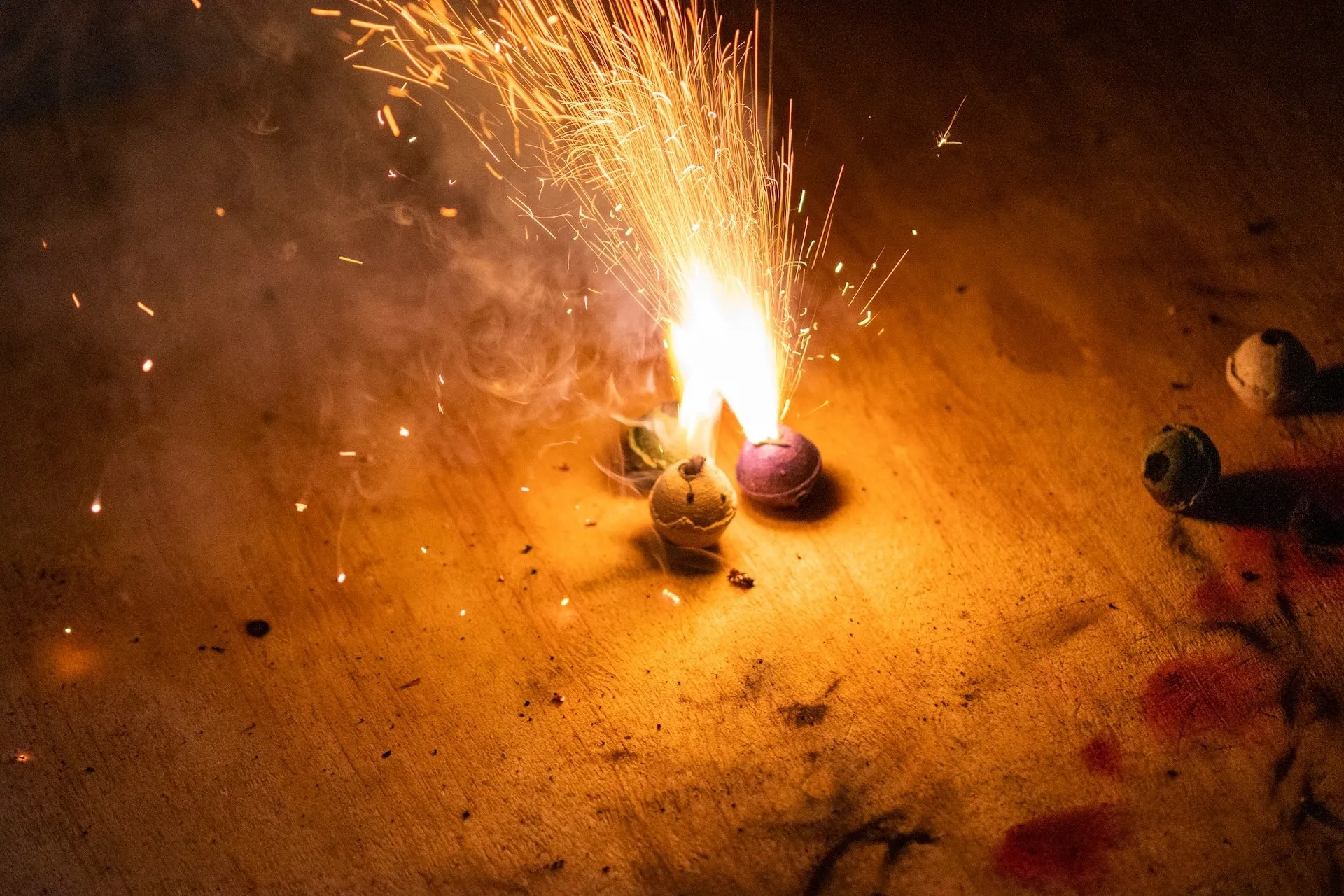
The familiar crackle of a ladi, a long string of firecrackers that bursts in rapid succession, could sound different this Diwali. India’s Supreme Court has permitted specified next-generation joined green crackers, reopening a debate that sits at the intersection of festive traditions, livelihoods and the country’s struggle with air pollution.
On 30 September, 2026, the court accepted a proposal to allow these redesigned crackers under strict technical conditions. The decision does not mean that every ladi can return to the market, nor does it settle every question about firecracker pollution, particularly in Delhi and the National Capital Region (NCR).
At the heart of the decision is a question that has shaped India’s firecracker debate for years: can manufacturers reduce the harm without eliminating the celebration?
Why ladi crackers became a flashpoint
Unlike individual fireworks, joined crackers contain multiple firecrackers linked in a series. Their appeal lies in the continuous succession of explosions, but that same design raises concerns about concentrated noise, smoke, and the solid waste left behind.
The Supreme Court addressed these concerns in Arjun Gopal versus Union of India, a case that began in 2015 when three children sought restrictions on firecrackers because of their effects on air quality. In October 2018, the court prohibited conventional crackers in Delhi-NCR and allowed only specified reduced-emission alternatives under its directions.
It also prohibited “joined” firecrackers (a string of crackers burst in sequence), citing their contribution to air pollution, noise, and solid waste.
The debate has since moved beyond an outright choice between permitting fireworks and banning them. Scientists have explored whether changes to their chemical composition and construction can reduce emissions, while the courts have continued to weigh environmental risks against public sentiment and the practical difficulties of enforcing restrictions.
That distinction matters because firecracker smoke contains particulate matter, including PM2.5 and PM10, alongside gases such as sulphur dioxide and nitrogen oxides. Fine particles can penetrate deep into the respiratory system, making additional pollution particularly concerning for children, older people and those with existing respiratory conditions.
What makes the new crackers different?
The latest proposal centres on next-generation joined green crackers assessed by the Council of Scientific and Industrial Research’s National Environmental Engineering Research Institute (CSIR-NEERI).
According to the Union government’s submissions recorded in the Supreme Court’s 30 September order, conventional joined crackers can burst approximately 25 braids in a second. The proposed next-generation versions burst around five braids per second, extending the bursting duration and changing the pace of the explosions.
The government also presented technical specifications for shell size, the number of crackers in a series, and the time between bursts. The reported noise measurements for the specified new-generation products were lower than the applicable ceiling for individual crackers, although compliance with the prescribed standards remains essential.
The environmental argument goes beyond slowing the sequence. CSIR-NEERI has developed green-cracker formulations designed to reduce particulate emissions by at least 30% compared with conventional products, with reductions varying by formulation and product.
Researchers have explored smaller shells, changes to chemical ingredients, and additives that improve combustion or suppress airborne particles.
However, a reduction in emissions from an individual product does not mean that its use is pollution-free. Nor does a laboratory result automatically establish the effect of thousands of crackers being burst across a city over a short period. The actual environmental outcome depends on the products used, the number burned, weather conditions and the pollution already present.
What the ruling means for Diwali
The court’s permission comes with conditions.
-
The products must follow approved formulations and specifications.
-
Come from licensed manufacturers.
-
Meet applicable noise and emission standards.
-
Undergo prescribed testing and certification.
-
Carry identification that helps authorities trace them.
-
Banned chemicals remain prohibited under the applicable requirements.
The court has also kept a significant question open. The Union government told the bench that open-ground testing was needed to assess the impact of barium-containing green crackers on air quality, with the exercise due by 14 October, 2026. The court listed the matter for 15 October. The outcome could influence the next steps for products whose chemical composition remains under scrutiny.
/filters:format(webp)/english-betterindia/media/media_files/2026/10/14/5-2026-10-14-09-37-08.png)
Delhi-NCR also requires separate attention because its restrictions arise in overlapping proceedings. The latest order in Arjun Gopal does not, by itself, settle every restriction applicable to the region. The court’s wider approach is to avoid both a blanket prohibition and unrestricted use, with conditions intended to limit the harm.
For consumers, the practical distinction is important: the term green cracker does not mean harmless, and a product’s appearance cannot establish whether it meets the prescribed standards. Certification, approved formulations and effective enforcement matter as much as the claims made about emissions.
The Supreme Court’s decision therefore represents a conditional step towards allowing a specific category of redesigned fireworks, not a declaration that the pollution problem has been solved. The promise of lower emissions will need to withstand scrutiny beyond controlled tests, particularly when celebrations bring large numbers of people into the streets.
But with scientific evaluation, reliable certification and stricter enforcement against unapproved products, the move could help India explore a more responsible way to celebrate.
Sources:
1. ‘Arjun Gopal vs Union Of India on 30 September, 2026’: by the Supreme Court of India, reproduced on Indian Kanoon, 30 September, 2026.
2. ‘SC Permits Next-Gen Joint Green Crackers, Gives Centre Time to Assess Barium Variants’: by Utkarsh Anand and Abraham Thomas for Hindustan Times, published on 30 September, 2026.
3. ‘Green Crackers: National Centre of Excellence’: by CSIR-National Environmental Engineering Research Institute, official institutional resource, publication date not stated.
4. ‘Green Firecrackers with Reduced Barium Emissions in Particulate Matter’: by the study’s authors for Environmental Pollution, published in 2023.
5. ‘A Green Firecracker That Creates Water? CSIR May Have Cracked The Formula!’: by Rinchen Norbu Wangchuk for The Better India, published on 24 October, 2018.
Disclaimer : This story is auto aggregated by a computer programme and has not been created or edited by DOWNTHENEWS. Publisher: thebetterindia.com