
When “Slow Horses,” the darkly comic Apple TV drama about the misfits of British secret intelligence, was shooting its first season, the creators faced a conundrum.
Every new series must announce itself with the opening scenes of its pilot episode, and in the era of prestige TV and now streaming saturation, creating distinctive and even challenging openings became essential.
“It’s extremely important to come up with a good opening,” says “The Sopranos” creator David Chase, who helped usher in the modern era.
“If you get me in the first 10 minutes, I’ll chill and trust you,” adds Sterlin Harjo, whose FX series “The Lowdown” returns for its second season on Wednesday, explaining that showrunners understand they must captivate viewers while quickly establishing the show’s world and introducing its characters.
There’s no one way to create an opening potent enough to keep viewers tuned in: Some show creators drew on personal experiences to ground their stories in specific details, while others brought storytelling techniques and cinematography styles from film. The crucial factor, it seems, on shows as far back as “Hill Street Blues” and “Twin Peaks” or as recent as “Succession” is to trust the viewers to dive into a new world without heavy-handed exposition.
Emotions over exposition
The thrilling opener in “Slow Horses,” involving a chase scene with several twists as MI-5 agent River Cartwright (Jack Lowden) races through a London airport, was pulled from the novel that the show is based on. But executive producer Doug Urbanski says they were dissatisfied with the transition into the crucial second scene, which introduces Jackson Lamb (Gary Oldman), the dissipated genius spy and the cynical heart of the show. (The show, which earned nine Emmy nominations and won one for directing for its fifth season, is hurtling toward its season finale on Oct. 21.)
“We tried probably 20 different cuts and every producer and executive put in their two cents, but we weren’t getting it right,” Urbanski says. “Do we add voiceover or music? Do we cut the scene?”
Finally, Urbanski called Oldman and said they needed to quickly demonstrate this show would be different from most spy stories. “Gary immediately said, ‘I have the answer: Jackson Lamb wakes himself up with a big fart,’ ” Urbanski recalls. “So we flew back to England, reconstructed the set and shot Lamb on that sofa passing gas in a very loud way.”
Gary Oldman, left, and Jack Lowden in first episode of Apple TV’s “Slow Horses.”
(Apple)
Early TV dramas launched with mundane, exposition-heavy introductions to their premise and characters. “Television was addicted to spoon-feeding explanations to audiences and never letting them feel doubt or uncertainty,” says Mark Frost, who co-created “Twin Peaks” with David Lynch.
Chase says “exposition is death,” and “Succession” creator Jesse Armstrong adds that shows now trust actors to provide exposition through the emotions they convey, trusting modern audiences to understand it without everything being spelled out. That has the added benefit of forcing viewers to pay close attention, Armstrong adds.
The first time audiences meet Kendall Roy in the opening minutes of “Succession,” Jeremy Strong captures the character and sets the tone for the show. “He could be saying almost anything as Kendall, but his performance lets you know, ‘This guy hasn’t got it,’ ” he says. “He’s trying to wear his dad’s shoes, and it’s not working. If I wrote it more on the nose with the exposition it doesn’t help — it just means you can be double screening and be elsewhere.”
Harjo’s pilot for “The Lowdown” kicked off with a brief, silent scene that ends with a man alone in a room dying from a gunshot. It’s followed immediately by one with Lee Raybon (Ethan Hawke) talking — and talking and talking — his way into and out of a confrontation that laid the groundwork for his character and the season’s plot.
“I wanted to show his strengths, flaws and eccentricities all in one scene,” Harjo says, while the previous scene set up the central crime so viewers would say, “I can’t wait to find out where it’s going.”
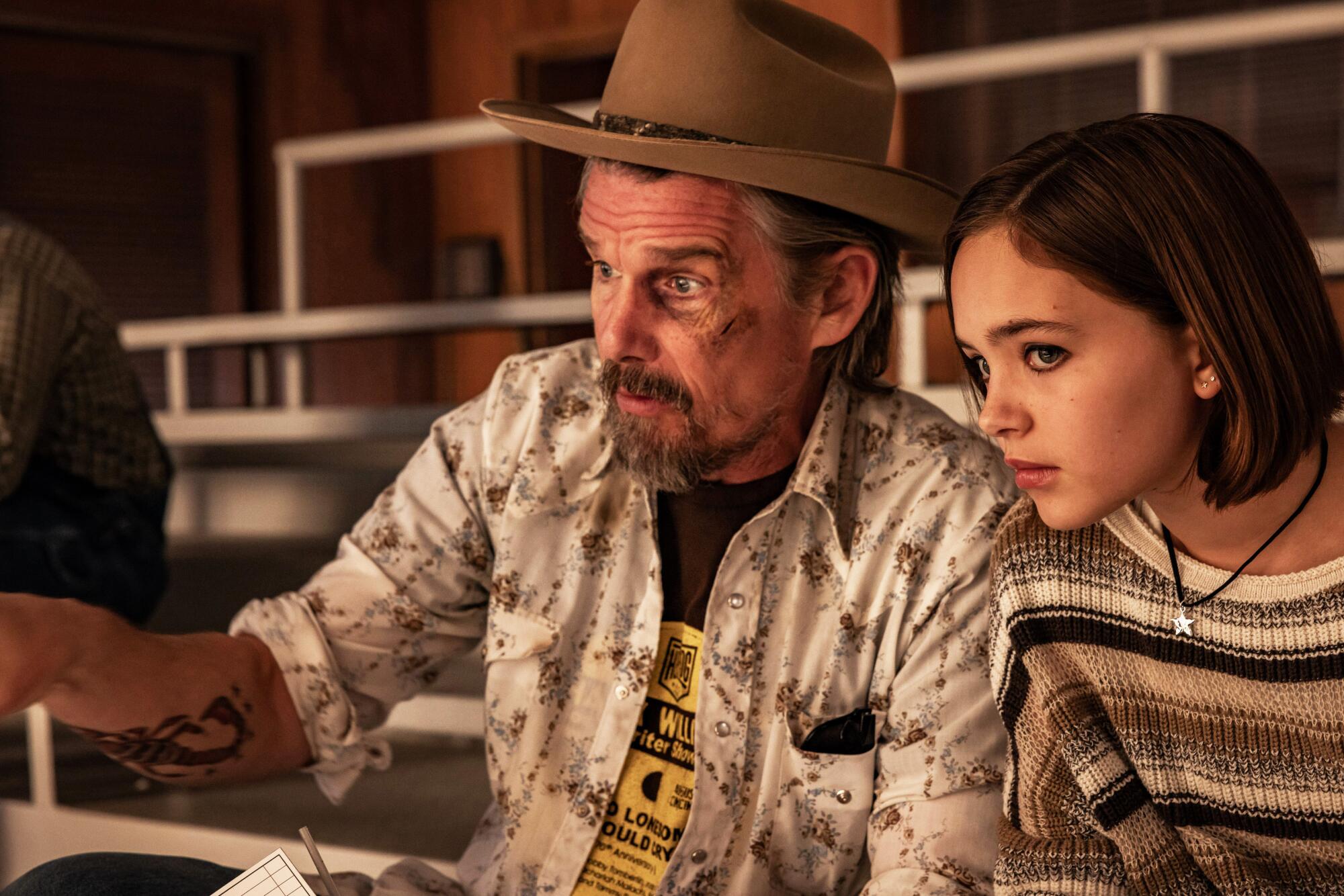
Lee Raybon (Ethan Hawke) and Francis (Ryan Kiera Armstrong) in “The Lowdown.” “I wanted to show his strengths, flaws and eccentricities all in one scene,” says showrunner Sterlin Harjo about his central character.
(Shane Brown / FX)
Bryan Cranston starred in an opening that Harjo and others cite as the ultimate in piquing curiosity: Walter White, wearing a gas mask but no pants, careening through the desert in an RV containing several unconscious bodies. After he crashes the RV, he grabs a gun and a video camera and staggers out to face his destiny.
Cranston says he initially read the scripts as if he were an audience member, and after the first page of “Breaking Bad,” he said, “What the hell is going on?”
“Vince Gilligan knew just the right bait to lure an audience into the story,” he says. “That first scene is so compelling and ambiguous so you’re leaning in and thoroughly invested.”
It also sets up the pilot, which flashes back to Walter’s financial woes and his cancer diagnosis, making “the audience complicit with Walter,” Cranston says, by the time the episode returns to him in the desert.
Bringing filmmaking to TV
A brief history of TV dramas reveals that only a handful of series made before 1990 demanded audiences lean in. “The Prisoner,” a 1968 series, was directed like a film, utilizing quick cuts and a propulsive pace in a wordless opening that’s mysterious while still setting up the story of a British intelligence agent who resigns and then is abducted.
Steven Bocho’s groundbreaking “Hill Street Blues” (1981) utilized handheld cameras, overlapping conversations and panning shots during the police roll call that left viewers uncertain who were the stars and who were the extras. Even when key characters were finally introduced, their conversations occurred amid the swirling chaos of precinct life.
“Hill Street” introduced to television the notion that “the direction and camera work were essential to the show’s storytelling,” says Charlie Haid, who played Andy Renko and later went on to become a TV director.
The show’s early ratings struggles may have been because “for some people it was a little much,” he says, “although eventually they got it.”
But with the exception of Bochco’s “NYPD Blue,” few of the acclaimed dramas that followed, like “St. Elsewhere,” “L.A. Law” and “ER,” strived to break new ground (although “ER’s” opening does showcase a very, very young George Clooney).
The shift began gradually when “Twin Peaks” (1990) brought Lynch’s beautifully warped film sensibility to broadcast television. ABC had pitched Lynch and Frost on creating a “different kind of nighttime soap opera,” Frost recalls.
“The murder of Laura Palmer was a convenient way to draw people in and get past the need for a lot of exposition,” he says, “but then the opening became iconic because of the image David carefully created of her body on the beach.”
While they grounded the opening in realism without hinting at the surrealism to come, they still consciously broke TV’s rules in terms of pacing and style. “After we came along, people realized that audiences had an appetite for things that required them to pay more attention,” Frost adds.
Some shows that followed, like “X-Files” and “Buffy the Vampire Slayer,” could easily grab viewers because theirs was an alternate reality. As audiences grew more sophisticated, dramas broke more boundaries.
Following their instincts
Unsurprisingly, it was HBO that really transformed how dramas introduced themselves — the twisted tone poem of “Oz” (1997) was quickly followed by creative openings on “The Sopranos,” “Six Feet Under,” “The Wire” and “Deadwood.” But the game changed for dramas everywhere, from broadcast networks (“West Wing” and “24”) to basic cable (“Battlestar Galactica,” “Mad Men,” “The Americans,” “Better Call Saul”) to streaming (“The Handmaid’s Tale” and “Stranger Things”).
Several showrunners said their first scenes simply came from following their own vision.
“I didn’t really think in terms of a good opening because my creative process is organic,” says Alan Ball, whose “Six Feet Under” shocked viewers when the family patriarch Nathaniel Fisher (Richard Jenkins) is killed after a bus crashes into his hearse in the first five minutes. (He remains a ghostly presence on the show.) “It’s a show about life in the constant presence of death so I needed to start with a death. But I was trying hard not to think about how it would be received.”
Likewise, Chase was following his muse when he added the flashback that takes Tony Soprano out of Dr. Melfi’s office to his swimming pool where he’s happily cavorting with ducks. Chase saw a ramp in a swimming pool at a friend’s house and when he learned it was for ducks, he immediately knew he’d include that. “Who was telling me those ducks belong in this gangster pilot,” he says. “It makes no sense if you think about it. You have to develop a thing where you trust your instincts.”

In “The Sopranos,” the opening scene shows Tony Soprano (James Gandolfini) cavorting with ducks in a pool. “It makes no sense if you think about it. You have to develop a thing where you trust your instincts,” says creator David Chase.
(Anthony Neste / Getty Images)
For “The Wire,” David Simon opened with a quiet conversation between Det. Jimmy McNulty (Dominic West) and a witness about the shooting of a kid nicknamed Snot Boogie who lies dead in the street.
The almost accidental sociopolitical observations in their conversation “is allegorical for what ‘The Wire’ would be about — this idea that there are two Americas side by side operating under different socioeconomic rules but supposedly sharing the same national premise,” Simon says. He adds that television executives have said that “one of my myriad problems is that I’m less interested in grabbing viewers by the throat and holding them but more interested in stating the show’s theme and then putting a question mark on it.”
(He notes that the killing is never followed up on and the action quickly shifted to a courtroom, introducing several key characters while an intimidated witness undermined a straightforward murder case, setting the stage for the season’s wiretap storyline.)
Armstrong also followed his instincts and focused on theme instead of maximum drama. “Succession” opens with a disoriented Logan Roy waking up in the night to urinate. Unable to find the bathroom, he lets loose on a rug, showing this media tycoon as suddenly frail and vulnerable. The show is about Roy’s tight grip loosening on his fading power and in this scene he’s “literally losing control,” Armstrong says. “The end of the show is latent in its beginning.”

Kendall (Jeremy Strong), left, and Logan Roy (Brian Cox) in the first episode of HBO’s “Succession.” In the opening scene, Logan is “literally losing control,” says creator and showrunner Jesse Armstrong.
(Craig Blankenhorn/HBO)
Still, Armstrong won’t swear it was the best opening. “It’s opaque and not very grabby. I wouldn’t play it to students and say, ‘This is how you should open a show.’ ”
He expected the network to cut it in favor of the flashier scene that followed where Kendall desperately tries, and flagrantly fails, to prove himself worthy of succeeding his father. “It’s tonally more recognizable as the show,” Armstrong says.
Many of the showrunners grounded their introductions in reality. Chase spoke to a psychiatrist about having a criminal as a client. Simon heard the Snot Boogie story, down to the dialogue, from a detective when he was a newspaper reporter in the 1980s. “I knew it was a treasure so I used it in my book, “Homicide.” And then I extracted it from the book for the opening metaphor of ‘The Wire.’ ”
Others drew on even more personal experiences: Frost recalled the murder of a family friend from his adolescence that would become fodder for the inciting incident that revealed the inner turmoil of small-town life in “Twin Peaks.” Meanwhile, Ball had actually been in a car accident in which the driver was killed.
Even Armstrong knew whereof he wrote. “I was once in a hotel and slightly drunk so when I got up I was disorientated and I was pissing in the wastepaper basket until a friend woke me up fully,” he says. “It was very humiliating to realize you were getting something so basic wrong in such a disgusting way.”
More to Read
Disclaimer : This story is auto aggregated by a computer programme and has not been created or edited by DOWNTHENEWS. Publisher: latimes.com