
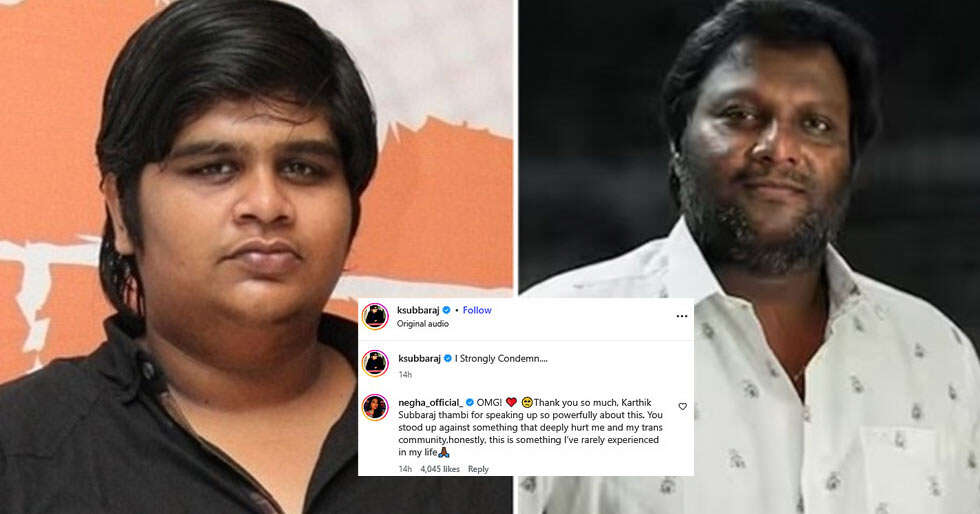
Karthik Subbaraj has spoken out against fellow filmmaker Mohan G over his remarks to transgender woman Negha during a televised discussion surrounding Dorothy. The controversy surrounding the film, which explores transgender identity and the discrimination faced by the community, has now expanded into a larger conversation about representation, prejudice and the treatment of transgender people in public discourse.
In a video statement shared on X on Tuesday, the director criticised the manner in which Negha was questioned during the debate, describing the exchange as transphobic and a form of psychological violence. “It’s not even a question; it’s an insult,” he said, arguing that repeatedly challenging a transgender woman’s prospects of marriage and parenthood was less about discussing an issue and more about publicly humiliating an individual.
Subbaraj stressed that his objection was not to people expressing differing opinions about Dorothy. Instead, he took issue with the way the conversation was conducted, maintaining that disagreements about cinema should not become an excuse to demean someone because of their gender identity.
Karthik Subbaraj Says Criticism Of Dorothy Should Not Justify Discrimination
During the debate, Negha reportedly spoke about the possibility of a transgender woman and a man building a happy married life together, with companionship and mutual support forming the foundation of their relationship. Mohan G, however, repeatedly returned to the question of whether such a couple could have children.
Responding to this line of questioning, Subbaraj challenged the assumption that parenthood must be the defining purpose of a relationship. “Is it the ultimate motive of humans?” he asked, pointing out that many couples who cannot have children nevertheless lead fulfilling lives together. He questioned why transgender people should be subjected to a different set of expectations when it comes to love, marriage and family.
“You can talk anything about the movie. I don’t even care. But there should be humanity,” the filmmaker said, making it clear that his concerns extended beyond the film itself. For Subbaraj, the issue was whether people could debate a work of cinema without stripping those whose lives it depicts of their dignity.
He also drew parallels between discrimination based on gender identity and prejudice rooted in caste and religion. Calling for greater accountability in public discussions, the director argued that there should be rules to address comments that cross the line from criticism into personal humiliation.
“Because the person sitting opposite you is a human being. Look at her as a human being,” he said, emphasising that no one should have to endure public insults because of who they are. His statement also raised questions about the responsibility of filmmakers and other public figures when participating in discussions involving marginalised communities.
Negha subsequently thanked Subbaraj for his support, describing his intervention as meaningful for both her and the wider transgender community. She indicated that such public expressions of solidarity had been rare in her experience, underlining the significance of the director’s decision to speak out.
Dorothy Controversy Reignites Debate Over Queer Representation In Tamil Cinema
The latest exchange is part of a wider debate that has followed Dorothy since its theatrical release on September 25. The film faced criticism on social media over a dialogue in which a transgender character suggests that society’s perception of transgender people could change over the next decade. While some users called for a boycott, others argued that the line had been taken out of context.
Subbaraj had previously urged audiences to watch the film before judging its intentions, dismissing the online backlash as the response of a small section of people. He also suggested that the reactions he encountered among theatre audiences differed considerably from the criticism circulating on social media.
Mohan G, whose filmography includes Draupathi and Bakasuran, has faced criticism over his own comments on LGBTQ+ representation in Tamil cinema. In September, he claimed on social media that such representation was being funded by NGOs to undermine traditional culture. His remarks prompted further discussion about the place of queer narratives in mainstream Tamil filmmaking.
The debate surrounding Dorothy has consequently moved beyond questions about its storytelling and creative choices. At its centre is a more fundamental issue: whether transgender people can participate in conversations about their lives, relationships and identities without being subjected to ridicule or having their right to happiness questioned.
For Subbaraj, the distinction is clear. Films can be criticised, debated and disagreed with. But that freedom, he argues, should never come at the expense of basic human dignity.
Also Read: Rajinikanth Showers Praise on Karthik Subbaraj’s Dorothy
Disclaimer : This story is auto aggregated by a computer programme and has not been created or edited by DOWNTHENEWS. Publisher: filmfare.com




