
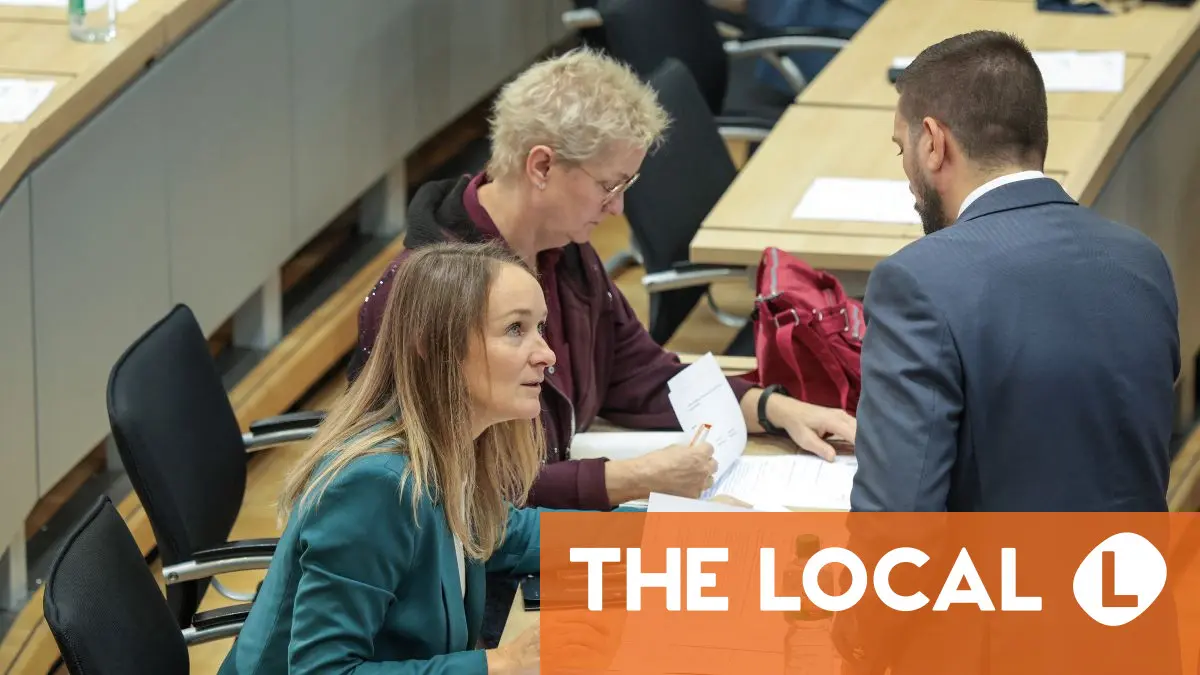
A state parliament in eastern Germany has voted to end support for Ukraine and lift sanctions on Russia. The decision is meant to affect the debate around Germany’s support for Kyiv.
A joint motion by the far-right Alternative for Germany (AfD) and the BSW — a smaller, left-wing populist party — passed with a majority in the state parliament in Saxony-Anhalt on Wednesday.
The motion called for an immediate end to arms deliveries to Ukraine, an end to financial support beyond humanitarian aid, and the lifting of economic sanctions against Russia.
In practical terms, the motion carries little weight. In political terms, it has attracted national attention far beyond the eastern state.
What exactly was passed?
The motion, titled “Peace Talks Instead of Escalating the War in Ukraine”, was approved during a special session of the Saxony-Anhalt state parliament.
The proposal urges the state government to use its influence, particularly through the Bundesrat, to push for a new Ukraine policy focused on diplomacy, immediate ceasefire talks and the restoration of economic relations with Russia.
The motion passed because the AfD (39 seats) and BSW (5 seats) voted together. Between them, the two parties hold 44 of the 83 seats in the Saxony-Anhalt state parliament, enough for a majority.
READ ALSO: Germany’s Merz hails NATO unity on Russia and rejects AfD claims
The CDU, SPD, Greens and the Left Party opposed the motion.
AfD state leader Ulrich Siegmund described it as an effort to increase pressure on Berlin to stop “prolonging” the war, and to spend money “on the people in our country instead of on weapons on the battlefields of Ukraine”.
BSW parliamentary group leader Thomas Schulze said his party had promised a peace resolution before the election and was keeping that promise.
Saxony-Anhalt on its own has no authority to decide questions on sanctions policy or military support for Ukraine. Those decisions are made in Berlin and Brussels.
What has the reaction been?
The reaction from the rest of the political spectrum in Germany was immediate.
Acting Minister-President in Saxony-Anhalt, Sven Schulze of the CDU, dismissed the motion as a “show” and a “wedding gift to the BSW”.
Ukrainian ambassador Oleksiy Makeiev went further, describing the proposal as the “height of absurdity”.
Perhaps the sharpest criticism came from CDU state parliament member Sven Ruhland. Speaking in the debate, he argued that the motion ignored a basic fact: Russia started the war.
READ ALSO: German state ministers scrap unanimity rule amid AfD concerns
“No one in this chamber wants war,” Ruhland said, noting that the AfD/BSW motion doesn’t identify the aggressor anywhere.
Referring to ongoing diplomatic efforts, he argued that a ceasefire required two parties: “Moscow refuses the ceasefire and is rewarded for it with the (proposed) disarmament of its opponent.”
The AfD and the BSW in cooperation
Beyond the motion itself, attention in Germany has also focused on the increasingly warm relationship between the far-right AfD and the BSW in Saxony-Anhalt.
Reporting in taz described a series of cooperative gestures between the two groups, including appearances together at an event organised by the far-right magazine Compact.
The newspaper portrayed Wednesday’s special session as part of a broader effort to deepen cooperation between the two parties and challenge Germany’s traditional political “firewall” against collaboration with the AfD.
READ ALSO: ‘Nothing is certain’ – Has Germany’s firewall against the far-right finally cracked?
Who does the motion benefit?
AfD politician Ulrich Siegmund and BSW figures including Thomas Schulze and Claudia Wittig presented the motion as a peace initiative.
The resolution itself states that the policy of sanctions against Russia, as well as arms deliveries and financial aid for Ukraine, have failed – despite the fact that that Ukraine to continues resist the invading army and to exist as an independent state.
The AfD’s opponents see things very differently.
Ruhland’s argument, reported in Welt, captures the central criticism. If Russia continues fighting while Ukraine loses military and financial support, then the balance shifts in Moscow’s favour.
From that perspective, ending aid to Ukraine and lifting sanctions on Russia won’t create incentives for peace, but rather lift pressure on the country that launched the invasion (while also weakening the country defending itself).
‘Putin’s mouthpiece’
The debate over the motion is also coloured by a broader question that has followed the AfD for years – its relationship with Russia.
Earlier this year, security-focused politicians and anti-Kremlin activists accused Russia of running online disinformation campaigns ahead of regional elections in eastern Germany.
Green MP Konstantin von Notz, deputy chair of Germany’s parliamentary intelligence oversight committee, said that narratives pushed by Moscow were then “deliberately re-broadcast by the AfD in a targeted way”.
CDU parliamentarian Marc Henrichmann, who chairs the same committee, went further. He described the AfD as “Putin’s mouthpiece in Germany” and accused Russia of waging a “cognitive war” designed to spread fear and deepen divisions within German society.
READ ALSO: Alternative for Germany members attend Russia meeting despite criticism
Disclaimer : This story is auto aggregated by a computer programme and has not been created or edited by DOWNTHENEWS. Publisher: thelocal.de




