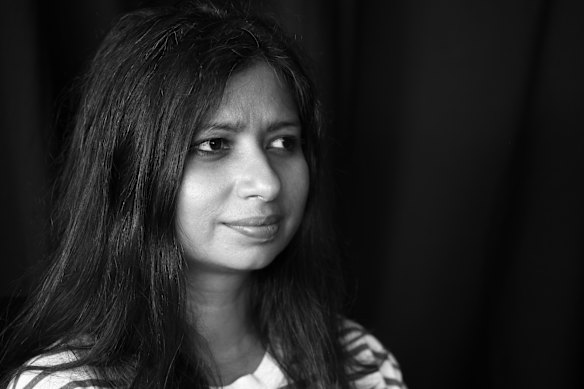
Sarah Ayoub
Neha Kale’s childhood memories are of time spent at her grandfather’s home on the banks of the Baga River in Goa. There, she splashed in tidal pools as small fish darted around her, ran through a “tangle of jackfruit and mango trees” on the hillside, and poked around the Virgin Mary grottoes, remnants of the region’s Portuguese conquest. In that house and its surrounding landscape, she felt “held”, afforded an assurance of her place in the world.
That feeling didn’t last, as her memoir Foreign Return demonstrates. When her family first migrated to Perth, she was often asked if she felt settled. Suburbia signals a politics of inclusion and exclusion; a house no longer feels like it is “the sum of material” of which it was built, but something more complex. When her grandfather died and the tether to his Goa house – one that his own grandparents built – was lost, Kale was no longer certain of what home was, or if it was indeed even a place.
The question of home, and what it is, is the central question in Foreign Return. Kale, an art critic and writer, does not only turn inwards to uncover the answer. Key to her musings is the world around her, specifically as it is captured in art, literature, photography and architecture.
She ruminates on the concept of home by keenly interpreting the works of others. There is Dayanita Singh, who has documented Indian life in Goa, Bombay and Delhi; John Brack’s 1953 painting The New House, a “study of cultural inheritance [and] the way suburban existence builds fences around middle-class whiteness”; Brett Whiteley’s legacy of work, and the way he saw places like Redfern and Bondi. Ana Mendieta’s Untitled: Silueta Series reminds her that home is not necessarily a physical place, and Albert Namatjira’s body of watercolour art challenges European perspectives of landscape. Carol Jerrems’ photographic archive, which dignifies those on society’s margins, shows her that to be “held safely by the gaze of someone who [saw] you” can be a version of home.
Place is integral to Kale’s work. She takes us through where she has lived and what she has learnt about herself and others, traversing India, Australia (including time spent in Perth, Melbourne, Sydney and Alice Springs), England and Mexico. When she returns to Bombay, she feels “ashamed of [her] awe” because time had made her foreign in the place she had come from. In Australia, she is unsure if the migrant dream is one she would necessarily choose herself, realising it is “less about moving towards a fixed address and more about a pursuit of the possible … calibrated towards opportunity”.
Split into three parts – House, World, Ground – Foreign Return is non-linear, and might be to some, an unusual memoir. At times, I would flip back a few pages, worried I had missed the introduction of someone whose name appears on the page. Her approach to the work mirrors the subject: it is meandering and fragmented, dipping in and out of contemplations about the legacies of colonialism, the politics of belonging, and the questions of ownership that especially plague migrants. Her body reacts viscerally to what is taking place in her mind, reaffirming her questions of whether we inhabit places or if they inhabit us, mapping themselves in and on our very bodies.
Foreign Return is a profound and laudable debut that reminds us that in “subscribing to the purity of our origins, we deny our multiplicity”. Home, it posits, can be a place of demolition, reconstruction and reconfiguration, a place of our own making.
Foreign Return by Neha Kale is published by NewSouth ($35).
From our partners
Disclaimer : This story is auto aggregated by a computer programme and has not been created or edited by DOWNTHENEWS. Publisher: www.smh.com.au