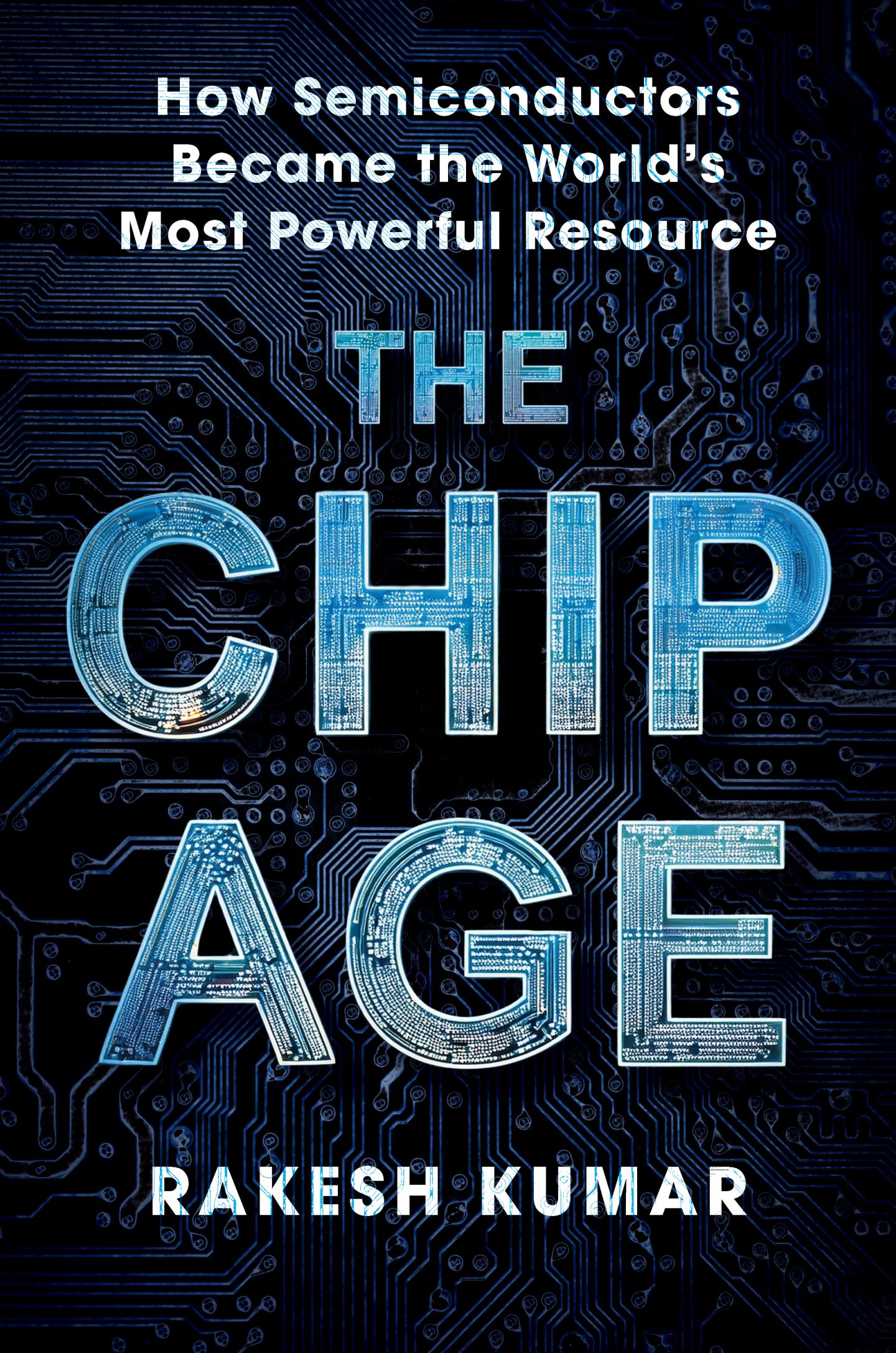
“I’m not going to say ‘I told you so,’” says Rakesh Kumar. “But it really is ‘I told you so.’”
Kumar, a professor of electrical and computer engineering at the University of Illinois Urbana-Champaign and author of Chip Age: How Semiconductors Became the World’s Most Powerful Resource, has spent four years as one of Washington’s most persistent academic critics of its attempt to freeze China’s chip industry.
Days before the Biden administration unveiled its sweeping export controls on advanced chips and chipmaking equipment in October 2022—restrictions that have been expanded repeatedly since—he warned in Fortune that the crackdown would not work. “You can’t win an important race by hoping to trip your opponent, especially when there are significant costs to doing so,” he wrote. “A far better strategy is to run faster.”
Four years later, the controls don’t seem to have worked. Chinese processors are closing the gap with their U.S. rivals; the country’s AI models already match some of the U.S.’s best models.
Kumar’s first question is what the controls were ever supposed to achieve. “For most applications of AI, you don’t need the most advanced chips,” he tells Fortune.
Robotics, smart cameras, and other widely used AI applications don’t require the most advanced silicon. And by cutting China off, Washington gave Beijing every reason to build its own alternatives. “Export controls spurred China to invest all this money to set up an ecosystem where they can now serve these applications by themselves,” Kumar says. “Not only have export controls failed in that sense, but they’ve had the opposite effect.”
Huawei—once on the brink of death under U.S. sanctions—is now releasing premium smartphones and AI processors. On Oct. 13, it said it had shipped more than 100 million devices powered by its homegrown Kirin processors since 2023.
China is catching up on the software side, too. Chinese models are “very, very close, in terms of performance, to the models from the U.S.,” Kumar notes.
Chinese AI lab DeepSeek and startup Z.ai have adapted their flagship models to run on Huawei’s Ascend processors. Meituan, China’s food delivery giant, said in June it had trained a 1.6-trillion-parameter AI model entirely on domestically made chips. Nvidia’s share of data center chips in China fell to 34% in the first half of 2026, while shipments of its AI accelerators dropped by 44% compared to a year earlier, according to IDC data cited by Reuters.
In memory chips, Chinese chipmakers even claim to be ahead. ChangXin Memory Technologies (CXMT), China’s leading memory chipmaker, said at an industry conference in Shanghai over the weekend that it would debut a new memory chip architecture by the end of the year—one that, if proven, would put it ahead of current leaders Samsung, SK Hynix and Micron.
Washington’s stated goal has changed. U.S. officials talk less about stopping Chinese AI development than about keeping the U.S. at the frontier. They point to a growing list of workarounds: Nvidia’s top-end B200 and B300 processors, barred from export, keep turning up inside China; Anthropic and OpenAI accuse DeepSeek and other Chinese labs of “distilling” American models (training on a rival’s outputs to close the gap cheaply).
Kumar isn’t persuaded. “I see this in the policy discussion already,” he says. “They keep shifting the goalposts.”
Squeezing more out of what they have
“If it’s a strategic goal or a military goal—where you really need to have the most advanced models, need to be at par in terms of AI—then I think there are all these different ways in which you can achieve that goal,” Kumar explains.
China can offset what it lacks in advanced chipmaking equipment with algorithmic techniques, open-sourcing, and advanced packaging. “You may be doing that at higher cost, but that’s a cost that you’re willing to swallow if you think that this is important for the country,” he says.
Chinese chipmakers have never been able to import the extreme ultraviolet (EUV) lithography machines built by Dutch chip-equipment giant ASML—the tools that print the tiniest features on the most advanced chips—because the Dutch government, under U.S. pressure, has withheld an export license since 2019. That has forced fabs such as Semiconductor Manufacturing International Corp. (SMIC), China’s largest chipmaker, to rely on less sophisticated deep ultraviolet (DUV) machines, squeezing out better performance from older machines.
“How scalable is it? How much yield can you get out of it? Those are questions that we still don’t know the answer to,” Kumar says.
Rather than cram more transistors onto a single layer of silicon, Huawei is stacking chips in three dimensions. In May, He Tingbo, president of Huawei’s semiconductor business unit, unveiled the company’s answer to Moore’s Law: the “Tau Scaling Law,” which focuses on how fast signals move across a computing system over how small its transistors are, with a target of 1.4-nanometer-equivalent chip density by 2031.
Strategic vs. commercial
But while China’s chip self-sufficiency is a strategic success, it’s not necessarily a commercial one.
“Can Chinese companies be competitive against Western inference providers? The answer would likely be no, at least in the short term,” Kumar concedes.
That may sound counterintuitive, given that Chinese open-source models have won plaudits worldwide for their low costs—and that China has cheap power. But the biggest inference providers are still not Chinese, he points out. “These models get developed in China, but then they’re getting served on American chips, in America.”
“If the Chinese could also serve these tokens cheaper than the Americans, well, they would just serve these tokens from China,” he adds. “Everybody would access these models on Chinese infrastructure. But that’s not what’s happening.”
The efforts by Huawei and other Chinese chipmakers to squeeze more performance out of less sophisticated hardware are impressive—but the results are still workarounds compared with the freedom Nvidia or AMD have. “The rate at which you get cost efficiency and performance benefits just from scaling the chips tends to be much higher than the other factors that contribute to overall cost and performance of systems,” Kumar explains.
‘AI is, in some sense, saving the chip industry’
The Chip Age is primarily a story about how semiconductors became one of the world’s most important commodities. But it’s also a warning.
According to Kumar, the cost of building each new transistor has started rising, and the foundry business has consolidated to the point where one company, Taiwan Semiconductor Manufacturing Co., dominates advanced chip manufacturing.
“There are these movies where you have a team and a set of protagonists, and they all end up dying one by one,” he says of the industry’s one-time rivals. “That’s how the movie played out in my mind.”
Semiconductors are a boom-and-bust industry. Before ChatGPT came on the scene, chipmakers were staring at a post-COVID chip glut.
“AI is, in some sense, saving the chip industry,” Kumar says.
So would a deliberate slowdown at the frontier labs—as pushed by Anthropic CEO Dario Amodei—put a dent in chip demand? “Not a strong one,” Kumar says. “The demand for semiconductors increases not only because a given customer needs more chips, but because the number of customers keeps increasing.” OpenAI and Anthropic, after all, aren’t the only drivers of semiconductor demand.
That doesn’t mean he’s not worried about a long-term stagnation in the chip sector. If demand for AI tapers, or the economics of chipmaking finally stall miniaturization, the West’s lead stops growing. “If chip scaling significantly slows down, or if the application drivers aren’t strong enough to sustain the increased cost of chipmaking, then that’s one scenario in which China may just catch up,” he says.
“Never underestimate the ability of humanity to innovate,” he adds. “The fact that these Chinese AI models are nearly as powerful as some of the American models, without access to these advanced chips, already tells you something.”
In Fortune’s Asia Agenda column, released at least twice a month, we speak with Asia’s top business leaders about how they are building for the future and the lessons they’ve drawn from leading companies in one of the world’s fastest growing and most dynamic regions. Explore all of our profiles here.

Disclaimer : This story is auto aggregated by a computer programme and has not been created or edited by DOWNTHENEWS. Publisher: fortune.com