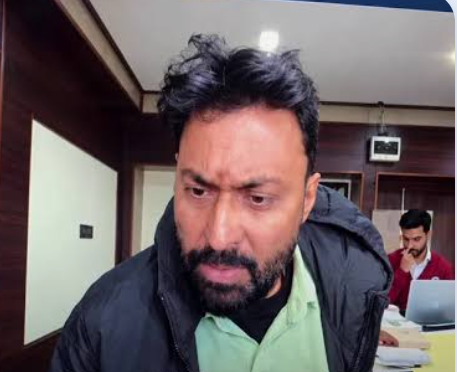
SRINAGAR: A senior IAS officer’s alleged verbal abuse of a subordinate woman JKAS officer during a virtual government meeting in Jammu and Kashmir has escalated into a major controversy, prompting widespread calls for an impartial inquiry and firm action.
The incident, captured in a video that has circulated widely on social media, has drawn sharp criticism from civil servants, political leaders, and the public, with many describing the officer’s behaviour as unbecoming of someone in a senior administrative position.
The controversy centres on IAS officer Kumar Rajeev Ranjan, who allegedly shouted at Assistant Director Beenish Wani, used derogatory language, and threatened to recommend her dismissal from service during a review meeting on Mission YUVA. The exchange reportedly unfolded as Wani attempted to explain the involvement of the National Rural Livelihood Mission (NRLM) in achieving departmental targets. Ranjan repeatedly interrupted her, questioned her competence, and allegedly asked her to “shut up,” later instructing another officer to draft a suspension order.
As seen in the viral video, the IAS officer is heard calling the woman official “bloody shit.” When she objects to his language, he responds by saying that he can speak to her that way because “I am your boss.” He then threatens to suspend her, to which she replies that he may do so and adds, “To hell with you.”
The IAS officer has not publicly commented in detail, but some reports suggest he has privately claimed that the viral video is “AI-generated,” a defence that has further fuelled criticism from the Jammu Kashmir Administrative Service (JKAS) fraternity, which maintains the video is authentic and corroborated by multiple officials present during the meeting.
Chief Minister Omar Abdullah, reacting strongly to the incident, said the conduct seen in the video “prima facie was not in keeping with the standards expected of a senior IAS officer.” In posts on social media, Abdullah said he had taken up the matter with the Chief Secretary and instructed that no retributive action be taken against the JKAS officer. He stressed that had J&K been a state, the IAS officer would have been attached to the General Administration Department pending an inquiry. As a Union Territory, he said, the authorities controlling IAS officers must “set the right example” and ensure that abusive behaviour is not ignored.
The JKAS fraternity issued a detailed statement condemning the alleged abuse and public humiliation of Wani, asserting that no supervisory authority can justify intimidation or language that undermines the dignity of a serving officer. They also alleged that this was not an isolated incident, claiming the IAS officer has a pattern of using “unparliamentary and demeaning language” in official settings. The fraternity criticised what they described as an attempt by the department to dismiss the video as fabricated, calling the clarification “deeply unfortunate” and demanding an impartial inquiry by the Lieutenant Governor, Chief Secretary, and the General Administration Department.
Political voices have also weighed in. National Conference MP Aga Syed Ruhullah Mehdi condemned the behaviour, describing it as symptomatic of a broader erosion of administrative dignity post–Article 370 abrogation. He warned that any retaliatory action against the woman officer would have consequences.
As criticism intensifies over the IAS officer’s conduct, commentators have begun revisiting his earlier entanglement in the high‑profile J&K arms‑licence scandal—a case that has shadowed his administrative career for years. Ranjan, a 2010‑batch AGMUT cadre IAS officer currently serving as Administrative Secretary in the Labour & Employment Department of the J&K Government, has previously held several significant positions, including Secretary of the Skill Development Department. Yet it is his tenure in Kupwara that continues to draw scrutiny.
Ranjan served as Deputy Commissioner and District Magistrate of Kupwara from roughly March 2015 to November 2016, a period that coincided with a broader multi‑district investigation into fraudulent arms‑licence issuance across J&K between 2012 and 2016. Before him, the Kupwara post was held by co‑accused officer Itrit Hussain Rafiqui (JKAS) from about 2013 to 2015. Across these years, several DMs/DCs in multiple districts were accused of issuing extraordinarily large numbers of gun licences—reports cite between 2 lakh and 2.78 lakh licences—to non‑residents, including many Armed Forces and paramilitary personnel, allegedly on the basis of forged documents and in exchange for monetary kickbacks. The racket first came to light when the Rajasthan Police ATS flagged suspicious licences; the case was later taken over by the Central Bureau of Investigation (CBI) in 2018 through a Vigilance Organisation Kashmir FIR.
On 1 March 2020, the CBI arrested both Ranjan and Rafiqui in connection with the scam, after which the J&K administration suspended Ranjan from service. He was remanded to CBI custody as the investigation widened across districts and administrative tenures. Nearly a year later, in early February 2021, a government review committee recommended revocation of his suspension. Ranjan was reinstated around 8–9 February and posted as Additional Secretary in the Revenue Department, also holding additional charge as Additional CEO of J&K Land Records Management Agency, before moving on to other senior administrative roles.
The case resurfaced prominently in late 2024 when the Union Ministry of Personnel, Public Grievances and Pensions (through the Department of Personnel and Training) granted formal sanction for Ranjan’s prosecution under the Prevention of Corruption Act. The order, dated November 28, 2024 and publicly reported in early January 2025, made him the first IAS officer in this multi‑officer investigation to receive such sanction, clearing the way for further legal proceedings.
As renewed criticism of his current conduct grows, this earlier chapter—marked by allegations of large‑scale irregularities, arrests, suspension, reinstatement, and prosecution sanction—has once again become central to public debate surrounding his administrative record.
Disclaimer : This story is auto aggregated by a computer programme and has not been created or edited by DOWNTHENEWS. Publisher: deccanchronicle.com