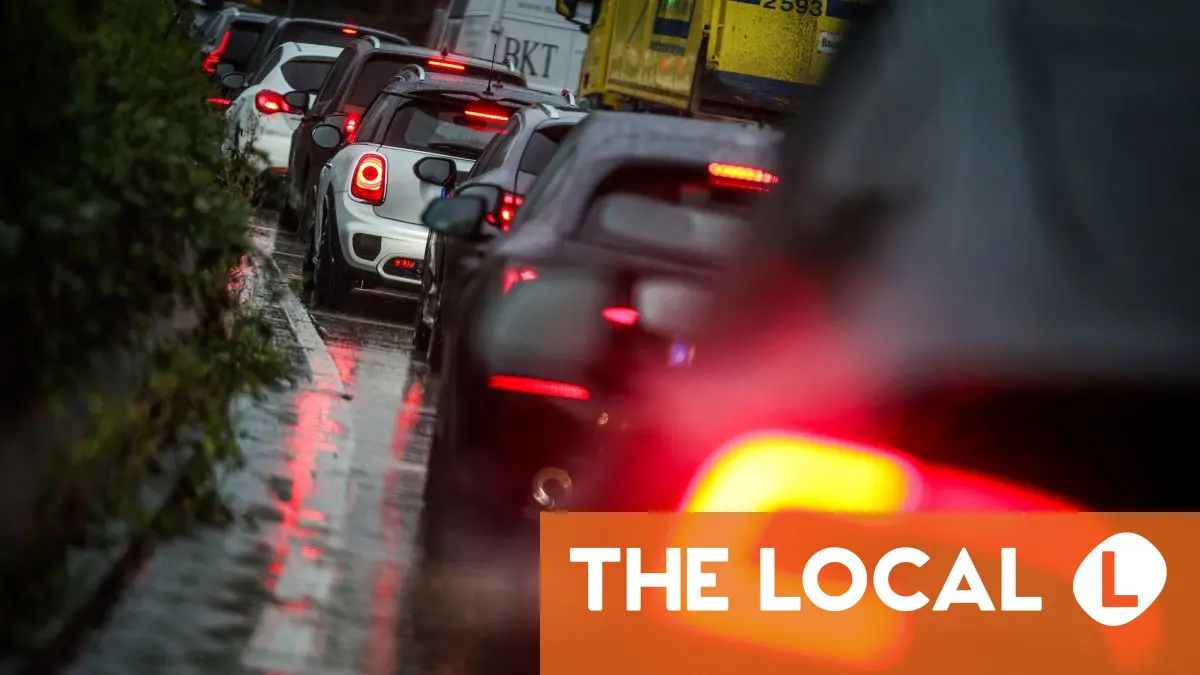
Anyone planning a road trip this weekend may need extra patience as major congestion is expected across Germany due to autumn holiday traffic and on-going roadworks.
The ADAC is warning of heavy congestion on Germany’s roads and highways this weekend as a number of states see schools let out for the autumn holiday.
According to the motoring association, which keeps an eye on expected traffic conditions in the country, traffic volumes could come close to the levels normally seen during the summer holidays, as millions of drivers take to the roads across Germany and neighbouring countries.
For travellers, that’s likely to mean lengthy delays, slow-moving traffic and longer journey times.
Why is traffic expected to be so bad?
This weekend school autumn holidays are either beginning, ending or continuing in 14 of Germany’s 16 federal states.
The break is just getting under way in Berlin, Brandenburg, Hamburg, North Rhine-Westphalia, Saxony-Anhalt and Mecklenburg-Western Pomerania, while holidaymakers in Hesse, Rhineland-Palatinate and Saarland are beginning their return journeys.
Several other states are already in the second week of their autumn break.
That means large numbers of families are travelling at the same time, whether heading for Germany’s coasts, the Alps and low mountain ranges or destinations further south in Europe.
READ ALSO: KEY DATES – All the school holiday dates in Germany for 2026 and 2027
On top of that, autumn remains a popular season for hiking trips, city breaks and weekend getaways. If the weather is favourable, many day-trippers are also expected to head towards mountain regions, adding even more pressure to the road network.
Roadworks are making the problem worse
Holiday traffic alone would be enough to cause delays, but drivers also face a second major challenge – roadworks.
According to the ADAC, work is currently taking place on more than 1,000 sections of motorway across Germany. Construction sites, lane restrictions and temporary diversions are expected to be among the biggest causes of bottlenecks throughout the weekend.
Several major roads will also face temporary closures, including sections of the A3, A8, A40, A43 and A93.
Drivers should check traffic updates before setting off, particularly if travelling through North Rhine-Westphalia, Bavaria or around major urban centres.
Where are the worst delays expected?
The ADAC says congestion is likely in both directions on many of Germany’s most important long-distance routes.
Particularly busy stretches could include:
- the A1 between Lübeck, Hamburg, Bremen and Cologne
- the A3 connecting Cologne, Frankfurt, Nuremberg and Passau
- the A5 between Frankfurt and Basel
- the A7 linking Hamburg with southern Germany
- the A8 between Stuttgart, Munich and Salzburg.
Heavy traffic is also expected on the Berlin ring road, the Munich ring road and routes around major cities including Cologne, Frankfurt, Hamburg and Munich.
READ ALSO: ‘Gute Fahrt’ – The essential vocab you need for driving in Germany
Cross-border routes are likely to be especially busy as travellers head towards Austria, Switzerland and Italy.
One small piece of good news is that a driving ban for lorries weighing more than 7.5 tonnes will be in force on most motorways throughout Sunday.
But drivers should still expect significant numbers of heavy goods vehicles on the roads. This is because several federal states have extended temporary exemptions introduced to help move freight during periods of low water levels on Germany’s rivers.
Border checks and autumn driving conditions
Motorists heading abroad or returning to Germany should also allow extra time for border crossings.
Germany has maintained stricter border controls since 2025, and waiting times are possible at several major crossings, including Suben on the Austrian border, Walserberg near Salzburg, Kiefersfelden in Bavaria and crossings from Poland.
Drivers travelling towards Austria, Switzerland or Italy should also be prepared for congestion on major transit routes such as the Brenner corridor and Switzerland’s Gotthard route.
READ ALSO: What you need to know about changing to winter tyres in Germany
Finally, motorists should remember that autumn weather can create additional hazards. Fog can reduce visibility dramatically, and anyone travelling in mountainous regions should ensure their vehicle is equipped for winter conditions.
In Germany, winter or all-season tyres are mandatory whenever snow or ice is encountered on the road.
For most drivers, the advice is simple: allow extra time, check traffic conditions before departure and prepare for a slower journey than usual.
Disclaimer : This story is auto aggregated by a computer programme and has not been created or edited by DOWNTHENEWS. Publisher: thelocal.de