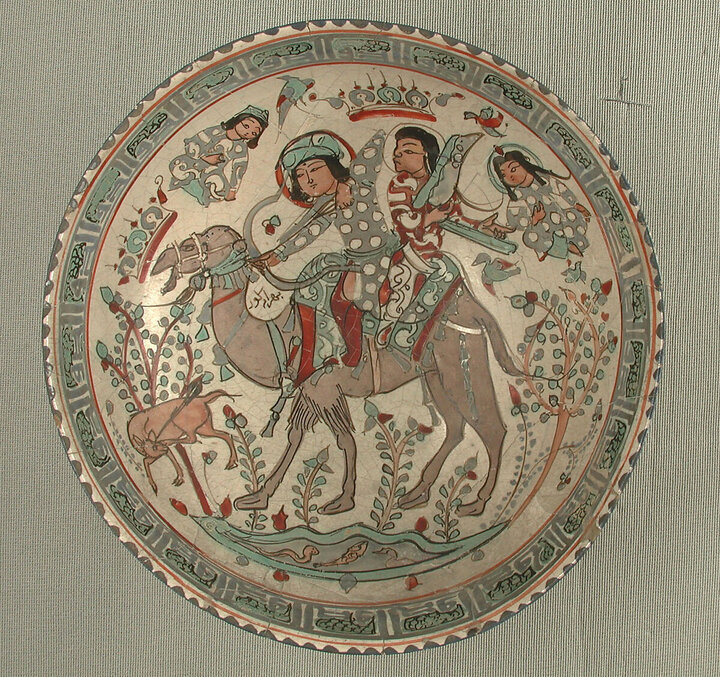
TEHRAN – Combining intricate craftsmanship with scenes from Persian epic literature, minai’i ceramics transformed ordinary vessels into richly illustrated works of art during Iran’s Seljuk period. The tradition flourished in the late 12th and early 13th centuries before disappearing amid the upheavals of the Mongol period.
A bowl preserved at New York’s Metropolitan Museum of Art captures a scene from the story of Bahram Gur and Azadeh, depicting the legendary Sasanian king hunting alongside Azadeh, a harp-playing woman. Made in Iran in the late 12th or early 13th century, the bowl features multicolored painting and gilding, demonstrating the technical skill and artistic imagination of medieval Iranian potters.
When pottery became a storytelling medium
Minai’i potters transformed bowls, plates and other vessels into miniature pictorial worlds featuring horsemen, hunters, musicians and characters from Persian literature. Rather than merely decorating functional objects, they used their curved surfaces to narrate stories through carefully arranged figures and scenes.
Episodes associated with the Shahnameh, the Persian epic composed by Ferdowsi around the turn of the 11th century, feature prominently among the subjects. Other motifs include royal hunts, courtly gatherings, musical performances and encounters between legendary characters.
These ceramics provide valuable evidence of how Persian literary narratives were translated into visual art before the Mongol period. In some cases, their imagery predates the earliest surviving illustrated Shahnameh manuscripts by nearly a century, according to the Metropolitan Museum.
The bowl depicting Bahram Gur and Azadeh is particularly revealing. The story combines a royal hunting expedition with a confrontation over the treatment of animals, ending in tragedy. By bringing together elements of the narrative, the artist compressed a complex literary episode into a single composition.
The Metropolitan Museum holds a notable collection of Iranian minai’i ceramics, including bowls decorated with human figures, horsemen and abstract motifs, as well as an ewer bearing a procession of riders and Kufic inscriptions.
Another important example is a large ewer preserved at the Los Angeles County Museum of Art (LACMA), attributed to Kashan in central Iran and dated to the late 12th or early 13th century. It illustrates the scale and complexity of the craft.
A demanding process behind the beauty
The sophistication of minai’i pottery lay as much in its production technique as in its imagery. The term derives from the Persian word mina, meaning enamel, and is used for ceramics decorated with multiple colors applied both beneath and over a glaze. The technique is also known as enameled ware.
The vessels were generally made from stonepaste, also called fritware, a ceramic material composed principally of crushed quartz, glass frit and a smaller proportion of clay. This mixture produced a relatively light-colored body suitable for fine vessels covered with an opaque glaze.
Decoration required multiple firings. Some pigments were applied beneath the glaze before the initial firing. Additional colors were painted over the fired glaze and fixed in a second firing, usually at a lower temperature. Gold could also be incorporated into the decoration.
The process demanded exceptional precision. The temperature had to be sufficient to fix the additional pigments without damaging the existing glaze or earlier decoration. An error during firing could ruin an extensively decorated vessel.
These labor-intensive, technically demanding procedures made minai’i ceramics costly luxury objects. Their production required expertise in materials, kiln temperatures and painting, resulting in vessels distinguished by their rich colors, intricate figures, elaborate costumes, decorative borders and gilded details.
Kashan and the rise of luxury ceramics
Kashan, in central Iran, is closely associated with minai’i production and was an important center of luxury ceramics during the late 12th and early 13th centuries. Museum catalogues and art-historical studies attribute many surviving examples to the city.
The LACMA ewer, for instance, is attributed to Kashan and identified as fritware decorated with both inglaze and overglaze painting. However, the available evidence does not establish Kashan as the origin of every surviving minai’i vessel. The precise origins of individual objects and the extent of production at particular workshops remain subjects of scholarly investigation.
The tradition emerged during a period of experimentation in Iranian ceramic art, as potters sought to expand their color palettes and create increasingly elaborate designs. The appearance of literary characters on these vessels also demonstrates how Persian stories circulated beyond written texts into other artistic forms.
Minai’i ceramics thus offer insights into the relationship between literature, courtly culture and visual representation in medieval Iran. Their carefully composed scenes preserve evidence of how artists interpreted familiar narratives and adapted them to the limited surfaces of bowls and other vessels.
An art interrupted
Minai’i production ceased as a recognizable luxury-ware tradition during the upheavals of the 13th century, coinciding with the Mongol invasions of Iran. The precise circumstances of its disappearance remain uncertain, however, and the available evidence does not establish the invasions as its sole cause.
Other forms of Iranian ceramic production continued and evolved under subsequent rulers. The disappearance of minai’i therefore marked the end of a particular combination of materials, techniques and figurative decoration, rather than the end of sophisticated pottery-making in Iran.
The surviving examples have a relatively narrow chronology, with many dating from the late 12th to the early 13th century. Today, collections in New York and Los Angeles preserve tangible evidence of this short-lived but highly accomplished tradition.
A minai’i vessel was more than a household object: it was a work of art that combined literary storytelling, technical experimentation and ornamental design. Centuries after the workshops that produced them fell silent, these ceramics continue to reveal how Iranian artisans transformed clay, glass, pigments and gold into some of the most sophisticated vessels of the medieval Islamic world.
AM
Disclaimer : This story is auto aggregated by a computer programme and has not been created or edited by DOWNTHENEWS. Publisher: tehrantimes.com