For over five decades, there have existed two types of movie lover: those who have been at least a little corrupted by Ken Russell’s 1971 iconoclasterpiece “The Devils” and those who haven’t seen it. With the release of a newly restored director’s cut, which premiered in Cannes this year to a reception that begs to be described as orgiastic, ejaculatory, lubricious or orgasmic — take your pick — the unjustly deprived inhabitants of the latter category get to be inducted into the former.
Some are going to hate it. Some may affect a “can’t see what all the fuss is about” attitude — that is their right, as it is mine to simply not believe them. But some, witnessing what critic Judith Crist once referred to as a “grand fiesta for sadists and perverts” will find that abandoning themselves to its wantonly grotesque, profane imagery will feel like the giddiest liberation. From what, exactly? The tyranny of tastefulness? The despotism of decency? Whatever it is, blasphemy loves company, so welcome, sickos!
Several honey-roastings beyond hammy and a hundred rows of tents beyond camp, “The Devils” tells the story of a real event: the 1634 heresy trial and execution of Urbain Grandier (Oliver Reed), a libertine Catholic priest, who fell afoul of the religious and political establishments when defending the independence of the Protestant-friendly fortified city of Loudon in western France. The torrid tale involves an order of Ursuline nuns led by hunchbacked Sister Jeanne (Vanessa Redgrave) who accuse Grandier of witchcraft, which provides wily Cardinal Richelieu (Christopher Logue) and peevish Louis XIII (Graham Armitage) with the pretext for suppressing dissent.
Aldous Huxley’s 1952 nonfiction account “The Devils of Loudon,” and John Whiting’s 1960 play “The Devils” both formed the source material for Russell’s screenplay, in the sense that he clearly read them, then flung them, along with the Latin bible, the Kama Sutra, a bit of Looney Tunes, a dose of swinging ’60s psychedelia and some of the more stomach-turning passages from the Marquis de Sade onto the pyre of his own unholy, lapsed-Catholic imagination.
The resulting film became infamous almost as soon as it was released and has never been readily available in the U.S, at least not in its full form. The 2026 cut (technically the first release from Clockwork, a distribution arm of the newly merged megacorp Skydance, which is hilarious) reinstates several minutes, including the full “Rape of Christ” sequence, in which a bevy of uninhibited and un-habited nuns writhe atop a statue of the crucified Christ, as well as the scene where Redgrave’s deranged, scoliotic Sister Jeanne apparently begins to masturbate on Grandier’s charred femur bone.
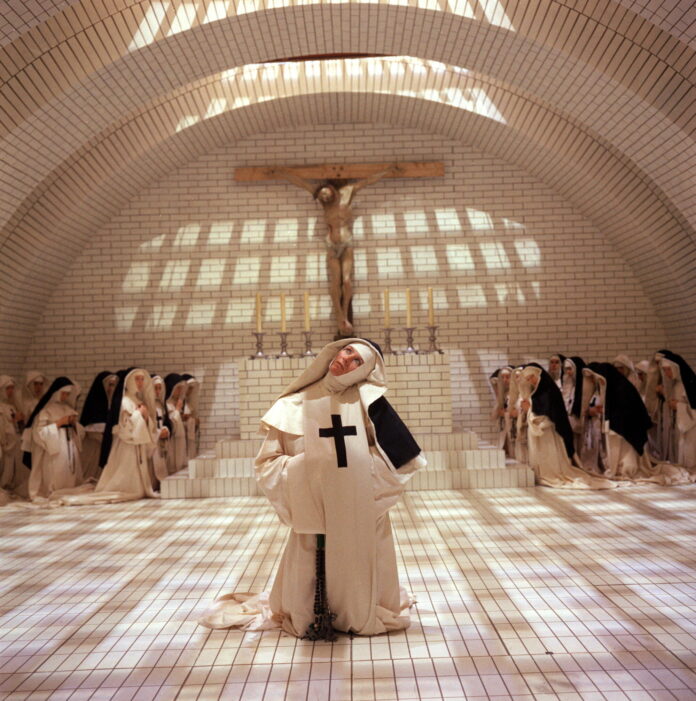
Both of these sequences have long been the Holy Grail for aficionados, but they are not the most impressive thing about this new version: That would be the immaculate re-conception of its visual splendor, which makes the movie dazzlingly sharp and new. The edges of Derek Jarman’s severe, anachronistically abstract sets are crisp and white again, the blood so very bloody and Oliver Reed’s eyes, which in the older, muddier versions look gray-brown, are suddenly so vivid they remind you that the hottest flames — hotter than the screaming orange conflagration that eventually consumes him — actually burn blue.
Hotness defines Reed’s Grandier beyond just his eyes and the smoky baritone in which he delivers his proclamations, prohibitions and occasional jokes. “Do you love the church?” asks Baron de Laubardemont (Dudley Sutton) as mad-eyed hipster Witchfinder Father Barre (Michael Gothard) drives another wedge between his mangled legs. “Not today,” grunts Grandier.
It’s hard to imagine any other actor being convincingly witty under torture and at other times quite silly (as when he fends off an attack using a stuffed crocodile that he happens to have just thrown out of a nearby window) while still radiating such charismatic cocksmanship that the local womenfolk invent sins just to confess to him. The mere mention of his name can send an entire hysteria of nuns into roiling spasms of sexual frenzy.
Vanessa Redgrave, center, in the restored “Ken Russell’s The Devils.”
(Warner Bros. Clockwork)
But to glimpse Reed here, at his most beautiful, is to think: yup, plausible. And yet his towering performance is characterized by restraint, even more so as the ghastly climax arrives, and we realize that all of Reed’s brutish sensuality, all of Russell’s sensationalism and all of “The Devils’” chicanery, buffoonery and primping, preening vanity have been in service of a furious message that is as deadly serious as its presentation is garish.
That message — a howl of righteous anger at state corruption and the perversion of religion to serve the nefarious agendas of cruel, power-mad men — is what makes “The Devils” sacrilegious yet not apostate. It does not scorn God or faith, but the misuse of both by petty manipulators. Sure, Russell has a little dirty fun in doing so — OK, a lot of dirty fun. However, charges of “The Devils” therefore being an inherently sexist piece of work also don’t really stand up, and not only because of Redgrave’s fearlessly creepy, giggly performance of outré erotic obsession.
In fact, there’s a whole feminine tragedy written in one single monologue: “Most of the nuns here are noblewomen who have embraced monastic life because there was not enough money at home to provide them with dowries,” crows Jeanne crookedly, “Or they were unmarriageable because ugly and a burden to the family.” Remembering that the naked nuns are not cloistered because of some vocational dedication to Christ but because of their troublesome uselessness to the patriarchal order, they become that much more sympathetic. These women are just doing what they must to survive another day as the most expendable members of a grossly unequal society; who among us should begrudge them an orgasm or two while they’re at it?
The debauchery is the point. Just as Grandier’s ultimate sacrifice is only made meaningful by his history of repeated, lascivious indulgence in the fleshier sins, so can “The Devils” be an unapologetically maximalist exhibition of carnal depravity that is also quite profoundly moral. And that its morality involves speaking truth to power and resisting authoritarian control makes it shockingly relevant right now. Writing in the Los Angeles Times in 1971, critic Charles Champlin ended his elegant pan with the observation that “you weep not for the evils and the ignorance of the past, but the cleverness and the sickness of the day.” To that, as to many of the negative responses, especially in our peculiarly sickly times, it is possible simply to respond, “Yes, isn’t that great?”
Imagining the movie lying dormant all these years just waiting for the right moment to be reborn, it becomes irresistible to conflate that small section of the public who have been avidly anticipating its return with Sister Jeanne, clamoring for the elusive object of her lust through a barred window. And to once more conflate Grandier — the repentant sinner immolated on the pyre of mass delusion, political machination and religious intolerance only to be rehabilitated as a charismatic martyr for liberty — with “The Devils” itself, as it finally rises from the bone-ash of its contemporary reception to shock, titillate, corrupt and invigorate anew. What you choose to do with its charred femur is between you and your God.
‘Ken Russell’s The Devils’
Rated: NC-17, for sexual content/graphic nudity
Running time: 1 hour, 54 minutes
Playing: Opens Friday, Oct. 16 in limited release
More to Read
Disclaimer : This story is auto aggregated by a computer programme and has not been created or edited by DOWNTHENEWS. Publisher: latimes.com