
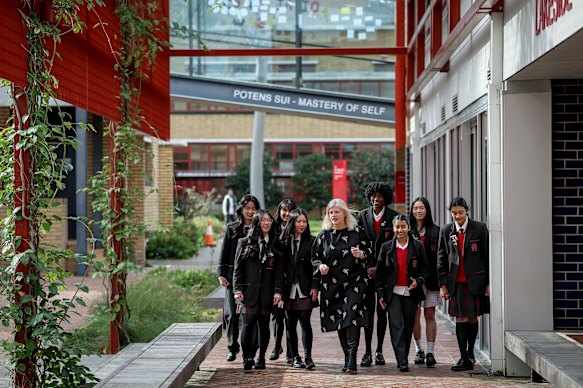

Thousands of students miss out on a spot at select-entry Mac.Robertson Girls’ High School every year.
Its popularity, and that of the state’s three other selective-entry high schools, is fuelling an ongoing debate that is about to become an election issue.
There are only 1000 new spots at the four schools every year, but thousands take the entry exam in the hope of securing a coveted enrolment.
While proponents argue this demand shows why Victoria needs new selective schools – as promised by the state Liberals – critics say they are fuelling social segregation.
Mac.Robertson is hemmed in by Albert Park, apartment buildings and the chaotic Kings Way, meaning its current campus has no room to grow.
The lure for parents is the promise of academic results that rival those of many private schools, without the expensive price tag.
An analysis of data from the education department, curriculum and exam body found it was consistently one of the top-performing schools in the state. That’s based on the percentage of individual study scores above 40.
According to the 2025 data, 34.7 per cent of the cohort received a score of 40 and above, while the median study score was 37. The state average last year was 30.
In the previous year, 31.1 per cent of the school’s students received a mark of 40 and above, and their median VCE study score was 37.
Its closest competitor is Ruyton Girls’ School in Kew, which had 30.9 per cent of its cohort achieve a score of 40, while its median study score was 36.
Principal Sue Harrap says she must balance the school’s “VCE reputation” with the reality of running an ageing campus with space limitations.
“We are tiny, we’ve got three buildings,” Harrap says. “There’s nowhere for us to expand to.”
There is no outdoor recreation area so they pay to use the nearby Melbourne Sports and Aquatic Centre and athletic centre, she says.
The school is also forced to shell out to use sports fields at Fawkner Park in South Yarra, where students have their physical education and health lessons.
Mac.Robertson also does not have the funds of some of the nearby private all-girls’ schools and was forced to drop its International Baccalaureate program last year due to its running cost.
A Victorian auditor-general’s report, published in June, rated the school in “worn” condition.
But despite these issues, Mac.Rob’s (its nickname) is still a destination of choice, with 300 pupils earning a coveted place there each year.
Harrap says many new students have to adjust to not always being the best.
“There is a huge impact on the students’ identity when they come here – they’re used to being the best,” she explains.
Many have perfectionist tendencies, an internal narrative that can be damaging to their self-confidence, she says.
“Then they can feel like they’re not good any more,” Harrap says.
Students also have to deal with the school’s reputation as a cut-throat “VCE factory” only concerned with getting the highest ATAR or study scores.
Harrap says while they value results, the reputation is overblown.
“The students understand the VCE works best if you collaborate as a group and support each other to do well,” she says.
“It’s not a dog-eat-dog world that people think it might be, and no one is dragging each other down. They really support each other to grow.”
Mackenzie Li did an intensive two-month study course before the entry exam to increase her chances of being accepted.
“It feels really stressful especially for a 13-year-old,” she says of the test.
Now a year 11 student at the school, the 16-year-old has just returned from the US, where she did an international extension program at Yale.
But for Li, it was worth the stress and study once she was accepted.
“We may not have the best facilities, or … the most money to build the fanciest campus, but I think the community really makes it worth it,” she says.
While the academic side of the school can be intense, she always felt supported by staff and her peers.
“If I had to do it again, I would, just because I think being in the school has, personally, given me a pathway to be the best version of myself and my future,” she says.
Stories like Li’s, however, are why critics argue the system is broken.
The drive for parents to get their children into the state’s four select-entry schools see many pay thousands on professional tutors.
Trevor Cobbold, from the group Save Our Schools, which campaigns for education equity, previously says more select-entry schools would be the wrong move for Victoria.
“More selective schools would exacerbate social segregation in the public system and increase the already high concentration of low-income and other disadvantaged students in some schools which lowers student results.”
Harrap warns if new students fixate on academic rankings, they will be let down, and the school has shifted to ensuring students work to achieve their personal best, rather than just getting top marks.
“The irony for this school is that you have to perform well on a test to get in, but if you continue to have that performance orientation, and you’re looking to be number one, [most] … we take 300 kids in every year, and 299 of them will be disappointed.”
To combat this, the school works to shift mindsets away from pure results towards emotional regulation and wellbeing – a vital transition for the incoming year 9s.
They not only have to navigate that change, but often face long commutes, a new routine and their own changing identities.
“Their mindset needs to shift to ‘I’m no longer striving to be the best; I’m striving to be the best version of myself’,” Harrap says.
The students realise their peers possess similar skills, and this helps, rather than hinders, their abilities.
At the same time, staff work to demystify academic struggle.
“Learning is about finding out about things you don’t already know, and that requires struggle.”
For year 12s, the myth that senior year is solely about chasing a 50 study score or a perfect ATAR is equally inaccurate, she says.
“There’s always an element of fun,” 18-year-old Claire says, pointing to school formals and house dress-up events alongside study sessions.
“There’s obviously a fair bit of stress as well, but it’s about riding the highs and lows as you go throughout the year.”
“Now the focus is pursuing growth, not just teaching information, but helping students set goals, apply skills, find help, and celebrate their vulnerability.”
Japanese teacher Shungo Sawaki
Her peer Suri agrees, noting the shared pressure for year 12s creates a safety net of sorts.
“You really have your people around you as a support system, friends you can count on to take a break from studying every once in a while.”
This emphasis on balance reflects an evolution within the school over the past decade, says veteran teacher Shungo Sawaki who has taught at Mac.Rob’s for nearly 30 years.
“I, personally, had to change my teaching methodology a lot,” Sawaki explains of the change from when he started at the school in 1999.
“Now the focus is pursuing growth, not just teaching information, but helping students set goals, apply skills, find help, and celebrate their vulnerability.
“Not everyone has to be a superhero.”
Sawaki has also watched the school demographics shift alongside Australia’s migration trends.
While its original students were largely from Anglo-Saxon backgrounds, this shifted to girls of Greek and Italian heritage, then Eastern and Central European families, and most recently to students of South-East Asian and Chinese descent.
According to MySchool data, 88 per cent of Mac.Rob’s students speak a language other than English at home – something the school considers one of its greatest strengths.
Former student, policy adviser and Miss Universe Australia winner in 2019, Priya Serrao, says her cohort included many first and second generation migrants.
“It allowed us to get access to facilities and teaching and amenities that we wouldn’t get otherwise,” she says.
For her, that included studying four languages and taking part in drama studies and performances.
Serrao still remembers waiting at Watergardens train station in Melbourne’s outer north-west with about 15 other girls in their Mac.Rob’s uniform to start their first day at the school.
“It was just a bit of a haven for someone like me, and I didn’t even think that schools provided those types of classes, and having kids around me that are just as kind of bubbling with excitement to do all of this stuff, too, was great,” she says.
Serrao recognises she was lucky to attend the highly sought-after school.
The vast majority of students who attend Mac.Rob’s (70 per cent) come from “advantaged” backgrounds, according to data about the socio-educational background of pupils.
The sentiment that education could offer young people more opportunities goes back to the school’s founding in 1905, when the co-educational Melbourne Continuation School opened in Spring Street, offering students the opportunity for education past year 8.
When the boys split off in 1927 to attend what would become Melbourne High School, the girls stayed behind in a dilapidated building.
By 1930, the Spring Street building would be condemned, forcing the girls to move first to Government House, and three years later shuffled off to King Street.
A landmark gift helped secure the school’s permanent home footsteps away from Albert Park.
Confectionery mogul Macpherson Robertson, who invented the Cherry Ripe and Freddo Frog, donated £100,000 to mark the state’s centenary in 1934, with £40,000 earmarked for a dedicated girls’ school. It was named in his honour.
Sophia Ao attended the school and now tutors other girls, like Li, hoping to gain admission.
Now studying a law and commerce degree at Monash University, Ao credits the school with her success and resilience.
She notes the increase in numbers of students who want to prepare for the entrance exam, with some starting up to a year in advance.
Many of those who attended Mac.Rob’s say it provided them with a life-changing experience and lifelong connections.
Its alumni include Miles Franklin-shortlisted author Alice Pung, historian and writer Clare Wright, OAM, technology entrepreneur and 1998 Young Australian of the Year Tan Le and opera soprano Antoinette Halloran.
Lauren Solly, president of The Palladians Association alumni group, says an unspoken connection exists between women when they find out they both attended Mac.Rob’s.
“We know how rewarding, but also how tough, it can be at times as a Mac.Rob’s student,” she explains. “As graduates we get it and can be the safe space, the supportive ear, the mentor, the coach, the guide, the words of wisdom and encouragement.”
The HR professional says leadership programs at the school helped her forge a successful career, and she wanted to give back.
“As much as the students are looking to alumni for inspiration for their future paths, the students are just as inspiring for us as alumni. It’s really purposeful work,” Solly says.
She says the network helped to give genuine feedback and support.
“So we can all put our best selves forward and thrive based on our merits and strengths – that’s the stuff that sticks in the long run.”
The future of Mac.Rob’s and the state’s other select-entry schools may hinge on the result of November’s state election.
The opposition has made an election pledge to build three additional select-entry high schools in the outer suburbs and convert six more to focus on gifted students.
Opposition Leader Jess Wilson says: “Thousands of students sit the select-entry school exam every year and too many of them are missing out because there are not enough places. A government I lead will expand opportunities for students and parents from across Victoria to access select-entry schools.”
Education Minister Gabrielle Williams says the plan was unrealistic for the $150 million pledge.
She warned that under the Liberals’ plan, existing year 9 students at converted schools would have to leave if they didn’t pass a test.
The minister did not respond to questions by The Age about whether she would consider land acquisition for MacRob’s or pledging more money to update infrastructure.
Start the day with a summary of the day’s most important and interesting stories, analysis and insights. Sign up for our Morning Edition newsletter.
 Caroline Schelle is an education reporter, and joined The Age in 2022. She previously covered courts at AAP.Connect via X or email.
From our partners
Disclaimer : This story is auto aggregated by a computer programme and has not been created or edited by DOWNTHENEWS. Publisher: www.smh.com.au



