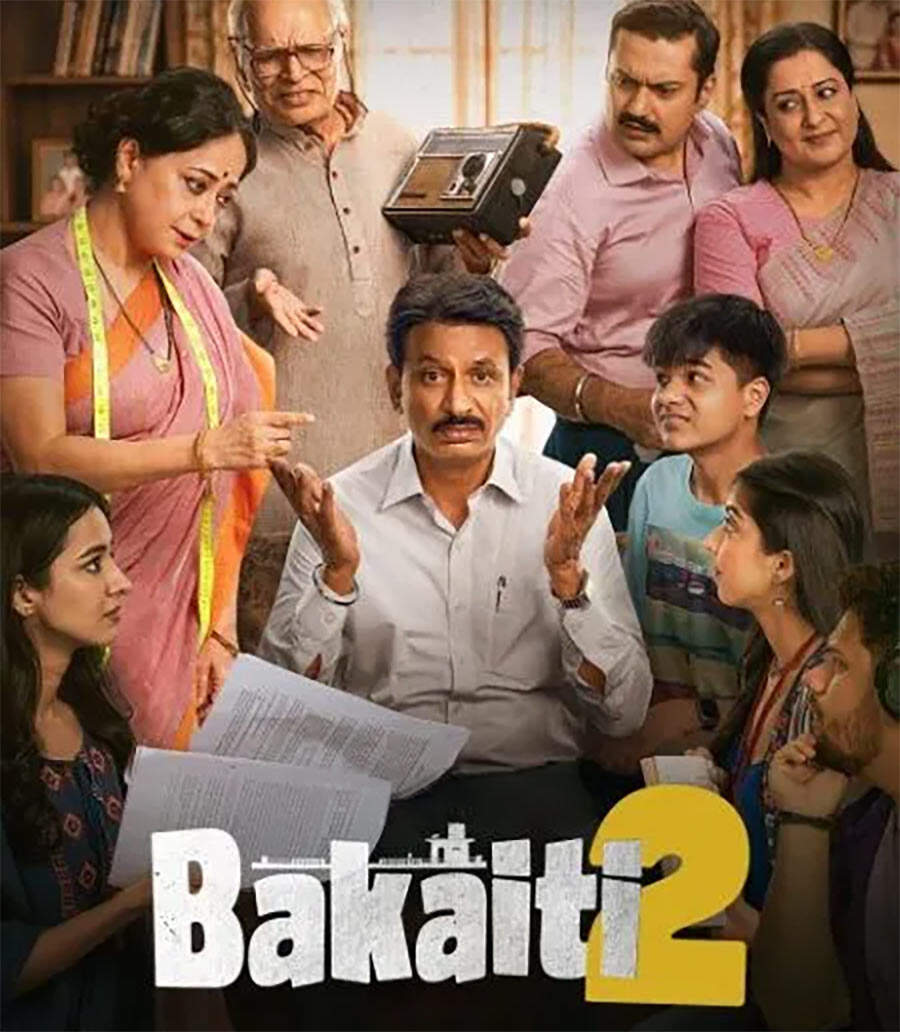
With Bakaiti 2 out, Rajesh Tailang returns to a family drama that finds its humour and conflict in the everyday lives of a middle-class household. As Sanjay Kataria, he plays a father whose sense of responsibility often comes with an instinct to keep his vulnerabilities hidden. The character also offers an interesting contrast to Tailang’s own experience of fatherhood.
In this conversation with Filmfare, the actor discusses the nuances of playing Sanjay, his long-standing working relationship with co-star Sheeba Chaddha, and why stories centred on families continue to find an audience. He also reflects on the changes he has witnessed in the film industry over the years and discusses taking the Mirzapur universe to the big screen.
What did you personally relate to about the Kataria family? How similar or different are you from Sanjay?
When you read the script or watch the show, you feel that everyone is a part of your family. If not your family, you’ll find someone like them in your neighbourhood. That makes the show very relatable, and it was a lot of fun to work on. At the same time, there is emotion and nuance to the story. I have a lot in common with Sanjay, but there are differences, too. I’m not like him in many ways. I’m more of a friend to my child than Sanjay is to his.
One of the things explored this season is Sanjay’s tendency to see himself as the patriarch of the family. He doesn’t want to share his vulnerabilities because he feels it might diminish him. This season, he realises that expressing emotions is not a weakness; it can actually be a strength. Personally, I don’t think that way. I’m quite comfortable being vulnerable at home.
Do you think the idea of fatherhood has changed across generations?
Yes. I see it changing with every generation, and children are changing, too. They are more vocal and quick to point out hypocrisy. But my father was also a friend to me. I’m giving my son what I received from my father. He treated me the way I try to treat my son. However, I’ve seen that this wasn’t the case in many families, and I can see things changing.
How has your working relationship with Sheeba Chaddha evolved?
We’ve been working together for almost 10 years. We’ve explored different kinds of characters and played husband and wife in three different series. I know her both as a person and as an artist. There are many things we don’t need to say to each other.
At the same time, exploring something new is exciting and unpredictable, especially when you’re working with a good actor like Sheeba. You never know exactly how she will approach a scene, and she doesn’t have to approach it the same way she did something earlier. That freshness is important. It’s not good for an actor to become too predictable. We try to keep exploring the dynamics of interpersonal relationships.
Do you think OTT has created more room for stories like Bakaiti, which focus on ordinary middle-class families and their everyday experiences?
Definitely. When OTT platforms first started becoming popular, there were shows that were very over the top. There were also violent shows and crime thrillers, some of which I have worked on myself.
Earlier, OTT was more of an individual viewing experience. You would watch a show on your own. But with easier access to the internet and the growing presence of smart TVs in our homes, OTT has also become a family viewing experience. The content has changed as a result. Shows like Bakaiti have found space because people can watch them together as a family.
You’ve witnessed the industry evolve from television and films to OTT. As an actor, what is the biggest change you’ve experienced since you started out?
I started with Shanti – Ek Ghar Ki Kahani (1994), which was one of the first daily soaps on Indian television. In the early days, I also worked on a few films with people such as Govind Nihalani and Ketan Mehta. Films were still being shot on celluloid then, which made for a very different experience.
There was always the concern of wasting footage, so things were more carefully planned. You couldn’t keep doing the same shot over and over again. With digital filmmaking, you can shoot from different angles and repeat takes more easily. That has made things more comfortable for actors. Earlier, you had to get the shot right quickly. There would be more rehearsals but fewer final takes. Now, there may be fewer rehearsals and more takes.
Another major change is the length of shooting shifts. Earlier, shifts were generally eight hours long; now, they can stretch to 12 hours. There are also advantages to the industry becoming more corporate. Many processes are better streamlined, sets are more professional, and things have improved in terms of scheduling and payments. Women’s participation in the overall filmmaking process has also increased significantly.
Your recent film, Mirzapur: The Movie, also became a hit. When you began working on it, did you anticipate this response?
Everyone was nervous because it was the first experiment of its kind. No series had previously been adapted into a film in this way. There were positives and negatives to consider. On the one hand, audiences already knew the characters and the world, which was an advantage. On the other hand, they might wonder what was new about it.
Everyone was a little apprehensive, but I think the approach was to make something honestly and then see what happened. We all tried to remain honest to our characters.
What’s next for you?
I have Carnaame – Badla Gear Palti Kismat in the pipeline, as well as Paan Parda Zarda.
Bakaita season 2 is streaming on Zee 5.
Disclaimer : This story is auto aggregated by a computer programme and has not been created or edited by DOWNTHENEWS. Publisher: filmfare.com