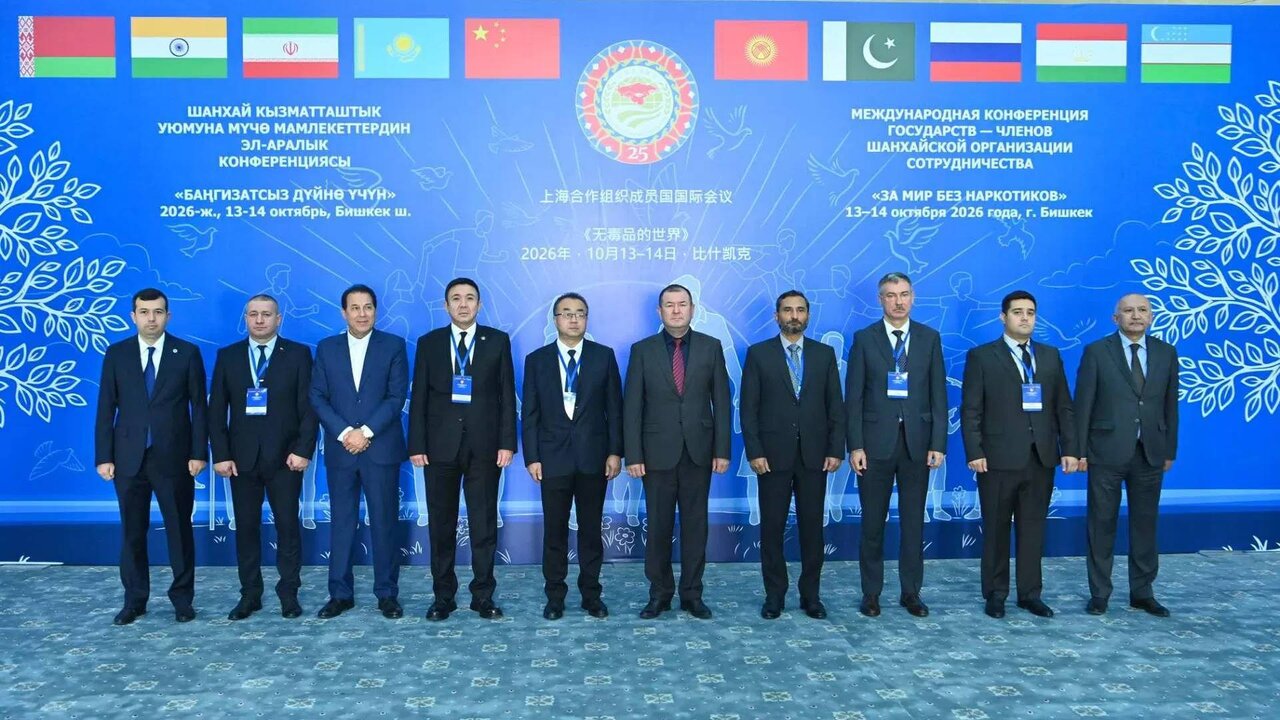
TEHRAN – Iran’s Drug Control Headquarters (DCHQ) has put forward six proposals to strengthen cooperation among Shanghai Cooperation Organization (SCO) member states in combating illicit drugs and related crimes.
Mohammad Narimani, an official with the DCHQ, presented the proposals at the opening ceremony of the SCO International Conference of Member States, titled “For a Drug-Free World,” held on October 13–14 in Bishkek, Kyrgyzstan.
The event was attended by representatives of the competent authorities of the SCO member states, the SCO Secretariat, the United Nations Office on Drugs and Crime (UNODC), the Collective Security Treaty Organization (CSTO), the Central Asian Regional Information and Coordination Centre (CARICC) and other regional organizations, as well as government bodies, higher education institutions and civil society of the Kyrgyz Republic.
Iran’s six proposals included strengthening the regional early warning system on synthetic drugs and new psychoactive substances, promoting cooperation in countering chemical precursors used in illicit manufacturing of narcotic drugs, establishing a SCO specialized network in prevention, treatment, harm reduction, and rehabilitation fields, developing joint capacity-building and educational programs, fostering operational and intelligence collaboration in countering transnational drug trafficking networks, and protecting health and humanitarian services, ISNA reported.
Highlighting the need for strengthening regional and international collaborations to fight against illegal drugs, the official said, “Today, the issue of drugs has transcended beyond the law enforcement sector, as it is directly connected to public health, youths, families, sustainable development, organized financial crime, and the rule of law,” Narimani said.
International drug traffickers’ use of online platforms, emerging technologies, artificial intelligence, and digital financial tools has worsened the situation. Hence, it is essential to adopt up-to-date, more coordinated, and forward-looking approaches at national, regional, and international levels to fight drug trafficking, he added.
Elaborating on the country’s achievements in addressing illicit drugs, the official voiced Iran’s readiness for the enhancement of ties with SCO member states through sharing expertise, as well as scientific and operational experiences.
The SCO International Anti-Drug Campaign “For a Drug-Free World” has been held since 2017. Its main goal is to foster in young people an intolerant attitude towards drug use and a commitment to a healthy lifestyle, as well as to establish contacts and exchange views between experts and representatives of the academic community in order to further deepen practical cooperation in countering illicit drug trafficking.
This year, during the two-day conference, participants discussed countering transnational drug trafficking, the spread of synthetic drugs and new psychoactive substances, the use of digital technologies in drug-related crime, as well as modern approaches to drug use prevention, treatment and rehabilitation of persons with drug dependence.
Following the event, the participants adopted recommendations aimed at strengthening interaction among the competent authorities of the SCO member states, improving the exchange of operational information, developing early warning mechanisms for new drug threats, conducting joint anti-drug activities and enhancing the effectiveness of preventive work.
Supporting Iran’s counter-narcotics work pays off beyond its borders: UNODC
In August, the UNODC released a report, emphasizing the need to support Iran in the battle against narcotics.
Supporting Iran’s counternarcotics work pays off beyond its borders, the report highlighted, saying it keeps drugs from reaching other regions, cuts into the money that funds organized crime, and supports public health by slowing the spread of addictive synthetic substances.
The main seizure of methamphetamine in and around the Middle East and South-East Asia over the past few years has been reported in Iran, according to the report, which was published on Thursday.
Iranian seizures of methamphetamine increased from 30,393 kilos in 2022 to 40,453 kilos in 2025, placing the country at the forefront of the fight against drug trafficking.
In the first quarter of 2026 alone, Iranian authorities have intercepted 3,663 kilograms of methamphetamine destined for Europe and the Persian Gulf.
These weren’t just street-level busts. These were five intelligence-led operations targeting industrial-scale shipments originating in Afghanistan, evidence that trafficking networks in the region are shifting toward synthetic drugs.
While international attention has primarily focused on the vast region’s declining opium production, advanced criminal drug trafficking networks have successfully shifted toward manufacturing and exporting synthetic drugs such as methamphetamine, commonly known as meth. West Asia is now the epicenter of a synthetic drug boom.
Iran is strategically positioned along the “Afghanistan-West Asia corridor,” which serves as the primary trafficking route for these illicit commodities. The clear signal from Tehran is that these substantial shipments are being intercepted before they can reach international markets. Yet, sustained success will require enhanced international cooperation and support.
Each interception reduces the illicit financial flows that fund organized crime and slows the spread of synthetic drugs into new markets. These shipments are not merely statistics. Each seizure disrupts a supply chain that would otherwise put methamphetamine on the streets of Europe and the Persian Gulf, while cutting into the earnings of organized criminal networks.
Through its Country Partnership Programme as well as the Cooperation Framework with the Islamic Republic of Iran, UNODC supports the country’s efforts in advancing border technology with procurement of detection scanners, strengthening labs’ forensic capabilities to identify new synthetic compounds, as well as regional intelligence sharing.
Sustained donor investment is critical to prevent this route from becoming a gateway for synthetic drugs. However, the scale of the challenge demands more than financial contributions—it requires a collective and sustainable approach by the international community. By supporting UNODC’s work in Iran, donor nations are investing in regional stability and international security, while also protecting their own borders from the flow of illicit substances.
Police seize over 250 tons of narcotics since March
The Iranian anti-narcotics police have seized more than 250 tons of narcotics in the first six months of the current Iranian year (started on March 21), indicating a 20 percent increase compared to the same period last year.
The anti-narcotics police have disbanded 780 drug trafficking gangs across the country, IRNA quoted Iraj Kakavand, the head of anti-narcotics police, as saying.
The official made the remarks at a press conference in Tehran on the occasion of the ‘national law enforcement week’, which is being held from October 2 to 8, under the theme ‘committed police, mobilized people, proud Iran’.
Over 7,000 smugglers were arrested, and six were killed; more than 330 weapons and 8,000 vehicles were confiscated, he added.
Monitoring social media, the police managed to arrest 196 individuals, seize over 460 kilograms of narcotics, more than 420,000 pills containing illicit drugs, and dismantle 14 gangs operating online, Kakavand further noted.
MT/MG
Disclaimer : This story is auto aggregated by a computer programme and has not been created or edited by DOWNTHENEWS. Publisher: tehrantimes.com