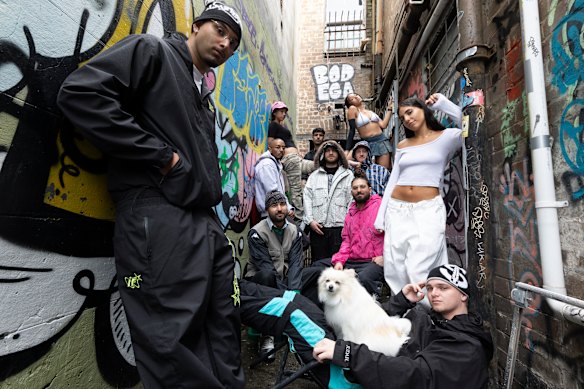
Looking back, it should have been obvious: in 2018, few people in the established music world would have dared venture into Parramatta to watch local acts. Western Sydney DJs Peter Sabbagh and Tom Elliott, unknown and starry-eyed musicians, performed a set for 20 people at Parramatta Square.
How quickly things have changed. The two now lead the Bodega Collective, a group of about 500, and are curating four nights of music for an entire street block – and they’re expecting 400,000.
They join 400 artists for the Parramatta Lanes event, where streets across the CBD turn into nightclubs, car parks into food courts, and the Civic Arcade into a non-stop Dance Dance Revolution competition from Wednesday to Saturday.
In its 15th year, the council-run event is leading a citywide push for nightlife less reliant on alcohol and arts institutions to dish up bolder, more experimental gig line-ups that attract mass young audiences.
It’s also a departure from western Sydney’s better-known cultural exports: stadium concerts and sporting events. Young local and international acts, including stars Genesis Owusu, Shady Nasty, Esha Tewari and Aja Monet, who have already cemented their artistry in Sydney’s live music scene, are performing at Lanes – leading to FOMO among the city’s music lovers.
“If you’re living in Newtown, which a lot of [the Parramatta Lanes] audience are, you’re gonna miss out on a free show just because it’s in Parramatta? No, you’re gonna get on the train and go,” Bodega Collective’s Willem Blomfield says. “No one doesn’t want to see Genesis Owusu play.”
And there is much more to come: from November 7 to 27, Powerhouse Parramatta’s opening festival will feature a series of events highlighting cutting-edge western Sydney acts, from techno, R&B and experimental pop artists to a Diwali rave paying homage to western Sydney’s South Asian communities.
Usually when a council runs something, it can be “a bit lame”, Sabbagh says. Before they began booking “cooler musicians”, he joked the council “were paying for people’s rap videos without knowing because they were giving such good rates to these up-and-coming artists”.
Infrastructure lacking
But cool doesn’t bring in cash. Sydney venue operators and art institutions won’t see commercial viability in establishing venues in western Sydney until more infrastructure arrives, says Fergus Linehan, chief executive of Redfern venue Carriageworks.
“There’s no point in being naive about it. If you do a show in the Metro Theatre and you do a show in Parramatta, it would be unreasonable to expect it to do as well at the moment,” he says.
The private sector will see opportunity in Parramatta for live music and nightlife when it has “critical mass” of people and shows can sell 1000 tickets at a certain rate. “It takes ages for venues to bed in,” he says. “If you were betting, you absolutely would say [Parramatta] is where it’s going in the next 10 to 20 years, as the infrastructure kind of builds around it.”
Blomfield says western Sydney’s arts scene has always received little investment and attention from the private sector. “Most [artists and collectives] haven’t received support from an institution, state, public or private. They’re just doing it out of their own pocket. They’re doing it DIY. I think DIY is the way of the future,” he says.
Sabbagh and Elliott believe the way to get more artists thriving in the west would be for councils to subsidise rent for artistic ventures. “It could be the next big White Bay Power Station,” Elliott said of Parramatta.
But Linehan says there’s also a foundational aspect to cultural programming that needs to shift – presenting shows young people actually like. Venues popular with young people, such as Carriageworks, Metro Theatre, Oxford Art Factory, the Red Rattler and the Museum of Contemporary Art taking in the Divine Playhouse, must possess a degree of “institutional spontaneity” as trends change.
International attention
For the first time, the array is attracting international attention: record label executives and music promoters from the Philippines are being flown in to track talent that could make it big in Manila, seen by some in the industry as a “trigger city” for global trends.
“When you bring people in, they’re experiencing the place the music comes from,” says Esti Zilber, executive producer at Sounds Australia, the federal government’s music export agency, which connects Australian musicians with a global audience.
It previously helped Australian musicians take their music overseas, but has had better luck getting overseas music leaders to listen to them at home.
“If you are building a global city, creative industries are a global part of showcasing that to the world,” she says. “And what we’re seeing in Parramatta is that the talent has always been there, but now, with enhanced infrastructure, [people can] see what it looks like when a city turns on all its lights.
“The rest of the city is now switched on to this very special event. I think it’s exceptionally well-programmed. It’s leaning into the most beautiful melting pot of different cultures.”
A council? Doing something fun?
Zilber’s agency has previously attempted to work with commercial festivals, including the ill-fated South by South West – but the fact that Lanes is “a free event in the heart of a city that is going through this massive boom” means the appeal and interest is far broader, she says.
The event, now in its 15th year, started as an event for Parramatta residents – but now it’s a gift to Sydney, the city’s new lord mayor, Cameron Maclean, says.
“It’s not an event for western Sydney, but it’s western Sydney’s event. This is important for the city because we’re about changing perceptions of western Sydney. Unfortunately, this has been so often defined by what’s on television or what they hear from far off. When they get here, they find it multicultural, engaging, fun, exciting – all the things that Lanes is going to be. … We’re trying to showcase western Sydney. We’re trying to showcase Australia.”
Parramatta Lanes has become one of the best ways for up-and-coming artists to acquire stage time, says Venezuelan-born, Sydney-based reggaeton artist Lamira, whose real name is Samira Rangel.
“They don’t really care if you’re a small artist, if you’re a big artist,” she says. “They just give the opportunity, and I think that’s like the first step for everything.”
Parramatta’s government area boasts 40 live music venues. A council report showed the music sector generated $99 million in economic output, with employment up by 3.8 per cent between 2018-19 and 2023-24.
More than 50,000 residents participate in music activities, including singing and playing an instrument, which is slightly less than one-fifth of Parramatta’s population.
Since their first gig in the square, Sabbagh and Elliott put Parramatta Lane’s success down to three things: the food, the virality and the consistency.
“For a long time, maybe the money wasn’t there [to pay big artists to headline], but even if it was there, it was like I don’t want to do that. That’s lame. No one cared,” Elliott says.
“But now, you go and pitch to an agent: 300,000 people foot traffic, 400,000 foot traffic … how could you say no to a decent paycheck and a crowd?”
Parramatta Lanes runs from October 21 to 24. For more details, visit atparramatta.com/lanes
 Kayla Olaya is a culture reporter at The Sydney Morning Herald.Connect via email.
 Anthony Segaert is the Parramatta bureau chief at The Sydney Morning Herald. He was previously an urban affairs reporter.Connect via X or email.
From our partners
Disclaimer : This story is auto aggregated by a computer programme and has not been created or edited by DOWNTHENEWS. Publisher: www.smh.com.au