
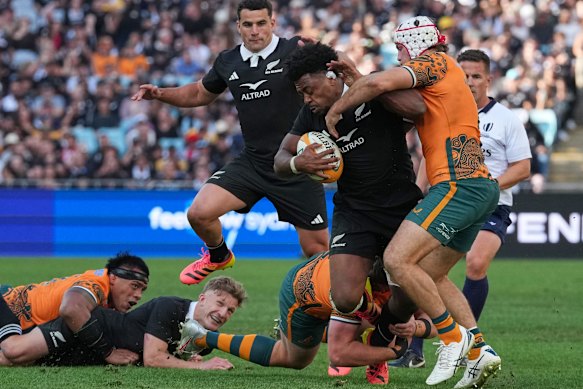

Star flanker Fraser McReight says the Wallabies will embark on the spring tour bruised but still armed with belief, having taken harsh lessons from a one-sided Bledisloe Cup campaign and knowing they won’t face any sides in the UK with the same attacking potency as the All Blacks.
Having gone six games undefeated – the latter five under new coach Les Kiss – the Wallabies came down to earth with a giant thud during a brutal eight-day stretch against New Zealand, in which the Kiwis thumped Australia by a combined score of 93-40 in two dominant victories.
The All Blacks effectively repelled the Wallabies’ attack, and were a class above with the ball, scoring 14 tries to six during the series with breakdown dominance and skill. Dave Rennie’s side scored six tries in a white-hot opening half at Accor Stadium on Saturday, ending the contest well before half-time.
The humbling trans-Tasman series was a massive reality check for the Wallabies ahead of a big spring tour in November, in which they will play England, Scotland, Wales and a yet-to-be determined fourth side in the Nations Championship finals.
But Australian players were attempting to keep a sense of perspective after Saturday’s game, based on the quality of the All Blacks’ performance, to ensure all confidence gained this winter isn’t stripped away.
“If we were saying we’re going to go into the Bledisloe unbeaten, we’re taking that,” McReight said. “We beat some really good teams, had some tough opposition and some tough, close games. But the ABs are world class for a reason. They’re top two in the world and I don’t think there’s many teams that attack like that: very fast and direct and decisive.
“It was a great test for us, and we learned a lot last week, albeit the scoreline wasn’t great. Same for today, we’ll learn a lot. You just can’t give a team 22 points – given they’re the top two in the world – can’t give them 22 points head start.”
McReight repeated the point about the potency of the world No.2 All Blacks when asked about the Wallabies’ belief heading into the spring tour.
“No other teams in the northern hemisphere that we’re versing – I guess Scotland maybe a little bit, but not at the ABs’ level – attack like that,” he said.
“So for us, we’re versing the best and adapting to the best, so what’s next rung? England’s first up, they love a high high-kick game, they’ve got some big forwards, quick outside backs.
“It is tough over there, but we really relish northern hemisphere teams and especially playing in England. In ’24 we had a great win and last year we’re in that match until the kind of 65th minute, and it kind of went away from us. So the belief is there, and we’ve just got to keep working and taking lessons.”
“Lessons” are a modern-day go-to for a losing dressing room, but the return of several significant starting players for the spring tour will provide a more tangible boost for the Wallabies. Coach Les Kiss confirmed Carter Gordon (broken leg), Hunter Paisami (suspension), Len Ikitau (concussion) and Ben Donaldson (groin) will all be good to tour, and Tom Hooper and Taniela Tupou will also rejoin the squad after stints with their clubs.
Halfback Ryan Lonergan conceded the confidence of the Wallabies had taken a “pretty big hit”, but said they’d been provided with “a good wake-up call” by the All Blacks about being clinical when given chances to score. The Wallabies had small windows to remain in the fight against the Kiwis, by scoring and building scoreboard pressure, but mostly failed to execute.
“It’s a great challenge to be able to play the All Blacks twice. Now we know where we’re at,” Lonergan said.
“You miss the mark a little bit against the All Blacks, they make you pay with the pace that they play at. We know that even through Super Rugby that if you’re a little bit off, particularly around that collision area, they can make you pay because they’re such good footballers.”
Rennie conceded New Zealand had focused on winning the breakdown, to negate the effectiveness of McReight, who he rated as “the best in the world” at poaching and disrupting a team’s recycle speed.
Having either been targeted by runners to make a tackle (he made a team high 19 in Sydney and 16 in Auckland) or with arriving players cleaning him out, McReight failed to win a single turnover in Sydney, and two successes in Auckland amounted to nought given the All Blacks had the penalty advantage.
“I didn’t really get too many clean opportunities to be fair. I tried to make a mess of it a lot of times,” McReight said.
Of the many lessons learnt, Lonergan said an important one was being more clinical when on attack in the opponent’s quarter. Several try-scoring opportunities were either lost through poor skill execution, passing choices or just the ability to keep dominating contact.
“Previously this year, we’ve stayed quite patient and we’ve been really, really good down there in that zone,” Lonergan said.
“The last couple of weeks, we’re just missing that execution a little bit. It’s as simple as a pass sometimes. Our structures down there in that zone haven’t changed much – credit to their defence. They’ve really sent the two into that contact and slowed our ball down.”
 Iain Payten is a senior sports reporter for The Sydney Morning Herald.Connect via X or email.
From our partners
Disclaimer : This story is auto aggregated by a computer programme and has not been created or edited by DOWNTHENEWS. Publisher: www.smh.com.au







