
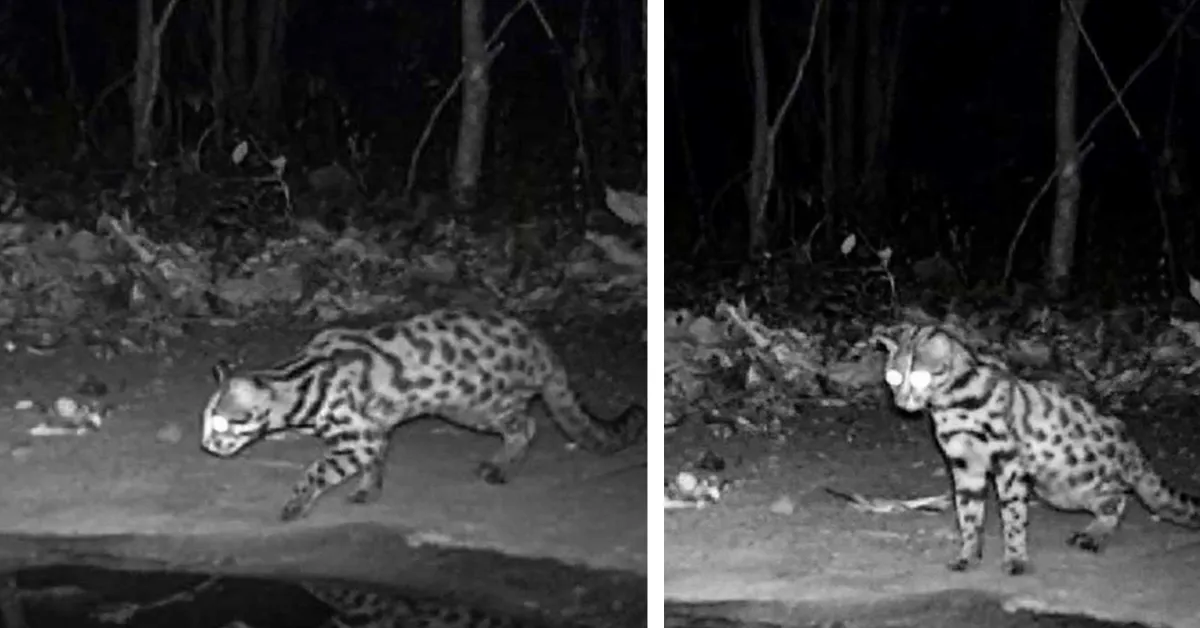
At 12:54 am on 7 March 2024, a small wild cat approached a man-made pond in a forest patch near Goa’s Bhagwan Mahavir Wildlife Sanctuary.
It stopped to drink, unaware that a camera trap beside the water was recording its movements. The camera captured five short video clips, which would soon become an exciting discovery for wildlife researchers Akshita Pungaliya and Atul Borker.
The visitor was a mainland leopard cat (Prionailurus bengalensis), a shy, elusive wild cat that had never been photographically documented in Goa, according to the researchers’ published findings.
The sighting became the state’s first reported photographic record of the species, with the findings published in the IUCN Species Survival Commission’s Cat News in 2025.
But the researchers hadn’t set out looking for a leopard cat. Their project began with a much simpler concern.
Every February, a freshwater stream running through this forest patch would dry up, leaving animals with fewer places to drink as the hotter months approached.
Akshita and Atul wondered whether a small artificial pond could make water available to wildlife during those months. They decided to create one and use a camera trap to see what happened.
What they recorded would help them understand the animals using this forest, including one that had rarely been documented in the region.
When the forest ran out of water
Akshita and Atul have long been interested in wildlife species that receive less attention than animals such as tigers and elephants.
In 2023, the two researchers co-founded Vanasa Conservation Foundation to work towards protecting lesser-known wildlife. Their work brought them to a patch of private forest land bordering Bhagwan Mahavir Wildlife Sanctuary, where a seasonal stream offered an opportunity to understand how animals cope with disappearing water sources.
“We wanted to understand if creating an artificial water source in these forest patches would actually be used by animals,” Akshita tells The Better India. “We’ve been monitoring activity across the year, but the original plan was to provide it in the drier months.”
Before building the pond, however, the team wanted to find a spot that animals were already likely to visit.
They walked through the forest looking for small trails, fruit remains and disturbed leaf litter. These were clues that mammals regularly passed through certain parts of the landscape.
“We looked at places where we could see smaller trails made by mammals, food lying around, signs that told us this is a walking path they use,” Akshita explains.
Using these signs, they chose a suitable location, dug a small pond, lined it and filled it with water. The artificial pond had a capacity of 40 litres.
A camera trap placed nearby would help the team find out whether animals discovered the water and, more importantly, whether they returned.
As the recordings began coming in, the researchers got their first answers.
Birds, squirrels and leopards began visiting
The camera soon captured birds arriving to drink, mongooses stopping by and squirrels moving across the frame.
As monitoring continued, the researchers began seeing larger visitors too, including Indian gaur and leopards. Giant squirrels also appeared in the footage.
Some animals came so close to the camera that it could barely capture their bodies. Akshita recalls moments when “you can barely see the hooves.”
For a team hoping to understand whether wildlife would use the pond, the variety of visitors was encouraging. But what caught Akshita’s attention was how some animals appeared to be returning to the same spot.
“If we keep it on across seasons in the year, you see them getting used to that spot,” she says. “Earlier they may have found it by chance, but now they recognise it.”
The repeated visits suggested that some animals were becoming familiar with the water source.
Meanwhile, the camera was helping the researchers observe wildlife that might otherwise pass through the forest unseen.
Across 390 camera-trap nights, they documented visits by several species. Among those recordings were the five clips of the mainland leopard cat drinking from the pond on 7 March 2024.
“My co-founder and I were just really excited to see that this happened,” Akshita says.
Their excitement came from knowing how difficult it could be to photograph a species like this, particularly in a region with so few previous records.
A wild cat that Goa had never photographed
The mainland leopard cat is actually one of Asia’s most widespread wild cats. It is found across parts of India, Southeast Asia, China, Taiwan, Japan and the Russian Far East, and is listed as Least Concern by the International Union for Conservation of Nature (IUCN).
Yet there are still gaps in our understanding of where these cats live in India.
Most records come from the southern Western Ghats, the Himalayas and the Northeast. In the northern Western Ghats, photographic sightings have been particularly scarce, with only two previously documented in the wider region.
Wildlife checklists had suggested that leopard cats could occur in Goa, but researchers lacked photographic evidence from the state.
The footage from Akshita and Atul’s pond helped fill that gap.
Part of the challenge is the animal’s behaviour. Leopard cats are small, shy, mostly active at night and often move through dense vegetation, making them difficult to observe.
“This cat doesn’t work the same way tigers or leopards do,” Akshita explains. “It’s small, elusive, shy, and mostly active at night.”
Researchers can sometimes recognise individual cats through their coat markings, but obtaining repeated camera-trap records across large forests takes considerable time and effort.
And that effort needs funding, which can be difficult to secure for lesser-studied species.
“Wildlife research highly depends on funding,” Akshita says. “And funding often goes towards larger species or species in conflict with humans.”
As a result, smaller carnivores often receive less research attention, even though they perform important roles within forests.
Leopard cats, for instance, feed on rodents and other small animals, helping regulate prey populations. Understanding their movements and habitats can help researchers learn more about how these forest ecosystems function.
This is why even a single confirmed photographic record can be valuable. It tells scientists that a species is present in a particular landscape and gives them a starting point for further research.
For Akshita, the Goa finding also shows what can emerge from a relatively small conservation experiment.
Could more forests benefit from this idea?
Creating an artificial pond like the one used in the project costs approximately Rs 30,000 to Rs 40,000, Akshita estimates.
A basic camera trap can cost between Rs 8,000 and Rs 10,000, while a higher-end model costs around Rs 25,000.
“This is in general a very low-cost plan,” she says.
The pond can provide a water source during dry months, while the camera trap helps reveal which animals visit the surrounding area.
Akshita says nature resorts in Karnataka have already begun discussing similar interventions. For privately owned properties bordering forests, carefully planned projects like these could offer a way to contribute to conservation while learning more about local wildlife.
But they also require an understanding of how different animals might respond.
For instance, if smaller animals begin using the pond, could larger predators follow?
“It could,” Akshita says. “And I’m very sure a lot of bigger cats do use these areas, and maybe nature resorts don’t even know them yet.”
That possibility makes careful monitoring important. People living or working near forests may have little idea of the different species passing through their surroundings, especially at night.
And as Akshita points out, learning about those animals doesn’t always require creating a new water source.
“If you want to know what’s in your backyard,” she says, “sometimes you don’t even need a waterhole. Just set up camera traps near good forest habitat.”
Her team’s experience in Goa offers an example of why that curiosity matters.
They began by noticing a stream that dried up every February. They followed the paths animals had made, created a small pond and placed a camera beside it to see who would come.
The footage revealed a variety of animals visiting the water, including a leopard cat that had never been photographically documented in Goa before.
Five short video clips gave researchers a new wildlife record and drew attention to a small wild cat that remains poorly studied in this part of India.
And it all began because two researchers noticed that the animals in a patch of forest might need somewhere to drink.
Disclaimer : This story is auto aggregated by a computer programme and has not been created or edited by DOWNTHENEWS. Publisher: thebetterindia.com




