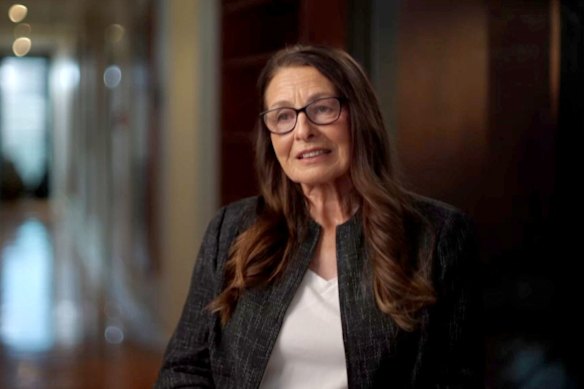
A Tasmanian grandmother convicted after a high-profile murder trial of killing her partner on their yacht has spoken for the first time, revealing why she lied to police about her whereabouts on the day he died and how she now fears for her life as she attempts to clear her name.
In her first interview since being convicted and serving 13 years in jail, Sue Neill-Fraser has told 60 Minutes she maintains her innocence and fears for her safety for speaking out about the 2009 death of her partner, Bob Chappell, in Hobart.
“There are huge vested interests in keeping this quiet,” Neill-Fraser tells 60 Minutes.
Fearful for her safety, Neill-Fraser says she wants it known she’s “not depressed” and if she was to die in suspicious circumstances, no one should believe it was self-harm.
The unlikely murderer
Sue Neill-Fraser is a softly spoken and extremely articulate lady, with kind but tired eyes. She’s also one of Tasmania’s most notorious, cold-blooded killers.
At 72, she’s strikingly beautiful, although she insists her face is weathered from her years working in paddocks with horses.
When Neill-Fraser talks about her grandchildren over a cup of tea, it’s almost impossible to reconcile the person in front of you with the violent murder she was convicted of committing.
“I’ve never physically harmed anybody, ever,” Neill-Fraser says in the exclusive interview.
It’s the first time she’s spoken publicly since leaving jail in 2022, and Neill-Fraser admits she’s nervous about finally telling her version of events. But she’s determined to explain herself.
Because four years into her parole, Neill-Fraser says she feels far from free.
“Sitting with a wrongful conviction is like having an infected thorn in your mind,” she says quietly.
“Never in my wildest dreams did I imagine that I could be convicted in Australia if I hadn’t done anything.”
Body overboard
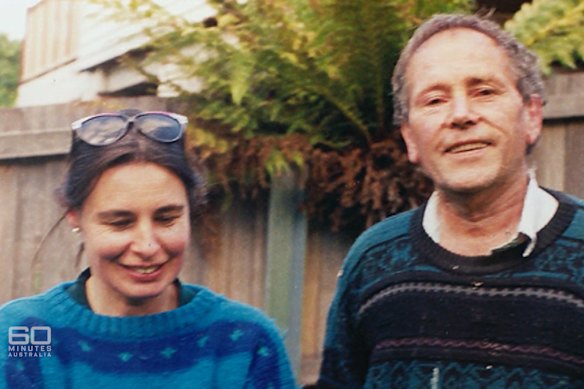
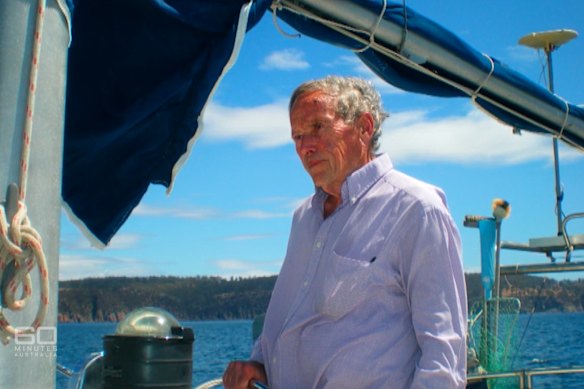
It was Australia Day 2009, and Neill-Fraser and Chappell, her partner of nearly 20 years, were pottering about the 53-foot yacht they’d bought months earlier with plans to spend their retirement sailing.
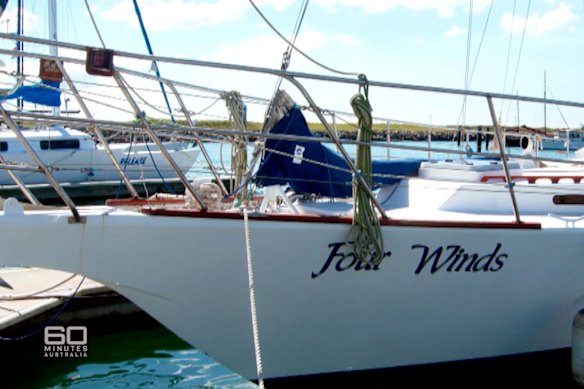
The Four Winds was moored at Hobart’s Sandy Bay, and Chappell was fiddling with the electrical wiring when Neill-Fraser decided to head back to land, to the home they shared.
Chappell planned to spend the night onboard, as he regularly did, and Neill-Fraser says their last words, down in the boat’s saloon, were the sort of idle chit-chat you’d expect between long-term partners.
“He said, ‘yep, all right, bye!’ And that was it,” Neill-Fraser says.
According to Tasmania Police, Neill-Fraser picked up a large wrench, bashed Chappell to death, and winched his body up two sets of stairs to the deck before manoeuvring him over the edge of the vessel into an inflatable dinghy below.
She then dumped his body somewhere in the Derwent River.
“I can’t make it real, even now,” Neill-Fraser says.
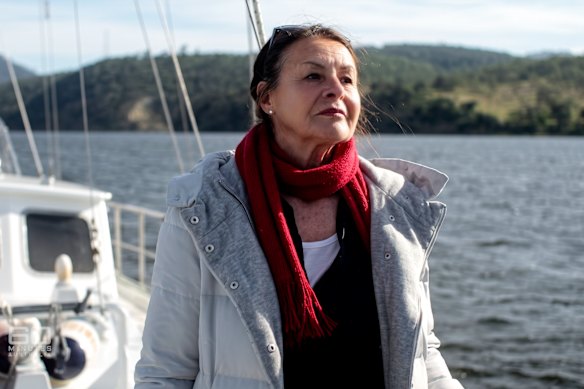
“I don’t understand how you would get somebody up two flights of stairs … I have a slipped disc that I’ve had for about 35 years, and I would’ve had trouble lifting anything over about 10 or 12 kilos.”
The police case was circumstantial; Chappell’s body nor a weapon were ever found.
But there were signs of foul play; the Four Winds was found sinking and sabotaged the following morning and Chappell’s blood was splattered about the saloon.
In the absence of witnesses or suspects, police quickly narrowed in on Neill-Fraser. As the victim’s partner and the last person to see him alive, she was the obvious culprit.
Investigators claim she stood to inherit Chappell’s assets and was motivated by money.
Neill-Fraser disputes this, and while usually private about finances, wants to set the record straight.
“When Bob went missing, I had over $80,000 in cash in a bank account,” she says.
“I paid for my half of the yacht outright. I had two rental properties and a farm. I didn’t need money.”
But she did nothing to dispel police suspicions.
In fact, in the days following Chappell’s disappearance, Neill-Fraser gave authorities every reason to believe she had something to hide.
Death, lies & CCTV
She told police she left Chappell on the yacht and went from the Four Winds to Bunnings Warehouse on Hobart’s Brooker Highway.
With the help of CCTV, officers quickly established she didn’t visit Bunnings that day.
“I can’t to this day account for it,” Neill-Fraser says.
“I can’t describe what it’s like to lose somebody after a long time … your brain doesn’t work properly.”
With her alibi already questionable, Neill-Fraser had also told police a deliberate lie – that she stayed home the night Bob disappeared.
In fact, in the late evening she walked down to Sandy Bay, where their boat was moored.
She says she had received a distressing phone call about Chappell’s youngest daughter.
Neill-Fraser had reason to believe the young woman may be down at the Sandy Bay beach that night. So she went down to check.
The next day, she says she lied about it because the issue was a sensitive topic within the Chappell family.
“It was probably the greatest mistake I ever made,” Neill-Fraser says. “But I think if I had told police the reason [I left the house], it would have caused a lot of family issues.”
Adding to police and public sentiment was Neill-Fraser’s perceived lack of emotion.
“The sort of upbringing I had, you didn’t show your emotions in public – you kept everything private,” she says. “And of course, that was used against me.”
Model prisoner
In October 2010, nearly two years after Chappell disappeared, a Tasmanian Supreme Court jury unanimously found Neill-Fraser guilty of his murder.
The Department of Public Prosecutions’ circumstantial case was based on evidence that Neill-Fraser maintains was fallacious, or inaccurate.
For example, the jury was shown a photo of the Four Winds dinghy after being sprayed with luminol, a testing agent that detects blood and about 100 other substances.
With the luminol activated, the boat was glowing blue; anyone who’d ever watched a crime show would have thought it was a bloodbath.
It was presented to the jury as Chappell’s blood; evidence that Neill-Fraser had moved his dead body in that dinghy.
But in fact, the photo was from a preliminary test.
Confirmatory tests later proved there was no blood in the dinghy, but that was never explained in court.
Then there was the Crown’s theory that she killed her partner with “a large wrench” which would have left marks on his body.
But there was no body, or murder weapon.
“If I’d been on the jury, I would’ve thought ‘this is a wicked woman’,” Neill-Fraser says.
“I too would have thought I was guilty.”
She was initially sentenced to 26 years in jail, which was later reduced on appeal to 23 years, with 13 years non-parole.
Neill-Fraser spent those 13 years in Hobart women’s prison, poring over police reports and legal documents. She launched two unsuccessful appeals.
Remarkably, when she returns to visit the prison with 60 Minutes, she doesn’t have a bad word to say about her time in jail.
“The deprivation of liberty is quite a startling thing, but I met some wonderful people, custodial officers, healthcare workers, inmates,” Neill-Fraser says.
“It was absolutely nothing like the American movies we see.”
When she was released, she recalls feeling “an anti-climax because I knew that the real fight was only just beginning”.
Not long after her release, she was slapped with a highly unusual parole condition, preventing her from speaking publicly about her case.
When Neill-Fraser challenged the gag order, her legal team discovered the parole board relied on a document prepared with the help of AI and cited case law that didn’t exist.
Her gag order was revoked last month.
Miscarriage of justice?
It would be easy for Neill-Fraser to keep her head down and enjoy her long-awaited freedom.
Instead – despite two unsuccessful appeals and the parole board attempting to silence her – the 72-year-old is assembling a new legal team to pursue avenues to quash her conviction.
“You can’t remain quiet about this sort of thing,” she says.
“You can’t just go and hide away and pretend it didn’t happen. It did happen and we need to fix it.”
She believes the police case against her was based on mistruths and that the jury was presented with a theory about Chappell’s murder that was not backed up by solid evidence.
Call it paranoia, but Neill-Fraser fears speaking out could cost her her freedom, or even her life.
But that’s not stopping her fighting to overturn what she maintains is one of the greatest miscarriages of justice in Australian criminal history.
If you or someone you know needs help, phone Lifeline on 13 11 14, beyondblue on 1300 22 4636, or 1800 RESPECT (1800 737 732).
Be the first to know when major news happens. Sign up for breaking news alerts on email or turn on notifications in the app.
Disclaimer : This story is auto aggregated by a computer programme and has not been created or edited by DOWNTHENEWS. Publisher: www.smh.com.au