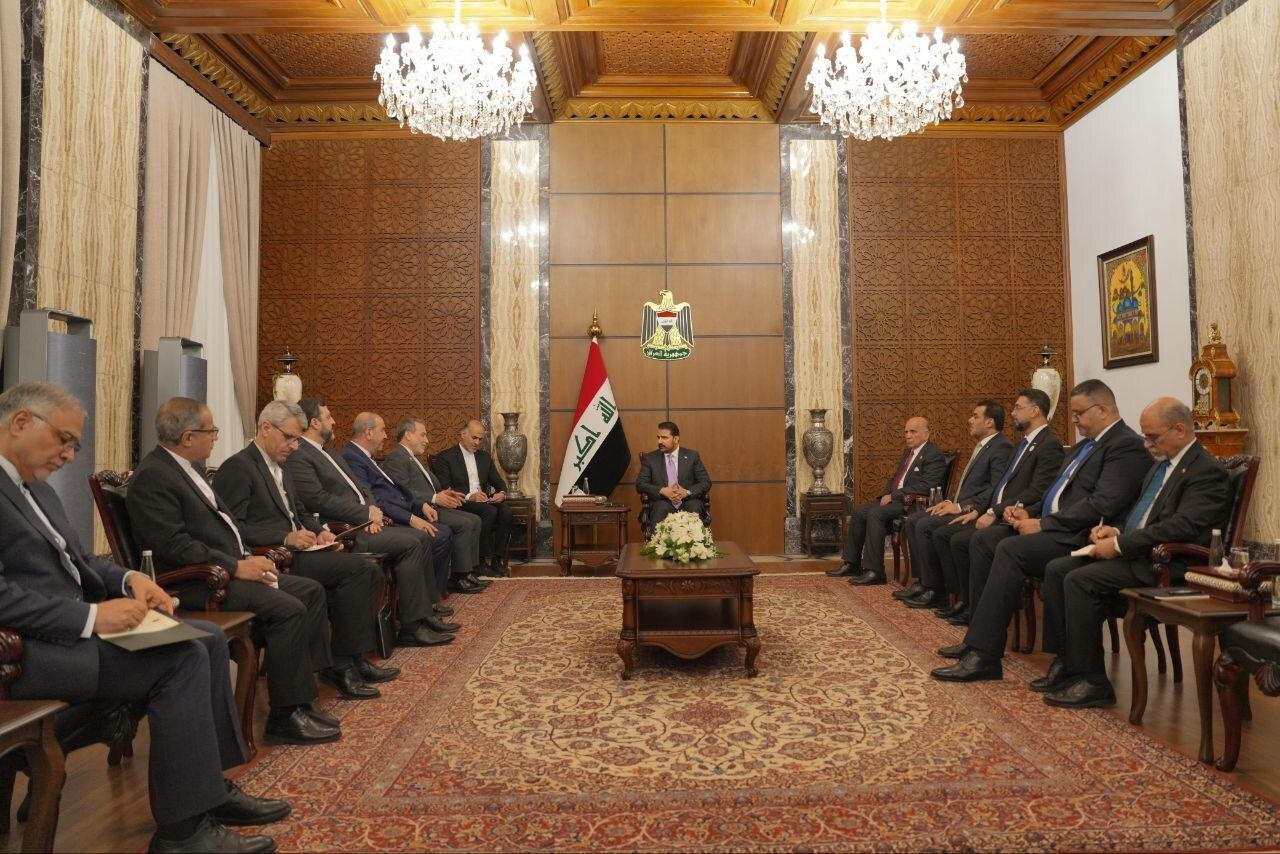
TEHRAN — Iranian Foreign Minister Abbas Araghchi has used a series of diplomatic meetings in Baghdad to press for an end to military escalation in West Asia, outline Iran’s conditions for restoring security in the Strait of Hormuz and call for a more active role for the Organization of Islamic Cooperation (OIC) in addressing disputes among Muslim countries.
Araghchi traveled to the Iraqi capital to attend the 52nd session of the OIC Council of Foreign Ministers, where he held talks with Iraqi officials and counterparts from Lebanon, Egypt and Algeria, as well as the organization’s secretary-general. His engagements focused on regional security, the Palestinian issue, bilateral relations and diplomatic efforts to prevent further escalation.
In remarks on the sidelines of the meeting on Sunday, Araghchi reiterated that Iran remained prepared to defend its national interests while pursuing diplomacy, provided negotiations respected Iran’s rights and were conducted on an appropriate basis.
Strait of Hormuz: Iran sets out seven-point plan for reopening
Araghchi said the insecurity affecting the Strait of Hormuz and its economic consequences for regional countries and the wider international community were a direct result of US-Israeli military aggression against Iran.
He said Tehran had presented Washington with a seven-point plan setting out its conditions for resolving the confrontation. The United States had submitted its own views, which Iran was reviewing, he added.
According to Araghchi, the proposed framework provides a clear path toward restoring security in the strategic waterway if Washington meets Iran’s conditions.
“If our conditions are met, the Strait of Hormuz will reopen on the sixth day, and negotiations will begin on the seventh day,” he said.
The foreign minister stressed that Iran’s conditions were not extraordinary, arguing that they concerned commitments the United States had previously undertaken under an earlier memorandum of understanding and in other negotiations. He said Washington could implement the requirements within days if it genuinely sought to reopen the strait.
Araghchi also briefed Iraqi Foreign Minister Fuad Hussein on ongoing diplomatic consultations related to regional peace and security. He reiterated that Iran remained committed to diplomacy as a means of preventing further escalation, even as it maintained its readiness to defend its national security.
The issue also featured in Araghchi’s meeting with Egyptian Foreign Minister Badr Abdelatty, during which the two officials discussed bilateral relations, regional and international developments, and diplomatic consultations conducted through mediators.
Araghchi told Abdelatty that Iran had consistently pursued diplomacy with the aim of reducing tensions, while accusing Washington of repeatedly violating its commitments. He cited a US breach of its pledge just two weeks after the signing of a memorandum of understanding intended to end the war.
Iraq ties and the need for regional dialogue
In his meeting with Hussein, Araghchi highlighted the importance of strengthening cooperation between Iran and Iraq, particularly in economic, trade and security affairs.
The two ministers also discussed developments in the Arabian Peninsula and ways to help end regional conflicts. Araghchi emphasized that Iran was prepared to facilitate dialogue between parties involved in regional disputes.
Araghchi also met Iraqi Prime Minister Ali Falih al-Zaidi during his visit to Baghdad. No further details of their discussions were immediately available.
Beyond bilateral ties, Araghchi argued that Muslim countries needed to strengthen dialogue and solidarity to address shared challenges, particularly the Palestinian issue and the continued expansionism of the Israeli regime.
OIC urged to play a stronger role in resolving disputes
Araghchi called on the OIC to play a more effective role in resolving differences among Muslim countries and strengthening cooperation across the Islamic world.
He said he had raised the issue in meetings with the Iraqi prime minister, Hussein, and the organization’s newly appointed Secretary-General Ismail Ould Cheikh Ahmed.
During his meeting with Cheikh Ahmed, the secretary-general expressed the organization’s interest in drawing on Iran’s experience and capabilities to develop initiatives for mediation and dispute settlement among Muslim countries.
Araghchi welcomed the prospect of a more active OIC role, stressing that the organization’s secretariat should operate professionally and impartially and avoid any perception of bias toward or against member states.
He also emphasized the importance of strengthening solidarity among Muslim countries in confronting common challenges, particularly those arising from developments in occupied Palestine.
The foreign minister noted that the OIC had lost some of its influence in recent years and expressed hope that Iraq’s assumption of the rotating presidency, together with the appointment of a new secretary-general, would help revitalize the organization.
Yemen Resolution: Iran insists on fairness, balance and a political solution
Foreign Minister Abbas Araghchi has warned that Iran will not join the consensus on a proposed resolution on Yemen at the Organization of Islamic Cooperation (OIC) unless the final text reflects fairness and balance, stressing that Tehran’s position will depend on the wording ultimately adopted.
Speaking to IRNA on Sunday on the sidelines of the annual session of the OIC Council of Foreign Ministers in Baghdad, Araghchi said the organization’s resolutions had not yet been adopted and that the final communiqué was still being drafted. He noted that Iranian diplomats had engaged in extensive discussions in recent days to ensure that Iran’s views were reflected in the documents, adding that most of the proposed resolutions, with a few exceptions, repeated texts adopted the previous year.
On Yemen, Araghchi said serious discussions had taken place among member states, with Saudi Arabia, Iran and other countries presenting their respective positions. The draft resolution had yet to be finalized, he said, expressing hope that the final text would reflect a fair and balanced approach. If these principles were not upheld, Iran would be unable to join the consensus and would formally register its reservations or reject the resolution, depending on its final wording.
Araghchi acknowledged that countries aligned with Saudi Arabia constituted a sizable bloc within the OIC, but said Tehran had conducted extensive consultations and clearly outlined its position on a just solution to the conflict. He stressed that Yemen’s crisis could not be resolved through military force or blockade, calling instead for a political process grounded in the United Nations Charter, respect for Yemen’s sovereignty and territorial integrity, and protection of the Yemeni people’s human rights. He also offered Iran’s assistance in facilitating dialogue among the parties.
Rejecting allegations that Yemen’s armed forces had attacked Mecca and Medina, Araghchi said repeating such accusations would neither serve the interests of the Muslim world nor strengthen unity among OIC member states. He emphasized that the sanctity of Islamic holy sites must be respected by all.
Lebanon: Iran stresses sovereignty while acknowledging political differences
Araghchi’s meeting with Lebanese Foreign Minister Youssef Rajji focused on bilateral relations, Lebanon’s sovereignty and national security, and regional developments.
Araghchi reaffirmed Iran’s support for Lebanon’s territorial integrity and its efforts to defend its sovereignty and national security against Israeli military action and expansionism.
Speaking separately to reporters, he described his meeting with Rajji as respectful but serious and frank, acknowledging differences between Tehran and the current Lebanese government over approaches to regional and domestic issues.
Nevertheless, he stressed that both countries had an interest in maintaining and developing relations.
“I emphasized that the Islamic Republic of Iran is interested in having comprehensive political, economic and cultural relations with Lebanon as a country,” Araghchi said.
He added that Lebanon’s internal affairs were for the Lebanese people to decide. Referring to Hezbollah, he described the movement as one of Lebanon’s most important political groups and an established part of the country’s political and social landscape.
Araghchi said decisions made by Lebanese political groups, including Hezbollah, should be treated as matters of Lebanon’s domestic affairs.
Algeria: Palestinian issue remains central to Muslim solidarity
In a meeting with Sofiane Chaib, Algeria’s secretary of state to the minister of foreign affairs, Araghchi discussed bilateral relations and developments affecting the Muslim world, with particular emphasis on Palestine.
He described Palestine as the foremost concern facing the Muslim world and humanity, citing the continued Israeli occupation and the situation in the occupied Palestinian territories.
Araghchi called for stronger unity and solidarity among Muslim countries to end Israel’s impunity and to confront its continued expansionism.
He also briefed the Algerian official on developments in West Asia and US interventionist and destabilizing actions in the Persian Gulf region.
Alongside his meetings in Baghdad, Araghchi held a telephone conversation on Sunday with Pakistan’s Deputy Prime Minister and Foreign Minister Mohammad Ishaq Dar.
According to Pakistan’s Foreign Ministry, the two officials discussed bilateral relations and regional developments and stressed the importance of dialogue and diplomacy amid continuing regional tensions.
The conversation added to the diplomatic contacts surrounding efforts to prevent further escalation and address outstanding regional disputes.
Diplomacy and defense remain parallel priorities
Across his meetings and public remarks in Baghdad, Araghchi presented diplomacy as a central instrument for addressing regional crises, while maintaining that Iran would defend its national interests and security.
His message combined calls for stronger cooperation among neighboring countries, a more active OIC role in resolving disputes, and greater unity among Muslim states over Palestine with a clear warning that progress on the Strait of Hormuz depended on Washington meeting Tehran’s stated conditions.
The meetings also highlighted the range of issues confronting regional diplomacy, from maritime security and the economic repercussions of conflict to Yemen, Lebanon and the future of Palestinian territories.
For Tehran, Araghchi’s Baghdad engagements provided an opportunity to advance bilateral ties, engage regional counterparts and press for diplomatic solutions while reiterating Iran’s position that lasting security requires respect for national sovereignty and the fulfillment of commitments.
Disclaimer : This story is auto aggregated by a computer programme and has not been created or edited by DOWNTHENEWS. Publisher: tehrantimes.com