Shielding Israel from accountability, supplying it with advanced weapons, and turning a blind eye to its unlawful and cruel acts against Palestinians for nearly eight decades have finally come back to haunt Europe and the United States. The consequences have reached a point where even European diplomats, journalists, and other officials are no longer safe from the emboldened Israeli occupiers.
On Saturday, Israeli settler militants attacked European diplomats, a French mayor and the archbishop of Cambrai in Taybeh, in the occupied West Bank, injuring three people and damaging a car, in the latest violent attempt to prevent Palestinians from harvesting olives on their own land, the Guardian reported.
Bernard Baudoux, mayor of Aulnoye-Aymeries, was wearing his red, white and blue sash of office and attempting to enter a vehicle with diplomatic plates when he was assaulted and knocked to the ground, the Guardian reported.
The masked militant shouted “Vive la France” as he launched the attack, a witness said. Badoux’s wife, and Vincent Dollmann, archbishop of Cambrai, were also threatened by the group of seven men, some armed with clubs.
The group had joined the olive harvest on lands belonging to the Christian town of Taybeh, along with the French consul general in Jerusalem, his wife and other diplomats, and the Belgian and Polish consuls.
Settlers first attacked a group working on the lower slopes of hills near Taybeh. As well as stealing olives, they kicked, abused and assaulted a Palestinian woman in her 70s and beat a man so badly he needed six stitches for a head injury.
Then they approached the diplomats and Badoux, who was in Taybeh for the launch of a twinning agreement with his town in northern France. During the attack, the militants smashed the window of an armored car belonging to the Belgian mission.
Maxime Prévot, Belgium’s deputy prime minister and minister of foreign affairs, condemned the violence against Palestinians, foreign diplomats and journalists, and said his country would continue to push for European Union sanctions on settlers.
“Harvesting olives, reporting the news or carrying out diplomatic duties should never put anyone at risk of attack,” he said. “This violence cannot be separated from Israel’s illegal settlement policy … the occupation of the Palestinian territory must end.”
Echoing those sentiments, French Foreign Minister Jean-Noël Barrot echoed called on Israeli authorities to “urgently halt this criminal violence and guarantee the safety of civilian populations.”
Poland’s foreign affairs ministry also called for a “firm response” from Israeli authorities and for “an end to the spiral of violence in the West Bank”.
The EU condemned the attacks, urged Israel to abide by international and human rights law, and end the expansion of settlements.
To render the incident insignificant, the office of the Prime Minister Benjamin suggesting it was part of a “coordinated campaign to smear Israel.”
Palestinian residents of Taybeh have lived with years of escalating attacks from Israeli militants, but settlers had never targeted foreign diplomats there, said Father Bashar Fawadleh, the town’s parish priest.
“What happened today is not an isolated incident. It represents a deeply disturbing escalation in settler violence,” Fawadleh said.
Since the start of the annual olive harvest in late September, Israeli militants have used violence to stop Palestinians bringing in a crop that is economically and culturally vital to their communities.
Since September 27, settlers have launched more than 170 attacks, Israeli rights group Yesh Din said. They killed at least four people, injured more than 100 and damaged thousands of trees, according to Palestinian authorities.
Even the presence of Israeli activists, diplomats, senior clergy and journalists no longer serves as a deterrence to extreme violence.
“If such violence can take place before international witnesses, one must ask what protection remains for local families and farmers when those witnesses are no longer present,” Fawadleh said. “No individual should have to risk physical assault simply to harvest olives from their own land.”
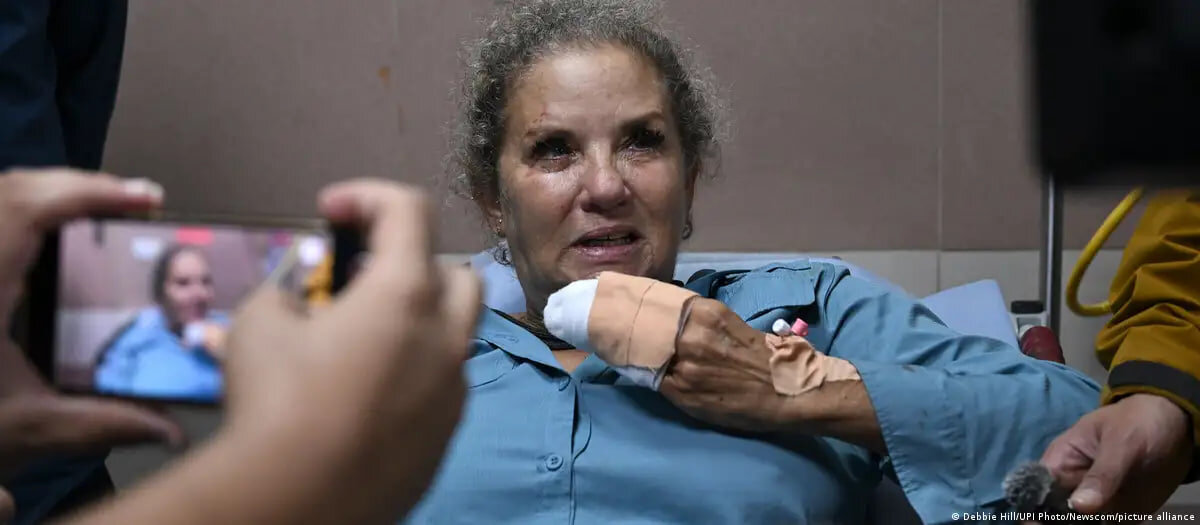
On Friday, Israeli militants attacked and severely injured Washington Post photojournalist Heidi Levine as she reported on the harvest in the town of Abu Falah. She required surgery on Saturday morning and is now in “moderate” condition, according to a spokesperson for Israel’s Beilinson hospital where she is being treated.
On Oct. 6, Armed Israeli settlers also beat an AFP photographer, leaving him requiring hospital treatment, as he covered ongoing violence by settlers against West Bank olive farmers.
Jaafar Ashtiyeh, 58, a veteran photographer for the international news agency in the Palestinian territory, suffered bruises to his head and torso and was taken by ambulance to a hospital, according to witnesses, his family and fellow journalists.
Israel had already severely restricted the harvest this year by imposing new rules barring Palestinians from trees located in Area C, an area under the Israeli military’s control, which comprises most of the West Bank’s agricultural land.
Gideon Sa’ar, Israel’s foreign minister, said the foreign ministry was in contact with the ambassadors of the countries involved.
But he added: “Without detracting from the severity of the incident, it is unfortunate that the visit was not coordinated with the IDF in advance. Such coordination could have helped safeguard the visitors’ security.”
Demanding diplomats give advance notification of travel violates both diplomatic conventions and international law, said one Western diplomatic source who asked not to be named.
“Israel is in charge of security in Area B and C (the majority of the West Bank), so is obliged to assure safety there for all,” the source said.
A culture of near total impunity for Israeli violence against Palestinians in the occupied West Bank has prompted former prime minister Ehud Olmert to call for the international criminal court to intervene.
Gadi Eisenkot, an opposition politician and former general hoping to unseat prime minister Benjamin Netanyahu in elections to be held later this month described the attack as “Jewish terror under the auspices of the Israeli government”.
Eisenkot backs Jewish Israeli expansion in occupied Palestine but wants militant violence brought under control because the attackers are “harming the settlement enterprise in [the West Bank] and national security”.
Disclaimer : This story is auto aggregated by a computer programme and has not been created or edited by DOWNTHENEWS. Publisher: tehrantimes.com