
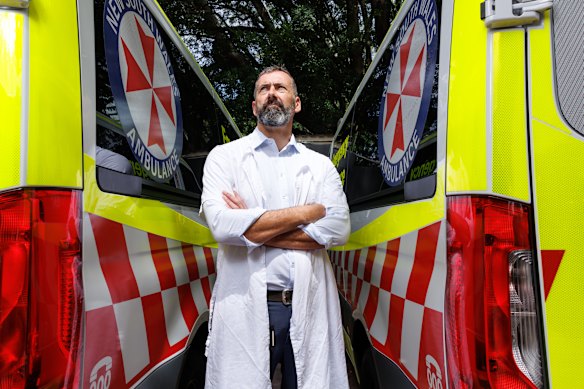

Hundreds of patients a month are arriving at NSW emergency rooms after injecting unapproved peptides as a black market of injectables fuelled by wellness influencers booms in Australia.
NSW Health is sounding the alarm after a steep increase in patients presenting to hospitals with complications from unapproved peptide use including liver damage, allergic reactions and severe dehydration.
A NSW Health report provided to the Herald shows there were 1180 emergency presentations that referenced unapproved peptide use between July 2025 and September 2026. In July 2025, there were just five patients, but by September this year that had increased to more than 217.
Young people are at particular risk, the report showed, with those aged 25-34 making up 32 per cent of peptide-related presentations and 16-24 year-olds accounting for 25 per cent. The Royal Australian College of General Practitioners’ Dr Tim Jones this year said the organisation had reports of young people needing skin grafts and amputations after complications from backyard injectables.
With online wellness influencers touting the drugs as cure-alls for weight loss, muscle gains and even skin tanning, NSW doctors are now admitting patients with liver injury after injecting themselves with unregulated chemicals.
“These people had severe injury requiring admission and care under a liver transplant service, so effects can be unpredictable, and they can be severe,” said Dr Darren Roberts, medical director of the NSW Poisons Information Centre.
What makes the unapproved peptide craze so dangerous is that there is no way of knowing which chemicals the vials contain, or what side-effects could come with it.
“It almost becomes a game of Russian roulette,” Roberts said.
Peptides are short chains of amino acids that act as chemical messengers regulating body functions such as tissue repair and metabolism, some of which the body naturally creates such as insulin and endorphins.
The synthetic peptide injectables popular with biohackers and influencers are artificially created molecules that aim to stimulate certain responses in the body, such as collagen production.
These peptide injectables are being promoted to Australians through websites offering “research grade” products, but are not approved by the Theraputic Goods Administration (TGA). One website advertising on TikTok offered Sydney local pick-up and discounts for TikTok users, who could pay using credit card or crypto.
Despite being a restricted substance in NSW, social media videos sharing suppliers, promoting certain drugs as “Ferraris” and sharing tips on avoiding Australian authorities are easily accessible online.
In one video seen by this masthead, a wellness influencer described being detained by Australian border force for travelling with unlawful peptides without a prescription, and encouraged her followers to instead ship bulk supplies to their travel destination to avoid detection by Australian authorities.
Data from NSW Health shows south-west Sydney had the most unapproved peptide-related hospital visits, making up 21 per cent of all presentations, followed by Sydney’s south-east with 15 per cent, and western Sydney with 13 per cent.
The number of patients identified in the NSW Health report is conservative, and only captures patients whose peptide use was disclosed. The scale of the issue in NSW is likely to be much higher, Roberts said.
Health Minister Ryan Park urged people to think about the potential long-term harms of injecting unprescribed drugs.
“We know that using these unapproved substances can come with real health risks, but it’s particularly alarming to see the growing pressure they’re placing on our health system,” he said.
New of the increase in NSW patients follows a similar warning in Victoria over six cases of acute liver toxicity associated with the popular peptide retatrutide, popular for its weight loss benefits.
Unlike other peptides such as Ozempic, retatrutide is not approved for use by the TGA, and is undergoing clinical trials in humans.
In September, the TGA reported a case of extreme adverse effects in an Australian patient linked to a product sold as retatrutide, which included uncontrollable vomiting resulting in a torn oesophagus. Testing by the TGA found the product contained semaglutide – the active ingredient in weight loss drug Ozempic – at eight times higher levels than those approved by the TGA.
Peptide “stacking” is also increasing in popularity online, with American podcaster Joe Rogan promoting a peptide combination for muscle repair dubbed the “Wolverine stack” after the superhero character. Google Trends data shows search interest for the term was up 700 per cent from last year, and was most popular in Australia.
The state’s chief health officer Dr Kerry Chant said: “A professional looking website, a label, purity claim, reviews or influencer endorsement is not proof of what is inside the product.”
Be the first to know when major news happens. Sign up for breaking news alerts on email or turn on notifications in the app.
 Jessica McSweeney is a reporter at The Sydney Morning Herald covering state politics and urban affairs.Connect via email.
From our partners
Disclaimer : This story is auto aggregated by a computer programme and has not been created or edited by DOWNTHENEWS. Publisher: www.smh.com.au



