

Australia’s new fleet of robotic submarines will be capable of carrying 12 sea mines and unleashing swarms of explosive drones against enemy targets thousands of kilometres from shore, as the federal government unveils previously secret weapons designed to transform undersea warfare.
The Australian-built Ghost Shark submarines will be able to secretly lay minefields, launch aerial strikes and deliver military supplies to special forces behind enemy lines under a major expansion of their military capabilities.
The breakthrough, part of a $5.8 billion investment in autonomous underwater warfare over the next decade, promises to give Australia the ability to threaten enemy warships and strike distant targets without risking the lives of sailors.
It also marks a significant advance for AUKUS Pillar II, the technology-sharing arm of the trilateral security pact, as the rapid development of comparatively cheap underwater drones raises questions about their future role alongside Australia’s $368 billion nuclear submarine program.
The autonomous submarines, which can be launched from shipping containers on wharves or deployed from relatively small vessels, are being manufactured at a Sydney factory under a $1.7 billion contract with American defence technology company Anduril.
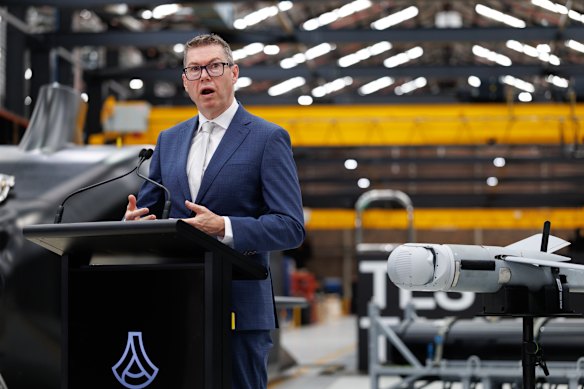
Defence Industry Minister Pat Conroy on Monday revealed three previously secret payloads for Ghost Shark, including naval mines, armed aerial drones and underwater caches of military equipment.
“The Ghost Shark now has teeth, and we’ll have the ability to inflict damage on any potential adversary,” Conroy said.
The submarines will be capable of deploying up to 12 naval mines in a single mission, allowing Australia to block strategically important shipping routes or restrict the movement of hostile warships. They will also carry swarms of Anduril’s Altius loitering munitions – small aerial drones capable of conducting surveillance before striking targets.
Conroy declined to disclose how many armed drones each submarine could launch, citing operational security.
A third payload will allow the submarines to deposit caches of equipment and supplies beneath the ocean surface for later retrieval, potentially supporting special forces operating in hostile territory.
Conroy said the vessels were designed to operate far beyond Australia’s shores.
“Ghost Shark is a flagship Australian success story that showcases the ingenuity of our defence industry and the value of investing in sovereign capability,” he said. “Our government opened this factory less than a year ago and Ghost Sharks capable of a range of complex missions operating far from our shores are now rolling off the line at an increasing rate into the hands of the Australian Navy.”
The government also unveiled a new submarine-detection capability for the Australian-made BlueBottle autonomous surface vessel, which will use a towed sonar array to hunt underwater threats.
The technologies will be showcased this week during Exercise Maritime Big Play Pacific in San Diego, involving Australia, the United States and Britain.
Anduril has also flagged plans to equip the robotic submarines with heavyweight and lightweight torpedoes, further expanding their ability to threaten enemy vessels.
The emergence of increasingly sophisticated autonomous submersibles comes as Australia begins acquiring nuclear-powered submarines under AUKUS, with the first American Virginia-class vessels expected in the early 2030s.
Conroy rejected suggestions that rapid advances in autonomous warfare undermined the case for the nuclear submarine program, arguing the two technologies would complement each other.
Uncrewed vessels could undertake dangerous missions and operate alongside Australia’s existing Collins-class submarines before being integrated with future Virginia-class and AUKUS submarines.
The government argues the combination of autonomous weapons and conventional naval platforms will make Australia a more difficult military target while allowing it to project force across vast distances without exposing sailors to the same risks.
Chief of Navy Vice Admiral Matt Buckley said autonomous systems were central to the navy’s plans to increase its reach, strengthen undersea warfare and protect critical seabed infrastructure.
“Given the vastness of our maritime geography, the ability to rapidly deliver uncrewed systems adds numbers to our fleet and complements our crewed ships and submarines,” he said.
The program has moved from initial development into large-scale production in just three years, with the first production submarine already delivered to the navy and more than 40 Australian companies involved in the supply chain.
Anduril is also pursuing opportunities to export the submarines to allied countries, including potential customers in the United States and Britain.
Cut through the noise of federal politics with news, views and expert analysis. Subscribers can sign up to our weekly Inside Politics newsletter.
 Rob Harris is the national correspondent for The Sydney Morning Herald and The Age based in Canberra. He is a former Europe correspondent.Connect via email.
From our partners
Disclaimer : This story is auto aggregated by a computer programme and has not been created or edited by DOWNTHENEWS. Publisher: www.smh.com.au



