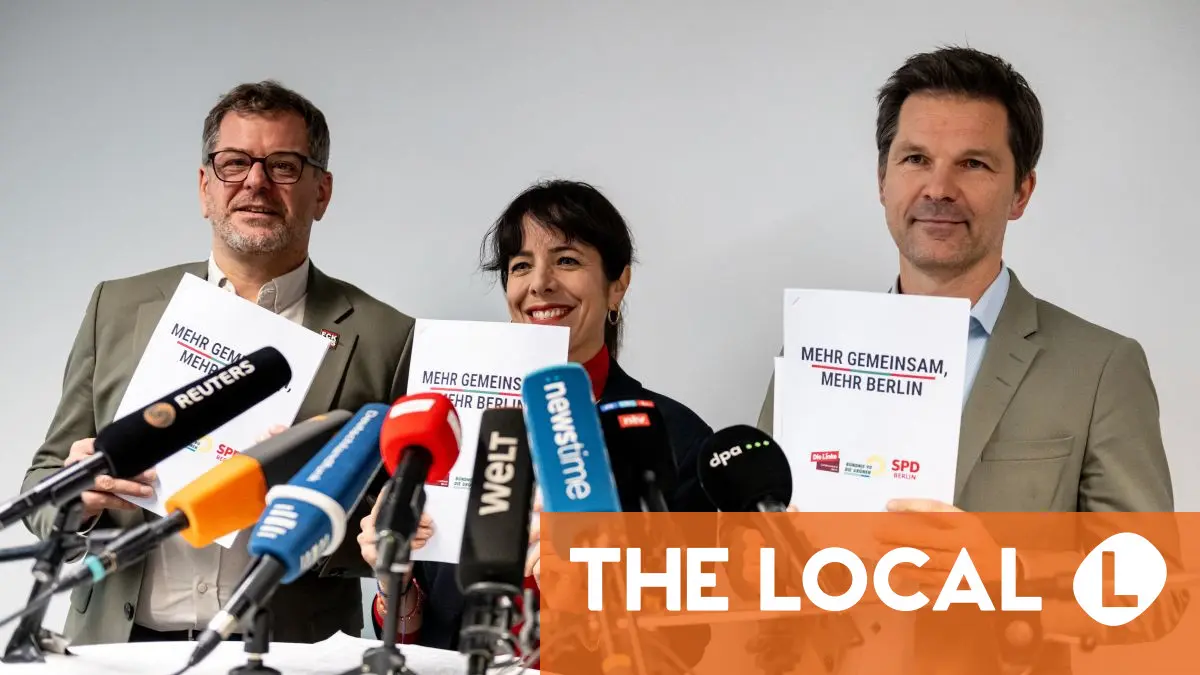
Berlin’s Left Party, Greens and SPD have reached a historic preliminary agreement that could pave the way for one of Germany’s most ambitious housing reforms. We look at what their proposals would mean for international residents.
Four weeks after Berlin’s state election, the Left Party (Die Linke), the Greens and the centre-left Social Democrats (SPD) announced that they had successfully concluded exploratory talks and agreed on a common framework for a future coalition government.
The agreement, known in German politics as an ‘exploratory paper’ (Sondierungspapier), is titled “More Together, More Berlin”. It sets out what the three parties believe they can achieve together if they proceed to full coalition negotiations and ultimately form a government.
The deal was reached on Saturday evening after days of intense negotiations and was far from guaranteed. Housing policy, particularly the question of socialising large private housing companies, had been considered one of the biggest obstacles.
The talks also faced pressure from parts of the national SPD and Greens, as well as fierce criticism from conservative Christian Union (CDU/CSU) politicians.
Supporters on the left have hailed the agreement as a bold attempt to tackle Berlin’s housing crisis and cost-of-living pressures. Opponents have warned of economic damage and accused the SPD and Greens of giving too much ground to the Left Party.
Beyond the political noise, the agreement itself arguably reads less like a revolutionary manifesto than an attempt to address some of the issues Berliners talk about most – housing, affordability, transport and public services.
READ ALSO: What does Die Linke’s election win mean for foreigners in Berlin?
Housing
The most eye-catching proposal is a plan to socialise the housing stock of private property companies that own more than 10,000 flats in Berlin. Under the proposal, around 160,000 apartments owned by major landlords could be transferred into public ownership.
This is not something that would happen immediately. The exploratory paper envisages legislation being introduced in 2028 and taking effect no earlier than 2029.
Even then, significant hurdles remain. Germany’s constitution has never been used in this way and any law would almost certainly face legal challenges. The agreement sets a compensation ceiling of €16 billion, but whether that figure would ultimately withstand court scrutiny remains uncertain.
In terms of housing in the capital, the agreement goes beyond socialisation. The three parties also promise what they describe as the biggest affordable housing construction programme since reunification, with a target of 100,000 building permits by 2031.
At least half of the planned new housing is intended to be built by state-owned housing companies and other public-interest actors. The agreement also signals that Tempelhofer Feld will remain undeveloped.
In addition, rent increases at state-owned housing companies would be capped at two percent per year. The parties also want stronger enforcement against excessive rents and new requirements aimed at helping lower-income residents gain access to housing.
READ ALSO: Nine in ten renters in Germany back tough penalties for excessive rents
Easier integration and more rights for residents
The three parties say they want to make full use of existing residence law options for granting and extending residence permits on humanitarian grounds. They also aim to introduce new state resettlement programmes and revive expired ones.
Perhaps most notably, they intend to campaign for voting rights at the local and state levels for all people who have lived in Germany for at least five years.
While that change would require action beyond Berlin itself, it signals the direction the potential coalition wants to take.
The parties also propose that refugee children be educated in mainstream schools rather than in large accommodation facilities.
READ ALSO: What political parties in Berlin say about immigration and German citizenship
Transport
Another clear theme is reducing dependence on private cars.
The exploratory paper promises further expansion of cycling infrastructure, support for safer routes around schools and measures to reduce through traffic in residential neighbourhoods.
The agreement also wants to make Berlin’s social transport ticket cheaper and to ensure that public transport receives priority when scarce public funds are allocated.
Meanwhile, the parties oppose further expansion of the A100 motorway, a long-running political battleground in the capital.
READ ALSO: Why is Berlin failing to build more bike lanes?
Schools, everyday services and quality of life
The parties want to maintain free education from daycare to university, continue free school meals and preserve free student transport passes.
One proposal that has already sparked debate is a planned mobile phone ban in primary schools. School leaders have broadly welcomed the idea, while some parent and student representatives have criticised it as an unnecessary interference with school autonomy.
READ ALSO: Where are smartphones banned in primary schools in Germany?
Elsewhere, the agreement promises neighbourhood canteens offering affordable food, the return of free museum Sundays and stronger anti-discrimination measures in schools.
The parties also pledge cleaner parks and streets, including free annual bulky-waste collection.
City finances
The biggest challenge may be money.
Berlin is facing a projected budget shortfall of around €5 billion, and the exploratory paper acknowledges that difficult decisions will be needed.
The three parties propose a combination of spending restraints, higher revenues, borrowing and lobbying for changes at federal level, including reforms to wealth and inheritance taxes.
What Happens Next?
After weeks of uncertainty and political drama, the significance of the agreement is that the three parties have shown they are willing to move forward together.
The next step is for the parties to formally approve the opening of coalition negotiations. According to the timetable outlined during the exploratory process, the Greens and SPD are set to make their decisions first, while the Left Party is expected to vote at a party congress on October 31st.
If all three give their backing, full coalition talks could begin at the start of November.
Those negotiations will be where the real detail is hammered out. The exploratory paper sets the direction of travel, but a coalition agreement would need to answer the practical questions — how exactly proposed policies will be funded, when they would be implemented and which party will control which government departments.
Assuming coalition negotiations are successful, Berlin could potentially have a new red-green-red government in place later this year. But even then, turning the ambitions of the “More Together, More Berlin” into reality would be a much longer process.
Disclaimer : This story is auto aggregated by a computer programme and has not been created or edited by DOWNTHENEWS. Publisher: thelocal.de