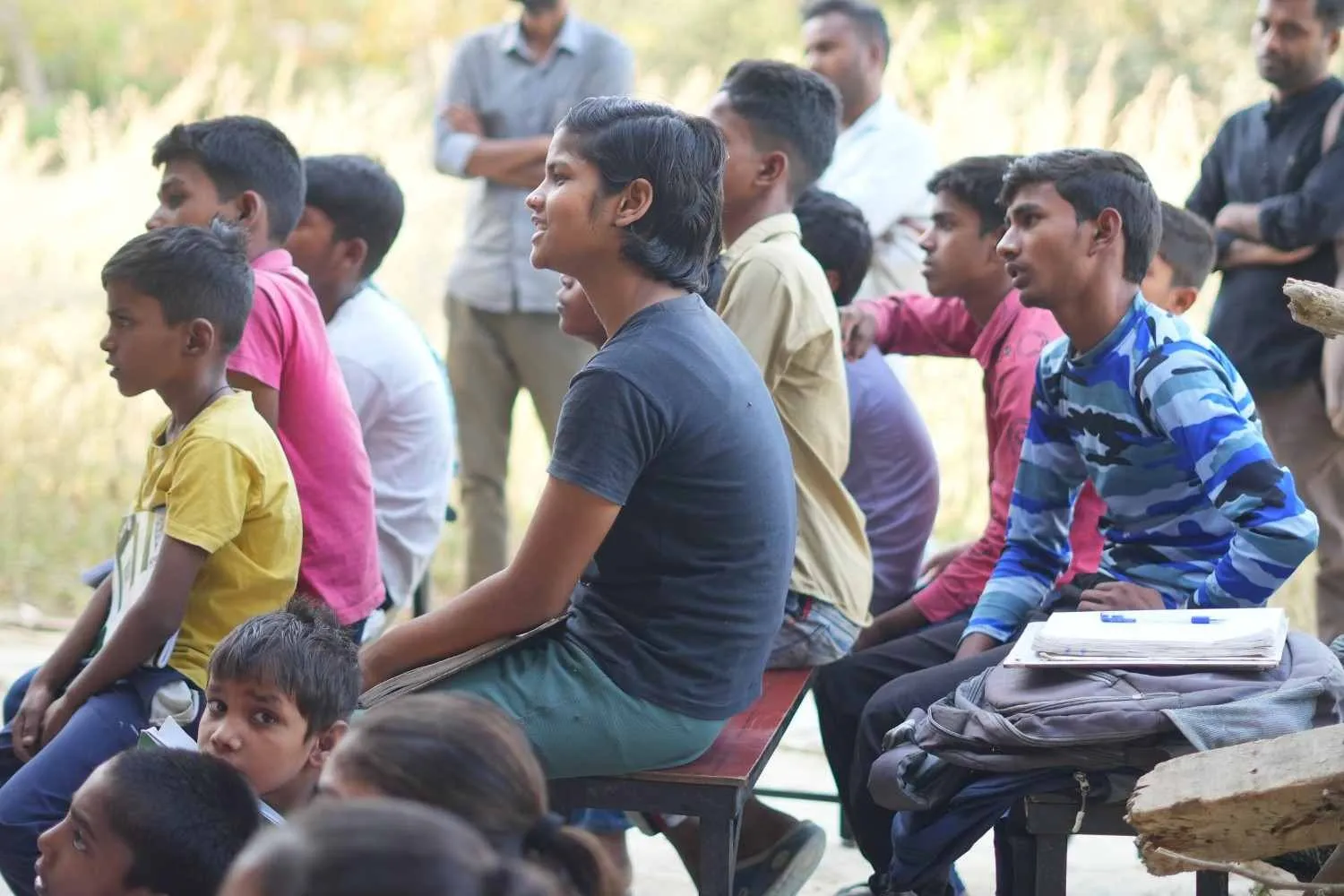
“Archana ma’am!”
The voice comes from one corner of the classroom.
“Ma’am, I have a question.”
Another hand goes up.
Archana Jaisal turns, listens and answers. Then comes another doubt, and another. In a rural Uttar Pradesh classroom, these may seem like ordinary questions. But to Archana, every child who feels comfortable enough to ask one represents something bigger: the opportunity to learn close to home.
It is the kind of classroom she wished more village children could have.
She knows what it means when education depends on circumstances: whether a family can afford coaching, whether a good teacher is nearby, or whether someone offers the right opportunity at the right time.
“I realised that the children were studying, but their studies were not really helping them,” she recalls of what she saw in villages.

That realisation eventually led her to start Shiksha Saathi, a rural education and livelihood startup that now runs over 78 learning centres across six districts of Uttar Pradesh, reaching more than 7,650 students with 67 teachers.
But the story began long before the first centre opened.
It began with her late father, Jagdish Ram.
From rickshaw puller to railway employee
Archana grew up in Ghazipur, where her father’s own childhood had been shaped by hardship.
Her grandfather died when her father was young, leaving the family struggling to survive. There was also pressure to get his sisters married. With little money coming in, her father had to make a difficult choice.
At 17, he began pulling a rickshaw.
Yet he continued his education alongside the work.
“In the beginning, he thought he would have to leave his studies and drive a rickshaw,” Archana says. “But gradually, he continued studying while working.”
He eventually completed his graduation.
His routine revolved around driving the rickshaw while finding time to study. One day, he struck up a casual conversation with a fellow rickshaw puller who had noticed him studying diligently over the past few months.
The man asked him, “Why don’t you apply for a railway job?”
Jagdish took the suggestion seriously.
“He didn’t know what to do next, but he applied for a railway job. He got the job and moved to Varanasi,” Archana recalls.
That one opportunity changed the family’s circumstances.
In Varanasi, he also found different ways to support the family while waiting for his career to settle. He painted boards and banners, made portraits and even wrote names and numbers on T-shirts.
“He used to make portraits and earn some more income. That is how my father survived in the city,” Archana says.

But perhaps the biggest thing he brought back from that struggle was a belief that his children should have a different life.
“My father did not want his children to grow up in the same circumstances he had,” she says.
A couple of months later, he brought his children to the city.
They studied, built new lives for themselves, and for a while, it seemed the family had finally moved beyond those difficult years.
When another challenge hit the family
Archana was still young when her father passed away.
His death left the family without the person who had worked so hard to give his children a more secure future.
Her mother was supposed to take up his railway job, but she was not in a position to do so. With little support and no stable income, the family of five sisters and a brother found themselves facing financial difficulties once again.
They continued living in the railway quarters, but meeting everyday expenses was becoming difficult. And with money running short, continuing their education — something their father had worked so hard to make possible — was now uncertain.
The siblings had to find ways to support one another. It was during this difficult period that Archana’s elder sister stepped in.
“After a few months, my elder sister began earning and helped pay for groceries and tuition,” she adds. “That gave us a means to continue studying and sometimes practising teaching along the way.”
For Archana, that support meant she could pursue her education despite the difficulties at home. She eventually went on to complete her graduation and post-graduation in Economics from Banaras Hindu University.
She had once hoped to become a professor, but without the right guidance and resources, that dream remained out of reach. Her own experiences had shown her how much education could change a family’s circumstances, and how difficult it could be to pursue one’s ambitions without the right support.
Years later, she began noticing another problem, this time among children in her own extended family in rural Uttar Pradesh.
They were attending school, but when Archana began asking them about their lessons, she found something troubling.
‘Children struggled to recall their own lessons’
Some of the children were already in Class 7, yet struggled to answer questions about what they had learnt in school.
“That’s when I realised that the quality of their education was not up to the mark,” she says.
As she looked more closely at the challenges children faced, she noticed another problem in the same villages.
Girls in villages often had few opportunities to earn, even after studying. Coaching centres were limited, and travelling to cities was not an option for many families.
“I realised that the girls were also struggling to find ways to earn because there was no tuition or coaching in the villages,” Archana says. “So, we thought we should do something for them.”
In 2022, she started what was initially called Your Coaching. The organisation was formally registered as Shiksha Saathi in 2023.
The idea was simple: if children could not travel to cities for better academic support, why not bring that support into their villages?
‘Teachers, too, need training’
Shiksha Saathi began offering affordable after-school coaching for children from Classes 1 to 12.
The fees are kept low, starting at around Rs 100 for younger children and going up to Rs 1,100 for Class 12 students. Children who cannot afford the fees can still study with the others.
But as the centres grew, Archana encountered another problem.

A classroom could have a teacher and students, but that did not automatically mean good teaching was happening.
At one centre, the team received a complaint about a teacher who was teaching English. When they tested him, they found that his own fundamentals were weak.
For Archana, it was an important lesson.
“We realised that simply teaching wasn’t enough. We needed to train the teachers too,” she says.
That became the foundation of Shiksha Saathi’s Educator Training Programme.
Every six months, new batches of rural girls and women are trained to teach children according to their age and learning levels. More than 740 rural girls and women have now gone through the programme.
The model began addressing two gaps at once: children received local academic support, while women got a chance to earn within their communities.
For young women like Neetu, that opportunity also meant being able to continue their own education.
‘I now pay for my own studies’
At 19, Neetu became a teacher with Shiksha Saathi, a role she had never planned for.
“I did it for myself and for the children in the village,” she says.
Coming from a Hindi-medium school, she was nervous at first. Shiksha Saathi provided classroom resources and six to seven months of training, gradually helping her gain confidence.
Today, Neetu earns around Rs 6,000–7,000 a month, enough to pay for her own education and coaching.

“I started paying for my own studies and coaching, so I no longer needed to take money from home,” she says.
For Neetu, the income means independence. She now hopes other girls can find the same confidence.
“I want all girls to stand on their own feet and do something for themselves and help the younger children around them,” she says.
Her experience reflects why Archana wants more rural girls to become educators.
“We give priority to girls because they should have the opportunity to learn, work and become financially independent,” she says.
And while women like Neetu are finding new opportunities through teaching, children in these centres are beginning to experience learning differently.
From fearing Maths to enjoying it
Among the children attending the centres is 10-year-old Riya, who has studied at Shiksha Saathi for three years. Maths, once her most difficult subject, is now her favourite.
“When I used to study Maths before, I used to feel scared. Now, things have changed,” she says.
She credits her teachers, who take the time to explain concepts and let her ask about things she does not understand at school. Her parents, too, encourage her to keep studying.

And when asked what she wants to become, Riya has a clear answer: a teacher.
For Archana, moments like these are why the work matters. She wants rural education to go beyond marks and school completion, helping children build the confidence to imagine possibilities beyond what they see around them.
But making such opportunities available within villages also meant earning the trust of the communities themselves.
‘The villagers support us now’
In the beginning, getting communities to accept the centres was not always easy.
People questioned girls travelling out, whether education was worth the cost, and whether women could work outside the home.
But attitudes have slowly begun to change.
In one village, that growing support came from a businessman living in Mumbai. After hearing about Shiksha Saathi’s work, he offered his house as a space for children to attend classes and arranged water and other basic facilities for them.
“The villagers support us a lot now,” Archana says. “They tell us that their children are doing well.”
For Archana, such support matters because it shows that education is gradually becoming a community concern rather than an individual family’s responsibility.
Today, Shiksha Saathi has expanded across Bhadohi, Varanasi, Mirzapur, Prayagraj, Mau and Ghazipur.
Giving more kids the chance to learn
Shiksha Saathi now works across six districts, but Archana’s vision goes beyond opening more coaching centres.
Its youth competitions have reached over 9,000 children, while its 2025 initiative, Yuva Pratibha Parishad, encourages students to think about their ambitions, Plan A and Plan B, and how they want to contribute to society.
“In villages, students have the talent, but they don’t always have the opportunity,” Archana says. “We want to give them the opportunities they are looking for.”

She hopes to reach more districts across Uttar Pradesh and make quality education affordable for families, a goal closely connected to her father’s experience.
Her father once pulled a rickshaw to support his family while continuing his studies. A stranger’s advice eventually helped him secure a railway job, move to the city and give his children a different future.
Archana hopes to help other children find opportunities that can shape their futures, just as education shaped her family’s.
And when children call out, “Archana ma’am!”, she listens to their questions. For her, each question carries something her father worked hard to secure for his own children: the chance to learn.
And she wants more children to have it.
All images courtesy of Archana Jaisal
Disclaimer : This story is auto aggregated by a computer programme and has not been created or edited by DOWNTHENEWS. Publisher: thebetterindia.com