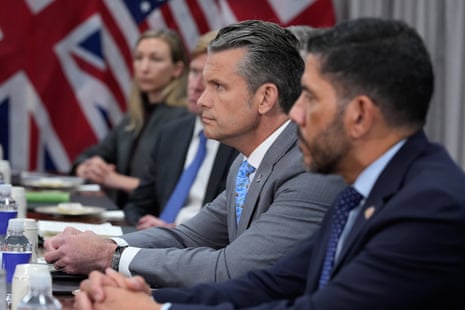
Downing Street has delivered a rare public reprimand to a member of Donald Trump’s administration, saying Pete Hegseth, the US defence secretary, was “wrong” to suggest that most non-American Nato soldiers in Afghanistan did not do any fighting.
Hegseth made the comment in a speech at the University of Tennessee, where he recalled serving in Afghanistan himself. He said:
I was a captain in Afghanistan and we would go to the headquarters in Kabul and there would be 50 flags at the headquarters. It was a beautiful thing to see, 50 different countries contributing to the Nato alliance and the Isaf [International Security Assistance Force] mission there.
Except there were maybe five that contributed. It was actually closer to one or two that by the end were actually involved in kinetic operations. In fact the patch Isaf, we joked it meant ‘I Saw Americans Fighting’.
Asked about Hegseth’s comment at the Downing Street lobby briefing, the PM’s spokesperson said Hegseth was “wrong” in what he said about the Nato operation in Afghanistan.
The spokesperson explained:
The facts speak for themselves when it comes to the UK’s and Nato’s contribution to Afghanistan. Thousands of British and Allied families made huge sacrifices to play their significant part in that war and uphold our values, and more than 450 British personnel never returned.
Their sacrifice and that of other Nato forces was made in the service of collective security and in response to an attack on our ally. We are incredibly proud of our armed forces and their service and sacrifice will never be forgotten, and it is wrong to diminish their role.
While the UK government disagrees with much of what Donald Trump and his team say and do, there is normally a reluctance to criticise them in public. However, this does not seem to apply when the reputation of British servicemen and women has been impugned. Keir Starmer tried hard to maintain a good personal relationship with the US president, but when Trump made a similar claim about Nato allies avoiding frontline fighting in Afghanistan, Starmer condemned what he said as “insulting and frankly appalling”.
-
Scottish Labour has become the second largest party at Holyrood after Amanda Bland, a Reform UK MSP, resigned from the party to sit as an independent. (See 12.21pm.)
-
Wes Streeting, the defence secretary has said the armed forces need to “live within their means” as he confirmed that some training exercises have been cancelled to save money. (See 2.54pm.)
For a full list of all the stories covered on the blog today, do scroll through the list of key event headlines near the top of the blog.
Miatta Fahnbulleh, the energy secretary, has published an article criticising the home secretary’s proposal to make immigrant workers wait much longer before they can apply for permanent residency in the UK.
In a post on the website that promotes her work as Labour MP for Peckham in south London, she said:
Ultimately, I want to see a system based on control and compassion, with a much stronger focus on integration …
If we continually prolong the time people have to wait for settlement, we can also prolong the process of building cohesion.
We need to raise the level of the debate, challenge divisive political rhetoric and make the case for communities like the one we have in Peckham. That means talking about immigration with care, control and compassion.
According to a story by Nick Gutteridge for the Telegraph, Fahnbulleh’s team say these comments were actually written by an aide as an account of what the MP said at a meeting with consituents last month. They describe it as poorly-phrased summary, and the post has been taken down so that it can be reworded. But they do not seem to be contesting that the public version captures the gist of what she thinks.
The language is contentious because Shabana Mahmood wants to make most migrant workers wait for at least 10 years before they can apply for indefinite leave to remain (ILR) in the UK. Under current rules, ILR is normally available after five years.
Mahmood originally published her plans last year. Fahnbulleh, who came to the UK as a child refugee from Liberia, is not the only cabinet minister with concerns. Andy Burnham has signalled that he is unhappy about Mahmood’s plan to make foreign care workers wait 15 years for ILF (supposedly because their low earnings mean they are more likely to be a burden on the state), and Mahmood has signalled that some sort of climbdown is coming.
The latest edition of the Guardian’s Politics Weekly UK podcast is out. It features Kiran Stacey and Pippa Crerar talking about the Alan Milburn review of youth unemployment.
Rhun ap Iorwerth, the Welsh first minister, will give a speech later inviting Andy Burnham to agree to a “new partnership’” between Wales and the UK government on growth. The two governments should also avoid “duplicating activity”, he will say.
According to a report for Nation.Cymru, ap Iorwerth will say:
I will invite the prime minister to agree a new partnership for growth between our two governments – a practical agreement about how our two governments work together to unlock Wales’s economic potential …
My message to the prime minister will be a simple one – let us spend less time designing new programmes and duplicating activity. Let us spend more time unlocking opportunity and supporting investment, and more time delivering the growth we both want to see in all parts of our respective nations.
Ap Iorwerth also posted this on social media.
Wales is not England, nor a region of it.
Our institutions are different.
Our communities are different.
Our geography is different.
Where power can sit as closely to the people it affects, it should.
That’s the case I’ll be setting out tonight.
The Green party has reacted with alarm to reports suggesting the Alan Milburn review of Neets will recommend lower sickness benefits for people under the age of 25.
Pointing out that the recent review from Prof Peter Fonagy into the prevalence of mental health conditions, autism and ADHD argued cutting benefits was bad for mental health, the Green party’s co-deputy leader Mothin Ali said:
It seems that when you commission an expert like Prof Fonagy rather than a Blairite former minister, you get a far more coherent analysis of the issues affecting young people and their mental health …
The Green party has a proper jobs guarantee for young people – real jobs, with real training and rights at work. It would be funded by those who can afford to contribute, not by cutting support for those least able to cope.
During defence questions, Edward Leigh, the Conservative MP and father of the Commons, asked Wes Streeting about the Diego Garcia military base on the Chagos Islands. Given that it was “to all intents and purposes an American military base”, why didn’t the government just sell it to Donald Trump for £6bn, and invest the money in defence?
Streeting said that he didn’t think that was the right solution.
In an earlier answer, Streeting defended the government’s plan to transfer sovereignty of the Chagos Islands to Mauritius as a response the legal doubt over the UK’s claims of ownership. He said:
Having looked at this whole issue with a fresh pair of eyes, I’ve reached the same conclusion as every prime minister since Boris Johnson, including this one, which is the capabilities provided by that base makes it extremely unwise and a risk not worth taking to have legal uncertainty. That is why efforts to negotiate a treaty continue.
Fraser Nelson, the Times columnist who is heavily involved in a project the paper is running investigating the nature of welfare spending, has written an interesting post on his Substack blog about Andy Burnham’s welfare article today. (See 9.34am.) Nelson argues that Burnham saying “benefits will become the backstop, not the starting point” is the key line. He explains:
I read this as an intention to dismantle what Whitehall officials call ‘the pipeline’ – in effect, a Neet factory. Children as young as five are categorised as disabled and a £10k package released to the parents. This ‘disability living allowance’ typically converts to adult Pip at age 16 paying about £9,000 straight to the kid.
Outcomes for such child claimants are poor: the Milburn review disclosed that the DWP holds the power to follow these kids in later life. It does not use this power lest anyone FoIs to find out the scandal (they rejected my request saying it’d cost too much to work out what happened to sickness benefit claimants, even though they could). But [Alan] Milburn used his powers to get them to publish a cohort analysis. This graph is The Pipeline.
And Nelson includes this chart showing what happens to children who have claimed DLA (disability living allowance) for children after the age of 16.
James Cartlidge, the shadow defence secretary, reminded Streeting that, soon after being made defence secretary, he was asked in a TV interview if he would resign if the Treasury did not allocate enough for defence spending. “Absolutely,” Streeting replied. Cartlidge asked if that was still the case.
Streeting said that his answer remained the same. And he said he was confident saying that because “this government is already delivering the biggest sustained increase in defence spending since the end of the cold war”.
Back in the Commons, Wes Streeting, the defence secretary, is now taking topical questions.
In response to Andrew Rosindell from Reform UK saying the UK’s “ability to protect the Falkland Islands is now in doubt”, Streeting replied:
It is simply irresponsible, not to mention inaccurate, to suggest that the UK is incapable of defending the Falkland Islands. We are perfectly capable of doing that. We had a very visible demonstration only recently. Maybe if Reform had a defence spokesperson, they might have noticed.
This morning Daisy Cooper cited Andy Burnham’s support for proportional representation as evidence that the Liberal Democrats are “winning the battle of ideas”. (See 11am.)
But only up to a point. There are a couple of reports around this morning that show that, while Burnham may personally favour PR, he is yet to convincingly win the argument for it in the parliamentary Labour party.
In an article for PoliticsHome, Harriet Symonds and Matilda Martin point out that some of Burnham’s most senior ministers prefer first-past-the-post. They say:
PoliticsHome understands that Louise Haigh, deputy PM and Burnham’s close ally, has concerns about shifting to PR.
Other Cabinet members have previously voiced reservations about the idea.
In 2022, Angela Rayner, now secretary of state for housing, communities and local government, said she was a “first-past-the-post girl” who was “yet to be convinced by PR”, telling The News Agents podcast that it could allow extremist parties such as the British National Party (BNP) to win House of Commons seats.
And David Blunkett, the former cabinet minister who has been one of Burnham’s political mentors, has written an article for the i restating his longstanding opposition to PR. He says:
In my view, the argument can’t be that “every vote must count”. Each vote already does count, because in order to have winners and losers, people engage in the process which inevitably means that some voters’ preferences will be cancelled out by a greater number preferring another candidate.
Not everyone can have prizes in a democracy. Some candidates lose, some electors are frustrated and annoyed that their candidate didn’t succeed. Hence, the first set of questions about what it is we think this change is going to improve. The second question is why we would believe that electoral reform would change people’s interest or engagement with politics?
Later this month we will have a demonstration of what is the purest form of proportional representation in the world. Namely, the Israeli general election. If there were ever an example of how tiny minorities representing not only outlandish views, but providing a blockage on progress, compromise and long-term outcomes, it has to be this form of PR.
Wes Streeting told MPs that the US is still on the side of Ukraine in its war against Russia.
During defence questions, the Lib Dem MP James MacCleary asked about reports that the Ukrainian military were left exposed last week after President Trump reportedly intervened to restrict access to the Starlink internet service for its weapons.
Streeting replied:
It is worth pointing out, after what was unquestionably a challenging week for relations between the United States and Ukraine, that the United States has and does and will continue to provide vital support to Ukraine, whether that’s intelligence sharing or indeed the work we do on procurement with and through the United States, as well as the diplomatic track.
Referring to a meeting he had with Pete Hegseth, his US counterpart, last week, Streeting went on:
This is worth reporting to the house; Pete Hegseth, my US counterpart, was keen to thank the United Kingdom for our leadership of Ukraine.
That would suggest to me the United States does know which side it’s on.
Wes Streeting, the defence secretary, is taking questions in the Commons.
When the Reform UK MP Danny Kruger asked him if he agreed it was “absolutely scandalous” that non-essential training had been cancelled by the army, Streeting said that training exercises were taking place for the rest of this year. But he accepted that some future training had been cut.
He told MPs:
When I arrived in the Ministry of Defence, there was an in-year overspend that would have seen us overcommitted by the end of the year.
And, as I did at health, I make absolutely no apology whatsoever for sending a very strong message very early on that, while this government is delivering the biggest sustained increase in defence spending since the end of the cold war, I also expect my department and our armed forces to live within their means.
Disclaimer : This story is auto aggregated by a computer programme and has not been created or edited by DOWNTHENEWS. Publisher: theguardian.com