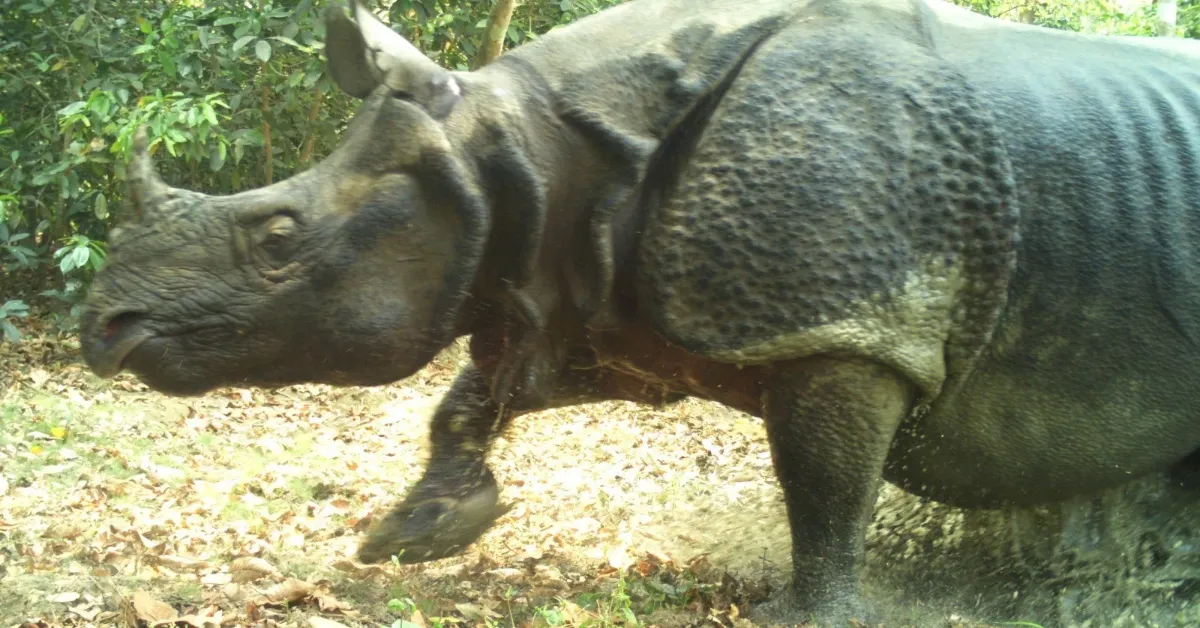
For decades, rhino conservation in Dudhwa Tiger Reserve in Uttar Pradesh was built around protected enclosures. The approach helped a population recover after the species had disappeared from the region, but the next question is harder: can these animals live, breed and survive as a genuinely free-ranging population within a functioning Terai landscape?
That question is now being tested.
In March 2026, four greater one-horned rhinos were moved out of Dudhwa’s fenced rehabilitation area into suitable grassland habitat in the reserve. The release took the number of mature rhinos free-ranging in Dudhwa to eight. The state’s longer-term plan is to explore the feasibility of having 10 rhinos free-ranging as an initial phase of a wider conservation strategy.
The latest census, conducted in June 2026, counted 53 rhinos in Dudhwa: 17 adult males, 25 adult females and 11 calves older than one year. Eight of them were among those released from the rehabilitation enclosures to improve genetic diversity and reduce inbreeding.
But the significance of Dudhwa is not simply that there are more rhinos here than there were four decades ago. It is that the reserve is now becoming a test ground for a much larger question: what does it take to move from reintroduction to a resilient rhino population that can sustain itself across the wider Terai?
From five rhinos to a larger experiment
Dudhwa’s rhino story began in 1984, when five rhinos were brought in as part of a reintroduction programme. The population has since grown, demonstrating that the Terai can once again support the species.
But numbers alone can conceal the harder ecological questions.
A population can grow while remaining vulnerable to genetic limitations, habitat pressures, disease, predation or a lack of connectivity with other populations. For a large herbivore such as the greater one-horned rhino, a viable future depends on much more than a protected patch of land.
Amit Sharma, National Lead, Rhino Conservation at WWF India, sees the current phase in Dudhwa as a shift in that direction.
“It is a great achievement for rhino conservation in Dudhwa as the rhinos have been allowed free range outside the enclosed area after almost four decades. Even though the initial plans are to release 10 rhinos, the objective should be more than releasing the 10 rhinos — it should be establishing an ecologically functional, demographically viable and genetically resilient free-ranging rhino population.”
The test now is whether the landscape can support the next generation, and the one after that, without conservation managers having to intervene constantly.
What does a rhino need from a landscape?
The Terai is a landscape of grasslands, wetlands, swamps, rivers and forests. Rhinos depend heavily on productive grasslands and water, while the mosaic of habitats allows them to feed, wallow and move through the landscape.
Dudhwa already has much of this.
“Dudhwa already has a successful reintroduction history and the basic ecological foundation: extensive terai grasslands, wetlands, swamps and riparian habitats are already in place,” Sharma says.
He points to a 2022 analysis which estimated that around 20% of Dudhwa was under grasslands and another 3% under wetlands, marshes and swamps, habitat classes that are critical for a flourishing rhino population.
But having these habitats on a map is only the beginning.
“The natural water flows must be maintained, and perennial water sources must be secured to maintain the habitat standards. Further, the grassland extent and quality also must be managed to support a good herbivore population, especially for a mega-herbivore like the rhino.”
That makes habitat management one of the central lessons of Dudhwa. A rhino recovery programme cannot be separated from the health of the grassland itself. If grasslands degrade or natural water flows are disrupted, simply adding more rhinos will not solve the problem.
And so the experiment in Dudhwa is also about learning how to manage a landscape before attempting to expand a population beyond it.
The real test begins after release
There is another difference between rhinos in an enclosure and rhinos that range freely. Once animals move through a larger landscape, conservation managers have to understand where they go, what they eat, how they reproduce, which calves survive and what causes mortality.
Sharma says this requires long-term monitoring rather than periodic population counts alone.
“For long-term viability of the population through active management, it will be necessary to undertake systematic monitoring for individual identification, reproductive success, calf survival, mortality, home-range use, forage availability and genetic diversity. Non-invasive DNA and technology-based approaches can strengthen population monitoring.”
In other words, Dudhwa’s success will need to be measured in biological terms.
Are females producing calves? Are those calves surviving? Are animals using suitable habitat? Is the population genetically healthy? Are rhinos able to expand their range? And can the population continue growing without continual human supplementation?
These are the indicators that could determine whether Dudhwa’s experience can inform future conservation in the Terai.
The landscape does not end at Dudhwa
The Terai does not follow state boundaries, and wildlife does not recognise them either.
Dudhwa sits within a wider ecological system connected to other forests and protected areas in Uttar Pradesh, Bihar and Nepal. Valmiki Tiger Reserve in Bihar is another important rhino landscape, while rhinos also move across the India-Nepal border.
A 2025 Wildlife Institute of India study on the Western Terai Arc Landscape highlighted how roads, development and other land-use changes can disrupt wildlife corridors, affecting the movement of large mammals and potentially isolating populations. Research and modelling under the project have specifically examined rhino and tiger habitat connectivity, and the areas where linear infrastructure could interfere with movement.
For rhinos, that connectivity has consequences beyond movement.
(1/3) Four greater one-horned rhinos have been released into the wild at Dudhwa Tiger Reserve, taking the free-ranging population to eight and strengthening conservation in India’s Terai landscape. @moefcc @DudhwaTR @ManpowerGroupIn @experisitindia #WWFIndia https://t.co/vBt5uekU30
— WWF-India (@WWFINDIA) March 24, 2026
“A landscape-level approach is essential for the long-term recovery of rhinos in the Terai,” Sharma says. “Rhinos do not recognise administrative boundaries, and the Katerniaghat–Bardia and Valmiki–Chitwan systems are ecologically interconnected.”
He points to a pattern already visible on the ground.
“Studies have confirmed rhino movement across the India–Nepal border as a natural process to meet ecological requirements. Rhinos from Nepal are observed across the border on the Indian side at Pilibhit, Katerniaghat and Valmiki almost regularly.”
That changes the conservation question
Instead of asking how Dudhwa can maintain one population, planners may eventually need to ask how Dudhwa, Valmiki, Nepal’s Terai and other suitable habitats can function as parts of a larger rhino landscape.
“It is thus essential to consider the entire area as one conservation unit and manage the rhino population as one single metapopulation or rather as a rhino landscape in the terai belt.”
But connectivity is not the only challenge. The same landscape that can support rhinos is also under pressure from infrastructure, human activity and climate-related changes.
“The omnipresent risk to any rhino population is the threat of poaching arising out of the demand for the rhino horn and, to some extent, its body parts in the international market,” Sharma says.
But he points to another risk that may become harder to manage because it affects the habitat itself.
“However, the predicted risk is the impact that a rapid change in the climate can exert in the region, which can lead to widespread effects in the fragile Himalayan system; the recent floods in Nepal during 2026 are indicative of the likely impacts.”
For rhinos, climate change is therefore not an abstract future threat. Changes in rainfall, flooding and water availability can alter the grasslands and wetlands on which the species depends.
“The habitats in the terai are already under stress due to degradation and any deviation from the climatic pattern may result in drastic changes in the composition and condition of the habitats that may put the survival of the rhinos at risk.”
Then there is the human landscape around these habitats.
“Again, due to multiple developments in the border areas and expansion of human activities, the connectivity with Nepal facilitating safe and active movement of rhinos and wildlife is under increasing threat. Any blockage in the natural connectivity will pose a huge challenge for rhino conservation in the entire Terai region.”
That means expanding rhino populations will require more than habitat protection. It will also require communities to be part of the conservation landscape.
What happens when rhinos meet tigers?
Dudhwa has another lesson to offer, and it is less comfortable.
In March 2026, a 30-year-old female rhino named Rajeshwari was found dead in a water body in the reserve, with a tiger on her carcass. A post-mortem confirmed that she had died from injuries sustained in the attack. Reports said two sets of tiger pugmarks were found near the site.
The incident raised an obvious question: if Dudhwa is trying to build a larger free-ranging rhino population, what happens when those rhinos share the landscape with a strong tiger population?
Sharma says predation is part of the ecological reality, but adult rhino predation remains unusual.

“Tiger is an apex carnivore in the Indian forest, and it is quite natural for them to prey even on large animals like the rhino or the elephant.”
“In a park like Kaziranga, where tiger presence ten years back was not that dense, yet the rhinos falling prey to them was not uncommon. However, tigers preying on a healthy adult rhino are relatively rare, as it has been observed that they mostly attempt to attack the calves.”
For Dudhwa, however, the demographic consequences matter.
“Rhino predation by tigers is not new to Dudhwa, and the death of the adult female rhino Rajeshwari in Dudhwa indicates that active predator–prey interactions are an integral component of managing a recovering rhino population within a tiger landscape with a high tiger population.”
But there is a limit to how much mortality a small or recovering population can absorb.
“The rhino population in Dudhwa is limited and still aims for growth; as such, a high rate of predation will negatively impact the demography and population dynamics.”
Dudhwa’s biggest lesson: release is only the beginning
A rhino reintroduction cannot be treated as the finish line.
“Dudhwa exemplifies a conservation story of return, resilience and the long road from reintroduction to rewilding,” Sharma says.
“The key lesson from Dudhwa is that reintroduction should be viewed as the beginning of population recovery; it teaches us to plan holistically to achieve a viable free-ranging population.”
A population of 50, 100 or 200 rhinos can remain vulnerable if it is isolated.
For Sharma, resilience means several things happening at once.
“The ability of the population to grow without continual human supplementation and connect naturally to be considered as a meta population including Nepal terai and communities to persist without perpetual intensive conflict will also be within the vision.”
That is why the 10 rhinos proposed for Dudhwa matter less as a number than as a beginning.
The real test will come later, when rhinos are counted as members of a connected Terai population that can move, breed, survive, and coexist across a changing landscape.
Disclaimer : This story is auto aggregated by a computer programme and has not been created or edited by DOWNTHENEWS. Publisher: thebetterindia.com