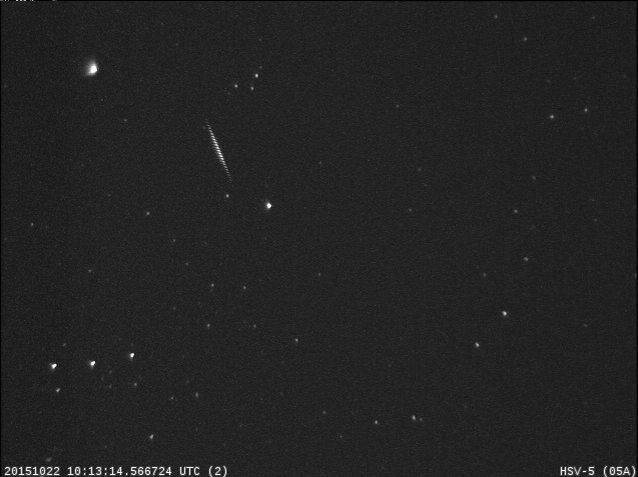
Halley’s COmet won’t be visible from Earth for another few decades but you can see fragments of it streak across the sky this month in the Orionid meteor shower. The event began earlier this month but will reach its peak on October 21 and 22. Here’s how to view these shooting stars and other upcoming astronomical phenomena.
Orionid Meteor Shower
The Orionid meteor shower will be ongoing until November 7, but in the US, the best time for viewing is between dusk on October 21 and dawn on October 22. During this time, you may see up to 20 meteors per hour. That’s in dark skies. The moon will be approximately three-quarters full at this time, which may obscure some of the shooting stars. The best time for viewing is therefore in the early morning between when the moon sets and the sun rises for peak darkness.
However, these particular meteors are known for their brightness as well as their speed, and in some cases especially fast meteors can turn into “fireballs,” becoming as bright as the planet Venus. Dark conditions, however, will be best for viewing some other phenomena associated with this event, such as glowing trains of debris Orionid meteors have been known to sometimes leave in their wake.
The shower gets its name from the constellation Orion, as this is the shower’s “radiant,” the source a large portion of the meteors appear to come from. However, you don’t need to find Orion to enjoy the show. The best viewing is, in fact, often away from the constellation, and meteors should be visible from any part of the night sky.
Other Astronomical Highlights in October
Earlier this month, Saturn reached opposition, meaning the Earth passed between the sun and Saturn. Since the gas giant rises in the eastern sky around sunset and reaches its meridian around midnight, it can be observed almost all night long. On October 24, the moon will also come close to Saturn.

Not only does this present prime viewing for amateur astronomers, but it will provide researchers further opportunity to observe a bizarre geometric structure recorded in Saturn’s atmosphere—a decagon centered on the planet’s south pole. This recent discovery came nearly half a century after a similar 18,600-mile-wide hexagon had been discovered encircling Saturn’s north pole.
Scientists believe these phenomena have been caused by currents confining powerful atmospheric waves, and the wave in the southern hemisphere appears to be gaining momentum. Being at its closest point to Earth, opposition provides researchers with a valuable opportunity to observe the gas giant’s peculiar atmosphere.

At the end of the month, the moon will pass close by the Pleiades star cluster. The Pleiades have been the subject of stories in many ancient cultures, perhaps because these bright stars can be observed from almost anywhere in the world.
The best time for viewing the Pleiades in proximity to the moon is the evening of October 27 into the morning of October 28. Look toward the east and wait for the moment when the moon and the cluster rise high in the sky. With the naked eye, you may see what appears to be a faint cluster of six to seven stars. Since this occurs just after the full moon, the cluster may at first be difficult to see, but you’ll be able to observe it more clearly with binoculars or a telescope.

This story originally appeared on WIRED Japan and has been translated from Japanese.
Disclaimer : This story is auto aggregated by a computer programme and has not been created or edited by DOWNTHENEWS. Publisher: wired.com