On the Shelf
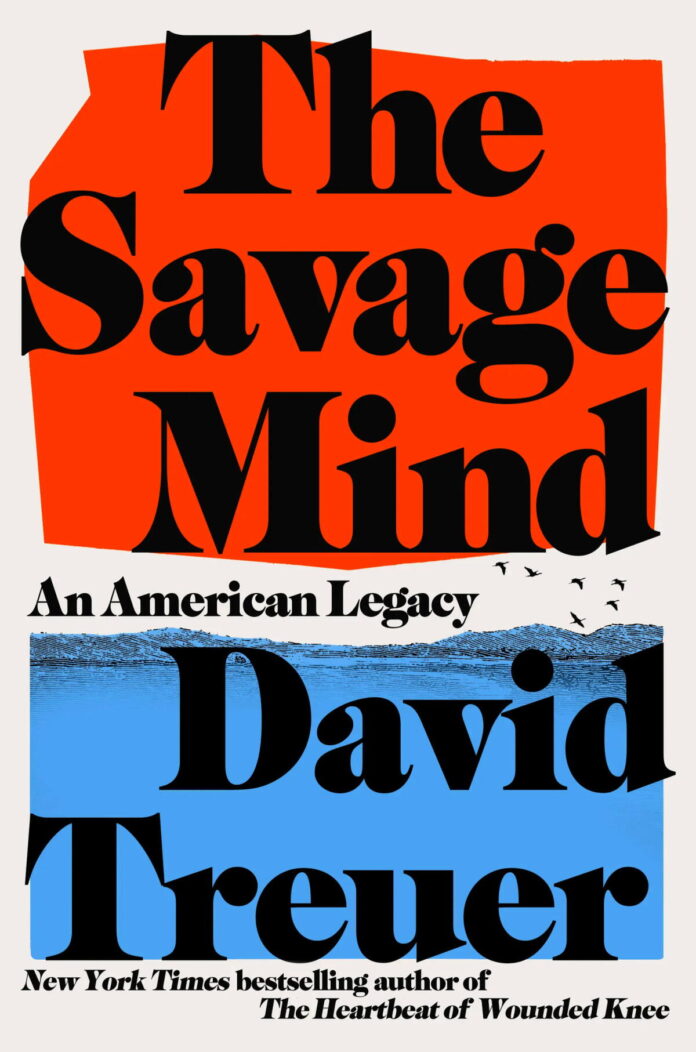
The Savage Mind
By David Treuer
Little Brown and Company: 272 pages, $29
If you buy books linked on our site, The Times may earn a commission from Bookshop.org, whose fees support independent bookstores.
David Treuer’s “The Savage Mind: An American Legacy” — his eighth book and fourth work of nonfiction — features an epigraph from James Baldwin’s “Nothing Personal”: “It has always been much easier (because it has always seemed much safer) to give a name to the evil without than to locate the terror within.” What Baldwin is lamenting is our tendency to fall back on binaries — right and wrong, good and evil — rather than to struggle with complexity. The dichotomy compels Treuer, as well. “I’m an admirer of Baldwin’s writing,” he tells me via Zoom from the Leech Lake Reservation in north-central Minnesota, where he was raised as an enrolled member of the Ojibwe Nation. “But even more, I’m an admirer of his thinking, and of how he carried himself in the world.”
That quality of admiration (or better: lineage) helps position “The Savage Mind.” Constructed as a letter to the author’s offspring — “My children,” it opens, “I don’t think I’ve told you this story before — but who knows? We’re always talking, and my memory has gotten away from me” — the book gives a nod to what may be Baldwin’s best known work, “The Fire Next Time,” which begins with a letter to his nephew. The effect, in both cases, is an unlikely intimacy.
Intimate because there may be no form of writing quite so unguarded as the letter. Unlikely because “The Savage Mind” seeks its own form: interweaving personal, family and collective histories. “I worked on this book for nearly 10 years,” Treuer says. “It was largely a matter of trying to find the right structure and the right angle of entry. Otherwise, I would have burned up.”
The result is a piece of writing that is by turns reflective, researched, confessional and infused with righteous anger. “This may or may not become your life’s work,” Treuer cautions his children. “It has, much to my chagrin, become mine.”
Treuer’s chagrin has roots, as it must, in childhood, not least an incident involving himself, his brother, a cousin and a sudden threat of violence. In the face of danger, the three sought to protect themselves behind a gun. “I don’t know how long I sat on that couch with your uncle and our cousin,” Treuer writes. “I don’t know if I’ve stopped. I think some essential part of me is still there.” The physicality of memory, the way it lingers, is the whole idea. Not only because the history of Native peoples in the United States is commonly recounted through a filter of erasure, but also because our national culture has long been predicated on forgetting, in which domination, conquest, is recast through a lens of innocence. How to deconstruct that? How to reinvent the terms? The process, Treuer suggests, begins with a willingness to look beyond oneself in the service of a broader reckoning.
(Little, Brown)
“The mistake of a lot of nonfiction writers,” he explains, “is that their hinges turn inward instead of outward. I think it’s much more interesting when we hinge out into the world. It’s an opening, rather than a closing down, you know? I would love for you to know this because it might mean something to you.”
In “The Savage Mind,” such an opening emerges in response to the pernicious myth of Manifest Destiny, which Treuer approaches through the lens of the frontier. This frontier, it turns out, is both geographic — as embodied by the ever-expanding borders of a nation intent on colonizing and conquering much of the continent — and psychological. “It was a process of discovery,” he says. “It wasn’t like I had this all worked out and just needed to stage it correctly.” The more complicated reality was that, despite having been declared closed after the slaughter of as many as 300 Lakota in Wounded Knee, S.D., in December 1890, the idea of the frontier had never been settled, only internalized. By way of illustration, “The Savage Mind” traces another line of heritage, from the cavalry officers who participated in this and other massacres to the police officers who have killed civilians including Philando Castile and George Floyd. In this way, “The Savage Mind” means to interrogate the unresolved, even unrecognized, conundrums of identity and race.
Treuer has wrestled with these legacies for much of his career. A professor of English at USC (full disclosure: He and I are departmental colleagues), he published his first novel, “Little,” in 1995. He began that manuscript, which takes place on the reservation, as an undergraduate at Princeton, in Toni Morrison’s long-fiction workshop. His follow-up, “The Hiawatha” (1999), explored the terrain of the so-called Urban Indian. In 2012, he returned to the reservation with “Rez Life,” which I’ve come to imagine as the first volume in a loose trilogy. Inspired by a 2005 school shooting on Minnesota’s Red Lake Reservation — an incident revisited in “The Savage Mind” — “Rez Life” revolves in part around the author’s grandfather, whose suicide became another catalyst. “The Heartbreak of Wounded Knee,” a 2019 National Book Award finalist, uses the 1890 massacre to reframe the history of Native peoples as one of continuity and presence, a motif Treuer develops further in the new book.
Does “The Savage Mind,” then, represent a closing of the circle? For Treuer, that feels a bit too intentional. Despite the overlaps and callbacks — in a whispery echo of “Rez Life,” sections of the narrative are centered by his mother, an Ojibwe tribal judge, and his father, an Austrian Jew and survivor of the Shoah — each book grows out of its own circumstance. The connections among them, in other words, are organic rather than preordained. Still, Treuer admits, “there is a movement from the local to the quasi-universal through the three books, the same mixture in all three, just with different emphases on historical, reported and memoiristic material.”
To get a sense of how this movement works, let’s go back to the matter of chagrin. Throughout “The Savage Mind,” there is a sense that Treuer is writing out of a relentless duty to set the record straight. In part, this is a response to the fallacies of narrative, or at least of narratives that are imposed. As he observes: “One of the problems with ‘Native stories’ is that they’re almost exclusively told as tragedies, which makes our history just a list of the abuses we’ve suffered, and if we’re not entirely gone, we’re just ghosts in the American imagination. That makes it devilishly difficult to imagine a future, if everything is in the past.”
At the same time, he continues, “by addressing the younger generation — as personified by my kids — I’m really talking about futures. This is important to me. So much emphasis has been placed on survival, and I don’t think that’s enough, socially, emotionally or politically. I think we should talk about living. About how we want to live and how we want our fellow citizens to live and to be.”
What this means is that the prevailing binaries are not — can never be — enough. “Being brown,” Treuer insists, “does not excuse us from being racist. We all live in a racialized system, so we all share that burden. All of us are complicit in the violence that has occurred on this land.” As evidence, he invokes, throughout the book, numerous instances of one nation waging war on another, or assisting U.S. forces against rival tribes.
This, in Treuer’s view, is the savage mind in action. This is another narrative that has been imposed. In a culture that refuses to accept its responsibilities, its complicities, we are all reduced, in some essential measure, to a state of savagery.
And yet, in one of the most remarkable moves in “The Savage Mind,” Treuer doesn’t leave us there. Instead, he finds a way to turn toward hope. The transition begins with a story about a ceremony called Big Drum, given to the Ojibwe by their enemy, the Dakota, “in the early-to-mid nineteenth century.” The Ojibwe, Treuer writes, “were told that every member who was seated in that inaugural ceremonial society — men and women — should be someone who had killed a Dakota person in close warfare … those who had ‘touched blood.’” What a gesture of empathy and reconciliation. What a strategy to transmute anger into grief. I’m reminded of another Baldwin declaration, this one from “The Fire Next Time”: “I imagine one of the reasons people cling to their hates so stubbornly is because they sense, once hate is gone, they will be forced to deal with pain.”
Pain, yes. The pain of grieving. The pain of everything we can’t resolve. Read through such a filter, Big Drum becomes another catalyst. It is the reason Treuer is speaking with me from Leech Lake. He has come to the reservation with his eldest son to participate in the ceremonial society, as he has more than once over the decades. This seems an almost perfect emblem of the larger conversation he is pursuing, the consolations he believes we must enact. “There’s a grief from having lost,” Treuer says, “and then there’s a grief from having caused harm. That’s a grief very few Americans want to touch.” He pauses, thinking for a moment. “But it was true bravery the Dakota exhibited in giving this to us. Where would we be if we could collectively acknowledge the harm we’ve done?”
More to Read
Disclaimer : This story is auto aggregated by a computer programme and has not been created or edited by DOWNTHENEWS. Publisher: latimes.com