Huge setback for Alberta’s separatist movement after decisive defeat
-
Published
It was a decisive result in a referendum that could have strained the bonds of national unity.
But preliminary results show that more than two-thirds of Alberta voters sent a clear message that they want to remain in Canada.
It’s possible that once the final tally is counted, the rejection by a comfortable majority of voters to pursue separation through a binding referendum could halt Alberta’s separatist sentiment in its tracks.
This would push the idea that had been discussed quietly for decades back into the political fringes.
For leaders of the Alberta separatist movement, while the result was expected given the polling, it was still disappointing after more than a year of campaigning and pushing for a vote on separation.
Asked by the BBC how he felt in one sentence after the results, separatist leader Mitch Sylvestre simply said: “Not happy”.
To play this video you need to enable JavaScript in your browser.
This video can not be played
The outcome was celebrated almost immediately by Prime Minister Mark Carney, who said in a statement that “Albertans made a clear choice”.
But the movement’s leaders say their battle is long from over and that the issue could dominate Alberta politics for years to come.
Jeffrey Rath, a Calgary-lawyer and one of the main spokespeople for Alberta separation, said he and others “plan to roll up our sleeves and work harder”.
Keith Wilson, another separatist, told supporters in Calgary that while the vote is over, “the conversation about Alberta’s future in Canada and our place in Canada and our role in Canada will continue”.
Smith, who openly supported and campaigned for the unity vote, thanked voters for the result.
The Alberta premier has been criticised for taking a “dangerous” gamble that the independence push would likely face defeat while still giving her restive base what they wanted.
She lowered the petition threshold needed to get the citizen-led campaign the ballot in the first place.
-
How oil-rich Alberta’s economy might fare if it broke away from Canada
-
Published8 October
-
-
Carney pitches oil pipeline as a response to US-Canada trade war
-
Published1 October
-
By making Monday’s result non-binding, she got around a court decision blocking the pro-separation petition because it failed to consult indigenous First Nations whose land would be affected if the province separated.
That gamble could test her leadership of the United Conservative Party, which she has led since 2022.
“She’s lost the confidence of the (party) base,” said Rath.
Albertans who voted against an independence referendum told the BBC throughout the campaign that they were motivated by a desire to keep the country united, especially as Canada grapples with tariff threats from the US, its longtime ally.
They also feared that an independent Alberta could be vulnerable to outside influence – or even annexation.
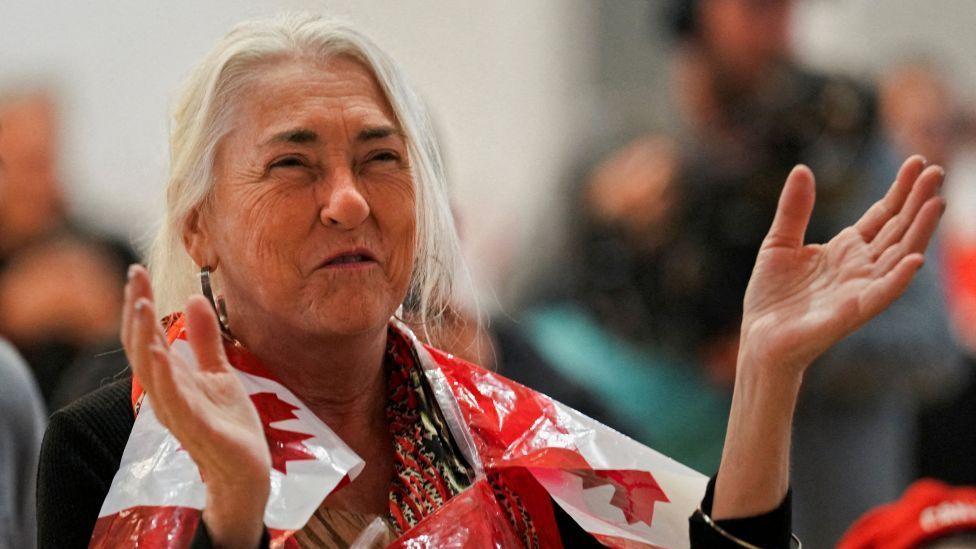
Thomas Lukaszuk, a prominent pro-unity campaigner, told a crowd of supporters on Monday night that the early results made him proud to be Albertan.
At a pro-unity results watch party in Edmonton, Lukaszuk appealled directly to separatists, saying that “some of the issues they have raised are legitimate”, and that the province must do the hard work of healing the divisions laid bare by this debate.
“I don’t want to see us doing another referendum like this ever again,” Lukaszuk said.
Premier Smith told CBC earlier in the week that she would not hold an independence referendum if Albertans vote against it as long as she is premier.
Some of the rifts can’t easily be smoothed over.
The separatist sentiment has its roots in “western alienation” which is a term that has been used for decades by some in Canada’s western provinces to describe a feeling of being ignored or overlooked by the federal government in central Canada.
To play this video you need to enable JavaScript in your browser.
This video can not be played
Alberta independence supporters – and many on the unity side – believe that Ottawa has long undermined the province’s oil and gas industry, most recently through environmental policies.
That anger later deepened as some Albertans grew frustrated with the response by former Prime Minister Justin Trudeau to the Covid-19 pandemic and vaccine mandates, viewing them as yet another example of government overreach.
Carney, who was raised in Alberta, has worked with Smith to address some of these issues, signing an agreement that would see a new pipeline from Alberta built to Canada’s pacific coast.
He nodded to that in his statement on Monday night, saying that his plan is to unlock Canada’s “full potential as a global energy superpower with Alberta at its core”.
But there are signs that there could be tension in the future between Carney and Smith, an able politician and a survivor – so far – of Alberta’s rough and tumble politics.
 Image source, Reuters
She also put nine other questions to Albertans on Monday, most that seek to give the province more autonomy from Ottawa, including on matters like immigration.
The (very) preliminary results suggest that many might pass.
Some who voted in favour of a second binding separation referendum have said they didn’t want outright independence, but some leverage over Ottawa. Smith has said these other nine questions help give her just that.
Quebec, another province with similar sovereigntist sentiments, could offer clues on where Alberta’s separation movement might end up.
They held two separation referendums, in 1980 and 1995, both of which were defeated by a close margin.
Alberta independence supporters don’t hide the fact that they gain inspiration from the majority French-speaking province.
They view Quebec as having successfully used the threat of separation to gain significantly more autonomy over provincial affairs.
And despite support for Quebec sovereignty being at historic lows, a newly elected provincial government has pledged to hold a third referendum on independence by 2030.
Rath made a note of that as he pondered his side’s defeat.
“A predominantly rural Independence Party in Quebec has just formed the government of Quebec with 28% of the vote,” he said.
“It’s not out of the realm of possibility”, he added, that Alberta separatists could do the same in the future.
Disclaimer : This story is auto aggregated by a computer programme and has not been created or edited by DOWNTHENEWS. Publisher: BBC